

STEINS;GATE RE:BOOT
Chiyomaru Shikura, MAGES., 5pb., Spike Chunsoft (2026)
(00/08/2026)
T|h|e Steins;Gate Re:Boot Re/View
my review and soft-analysis of the Steins;Gate re-release.

STEINS;GATE
Chiyomaru Shikura, MAGES., 5pb., Kadokawa (2009)
(19/08/2026)
Eigenstate;Steinsgate
compilation of Steins;Gate theories and explanations.Here Dead and Not Dead, Character and Reader
reworking of my past essay, A Fear of Missing Branches, with emphasis on Steins;Gate.The Gelnaniad
a fabulous (and) Greek myth examination of Steins;Gate.
NICE DAY
Magdalena Bay (2026)
(01/01/2026)
Second Sleep
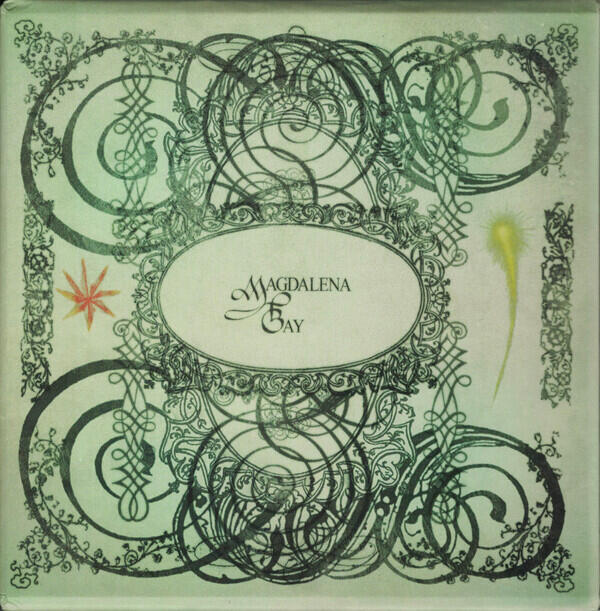
I've been so excited to rate this song - no this collection of singles - for much of the year. From the moment I heard some of them, I knew they would be at the top, securing not only my desire to see them live but also my confidence that the best is yet to come. This song is a painting in music. It's prosaic tosay but true: the vision is paired with the painterly EP artwork. It reminds me of Kate Bush, Bjork, Radiohead, Abba, Cocteau, and more. Cinematic soundscaping a'la Johnny Greenwood are just accoutrements to a deceptively complex composition that puts me to sleep and wakes me. Featuring various movements across it's nearly 5-minute runtime, I'd have to say the best passage is the holiday-vibes celebratory lap at 02:50 - actual joy in audio format.Star Eyes
Minutes of orchestral sweeps and dynamic notes in a warm foam room. Her vocal performance is gasping and yearning, and matches the AMSP-minimalism to brilliant effect. And then the music swells and swells, bursting into an arrangement of bliss, gorgeously mixed to activate the a warm yawn-response in the same way rain sliding down a window might. Soundscaping is the primary focus of these singles, seemingly operating as an opportunity for the two of them to experiment in different worlds with different instruments. I'm there for wherever they wish to take me.Human Happens
One of the only mainstream artists to pull off that sharp tone and vibe from Backside of the TV (Persona 4). It manages to marry that punctuative and standoffish melody to a warm and comforting rhythm to accomplish a dissonant yet harmonious piece which looks onwards as much as it retro-styles the 2000s.Paint Me a Picture
Guitar riff is perfect. Maintains and persistent fighting energy, a competitive edge with its stubbornness. This is more than art rock than pop - it even concludes by way of OK ComputerUnoriginal
We start with Blur (13 era) and build that countryside humility into a grungey rock anthem that spirals quickly into an art rock pop synthesis. It's an extraordinary achievement of genre management, giving the tractor wings to it might soar in the chorus. Haybales are the clouds if you listen hard enough. Both earthly and airy, it possesses a rigid backbone but moves with angelic fluidity.Black-Eyed Susan Climb
Many of the same remarks I made for Unoriginal can be made here, except it leans into their typical danceability more. She taps into a Dolly Parton familiarity, here, which paired with the occasionally cybernetic sampling offers an auditory metaphor for the death of country in the emerging world of technology. Particularly by the end, where we're washed away by fuzzy bass riffs that gradually drown out her humble singing. I also love the jaunty outro. Refuses to not be fun and interesting.This Is The World (I Made It For You)
These two are the ones I'm least familiar with, having heard them twice before these three listens each. This is a far more conventional track than before, with an emphasis on its crescendo and soundscaping. Folky while keeping that signature Magdelana production style, that digital edge to keep your headphones paying out what you put into them. It's romantic, keeping that insecure element that made Imaginal Disk so compelling. The accordion was a wonderful touch that brings it all together.Nice Day
While it doesn't flow particularly well off the previous track, treat on its own it's an awesome flavour of MagBay: sound collage, heavy noise walls and distorted guitars squiggling in multiple directions gives it a Deftones Chelsea Wolfe atmosphere I find personally compelling but can understand others bouncing off. It's sardonic, waxing about a nice day while the presumably bad day or night washes over us. I'd love to see a mirror to this EP which emphasizes dark tones but that will likely never happen (I get it).

POCO
Whalefall, Micah Boursier (2025)
(15/10/2025)
Poco: a Clown's Katabasis.
For whom those jingling bells toll.In this game, we tour a downtrodden neighbourhood of sensory-driven homunculus and their relationship with a carnivalesque upper class so elite that they've forgotten what bread and circus means. In the process, we find family and community, develop talents at a comfortable pace without judgment, and engage in the sensory and creative.The game channels Dropsy, Undertale and Earthbound, Smiling Friends, Hylics, The Outer Wilds, Rayman, Final Fantasy VII (and a minor amount of Souls/Metroidvania shortcut interconnectivity) and is rife with OneyPlays references, an extended Beatles gag, some wonderful Lo-Fi audiovisual aesthetic sensibilities, and genuinely fun minigames. It manages to synthesize all of these elements into a new personal favourite, a game I can see myself revisiting for its succinct cuteness and poignant delivery.It's free and won't take longer than 2 hours. Go and play it.PS. I wish there had been some reference to the Fool's journey around the major arcana, but I can't complain - this was a student project: well done! (I hope they got a grade they're happy with).
2026
Steins;Gate Reboot
Steins;Gate
Nice Day
2025
Poco
Imaginal Disk
Mini Mix Vol. 3
Mercurial World Deluxe Content
Mercurial World
Mini Mix Vol. 2
A Little Rhythm and a Wicked Feeling
Mini Mix Vol. 1
Night / Pop
Day / Pop
Let It Be... Naked
Let It Be
The Art Thief
Abbey Road
Dark Star Rising: Magick and Power in the Age of Trump
The Beatles
Magical Mystery Tour
How to Argue With a Meat Eater (And Win Every Time)
Play Nice: The Rise, Fall, and Future of Blizzard Entertainment
Carless People: A Story of Where I Used to Work
Sgt. Peppers Lonely Hearts Club Band
Revolver
The Bends
Rubber Soul
Help!
Beatles For Sale
A Hard Day's Night
Dummy
Pablo Honey
With The Beatles
Please Please Me
2023
Case Study
How to Make the World Add Up
Amazon Unbound
Fancy Bear Goes Phishing
Chasing Venus
The Yellow House
The Master and His Emissary
Van Gogh's Ear
The Everything Store
Magnificent Rebels
The Cosmic Dance
Lust for Life
Portable Magic
Other Minds
Ten Arguments For Deleting Your Social Media
How To Read Water
The Soul of an Octopus
Index, a History of The
Nabokov's Favourite Word is Mauve
How To Read Poetry Like a Professor
Ten Things Video Games Can Teach Us
Super-Infinite: The Transformations of John Donne
Literature and Evil
Beowulf
Monster Slayer
Beowulf
A Prayer for the Crown Shy
The Hidden Spring
Coincidance
William Blake vs. The World
19 Ways of Looking At Wang Wei
A Psalm for the Wild-Built
In Praise of Shadows
Quantum Psychology
The Collected Schizophrenias
Wittgenstein's Nephew
Cain
Reinhardt's Garden
Sum: Forty Tales From Afterlives
Impro
The Sailor Who Fell From Grace With The Sea
The Book of Imaginary Beings
Manga in Theory and Practice
The Curious Incident of the Dog in the Night-Time
Galatea
The Midnight Library
Red Thread: On Mazes and Labyrinths
Seven Brief Lessons on Physics
The Song of Achilles
Sophie's World
The Woman of Troy
The Queen's Gambit
On Writing
2022
Hamnet
The Silence of the Girls
The Perpetual Race of Achilles and the Tortoise
The Boy, The Mole, The Fox and The Horse
Six Memos For the Next Millennium
The Bell Jar
Treasure Island
Consider This
Peter Pan
The Merchant and the Alchemist's Gate
Augustus
The Plague
Wuthering Heights
The Death of Francis Bacon
I Am a Strange Loop
Cosmicomics
The Adult
The Mezzanine
No One Is Talking About This
Lanny
Serotonin
A Girl Is a Half-Formed Thing
My Phantoms
Minidiscs (Hacked)
Cat'S Cradle
Guards! Guards!
Nausea
Ca's Cradle
The Invisible Man
The War of the Worlds
We


STEINS;GATE RE:BOOT
Chiyomaru Shikura, MAGES., 5pb., Spike Chunsoft (2026)
(//////)
T|h|e Steins;Gate Re:Boot Re/View
my review and soft-analysis of the Steins;Gate re-release.

STEINS;GATE
Chiyomaru Shikura, MAGES., 5pb., Kadokawa (2009)
(19/08/2026)
Eigenstate;Steinsgate
compilation of Steins;Gate theories and explanations.Here Dead and Not Dead, Character and Reader
reworking of my past essay, A Fear of Missing Branches, with emphasis on Steins;Gate.The Gelnanaiad
a fabulous (and) Greek myth examination of Steins;Gate.
NICE DAY
Magdalena Bay (2026)
(01/01/2026)
Second Sleep
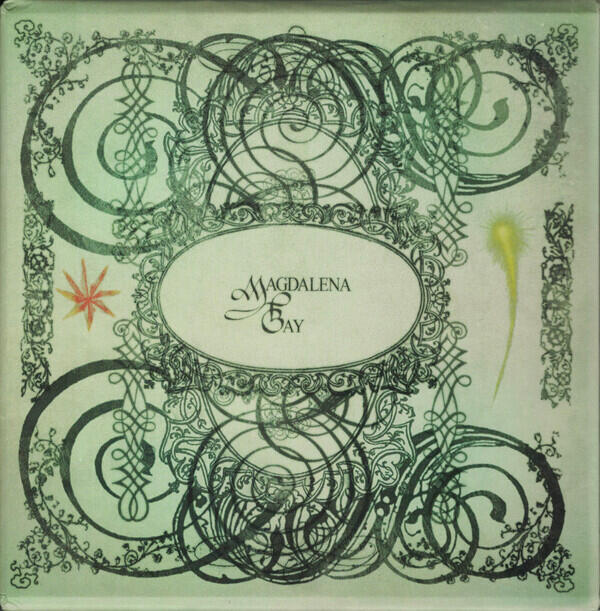
I've been so excited to rate this song - no this collection of singles - for much of the year. From the moment I heard some of them, I knew they would be at the top, securing not only my desire to see them live but also my confidence that the best is yet to come. This song is a painting in music. It's prosaic tosay but true: the vision is paired with the painterly EP artwork. It reminds me of Kate Bush, Bjork, Radiohead, Abba, Cocteau, and more. Cinematic soundscaping a'la Johnny Greenwood are just accoutrements to a deceptively complex composition that puts me to sleep and wakes me. Featuring various movements across it's nearly 5-minute runtime, I'd have to say the best passage is the holiday-vibes celebratory lap at 02:50 - actual joy in audio format.Star Eyes
Minutes of orchestral sweeps and dynamic notes in a warm foam room. Her vocal performance is gasping and yearning, and matches the AMSP-minimalism to brilliant effect. And then the music swells and swells, bursting into an arrangement of bliss, gorgeously mixed to activate the a warm yawn-response in the same way rain sliding down a window might. Soundscaping is the primary focus of these singles, seemingly operating as an opportunity for the two of them to experiment in different worlds with different instruments. I'm there for wherever they wish to take me.Human Happens
One of the only mainstream artists to pull off that sharp tone and vibe from Backside of the TV (Persona 4). It manages to marry that punctuative and standoffish melody to a warm and comforting rhythm to accomplish a dissonant yet harmonious piece which looks onwards as much as it retro-styles the 2000s.Paint Me a Picture
Guitar riff is perfect. Maintains and persistent fighting energy, a competitive edge with its stubbornness. This is more than art rock than pop - it even concludes by way of OK ComputerUnoriginal
We start with Blur (13 era) and build that countryside humility into a grungey rock anthem that spirals quickly into an art rock pop synthesis. It's an extraordinary achievement of genre management, giving the tractor wings to it might soar in the chorus. Haybales are the clouds if you listen hard enough. Both earthly and airy, it possesses a rigid backbone but moves with angelic fluidity.Black-Eyed Susan Climb
Many of the same remarks I made for Unoriginal can be made here, except it leans into their typical danceability more. She taps into a Dolly Parton familiarity, here, which paired with the occasionally cybernetic sampling offers an auditory metaphor for the death of country in the emerging world of technology. Particularly by the end, where we're washed away by fuzzy bass riffs that gradually drown out her humble singing. I also love the jaunty outro. Refuses to not be fun and interesting.This Is The World (I Made It For You)
These two are the ones I'm least familiar with, having heard them twice before these three listens each. This is a far more conventional track than before, with an emphasis on its crescendo and soundscaping. Folky while keeping that signature Magdelana production style, that digital edge to keep your headphones paying out what you put into them. It's romantic, keeping that insecure element that made Imaginal Disk so compelling. The accordion was a wonderful touch that brings it all together.Nice Day
While it doesn't flow particularly well off the previous track, treat on its own it's an awesome flavour of MagBay: sound collage, heavy noise walls and distorted guitars squiggling in multiple directions gives it a Deftones Chelsea Wolfe atmosphere I find personally compelling but can understand others bouncing off. It's sardonic, waxing about a nice day while the presumably bad day or night washes over us. I'd love to see a mirror to this EP which emphasizes dark tones but that will likely never happen (I get it).


POCO
Whalefall, Micah Boursier (2025)
(15/10/2025)
Poco: a Clown's Katabasis.
For whom those jingling bells toll.In this game, we tour a downtrodden neighbourhood of sensory-driven homunculus and their relationship with a carnivalesque upper class so elite that they've forgotten what bread and circus means. In the process, we find family and community, develop talents at a comfortable pace without judgment, and engage in the sensory and creative.The game channels Dropsy, Undertale and Earthbound, Smiling Friends, Hylics, The Outer Wilds, Rayman, Final Fantasy VII (and a minor amount of Souls/Metroidvania shortcut interconnectivity) and is rife with OneyPlays references, an extended Beatles gag, some wonderful Lo-Fi audiovisual aesthetic sensibilities, and genuinely fun minigames. It manages to synthesize all of these elements into a new personal favourite, a game I can see myself revisiting for its succinct cuteness and poignant delivery.It's free and won't take longer than 2 hours. Go and play it.PS. I wish there had been some reference to the Fool's journey around the major arcana, but I can't complain - this was a student project: well done! (I hope they got a grade they're happy with).

IMAGINAL DISK
Magdalena Bay (2024)
(11/12/2025)
She Looked Like Me!
Like with Fear of a Blank Planet, we are introduced to this album's orbit via logging on, technological execution, the start-up of a cybernetic Barbie here to belt in time with digital percussion. Grimes wishes she could make something so conceptually trained, tapping into the imposter syndrome dynamics of parasocial relationships through title, lyrics, and instrumentation. It's ghostly, other worldly: Phoebe Bridges with a wobbly bridge.Killing Time
One of their reigning masterpieces, lyrically and instrumentally. Gorgeously realized. Equal parts earnestly hopeless and optimistically relatable. Mica's voice is in its prime-time, building across the first half's two minutes with an affliction both cold and warm atop a percussive combination evocative of a summer beach in December. And then we reach the second half: this was a crescendo in disguise, a precursor to the heavy and gritty chanting that would hallmark the last minutes. They understand the value of time, and if you're going to kill it with them as they call attention to it, they best make it worthwhile. Fantastic.True Blue Interlude
MiniMix 4 slides its way in. Welcome to your digital vacation. She hands you the brochure through a fat monitor incapable of high-definition. Perfectly named for its oceanic screensaver liminality - and a much needed reprieve between two otherwise overwhelmingly bombastic tracks.Image
Softly returning to the themes of the first track, she tackles the construction of identity and self through the visual metaphor of disk burning, each of us ISOs of some origin write. The instrumentals are transitionary, a hyperloop through the cosmos in journey for self-image. Neat and tidy without striking the artificiality of songs found in A Little Rhythm, Image is one of the stand up tracks in an album of songs that can't sit down.Death & Romance
One of my personal favourites. Arguably a perfect pop song in all respects, from the title to the star-crossed lyrics, to the clanging piano, to the interstellar production. Here, she finds her Madonna, her Goldfrapp: confidence embodied, femineity unsheltered and proud. Kinetically unafraid, cinematically inspired, it ignites the kopfkino in a way few pop songs and many space rock songs do. In a short few years they went from struggling with 3 minutes to making me wish for an experimental and proggy 10.Fear, Sex
Reprising the melody and thematics of the previous song to show an aversion and fear of sexual intimacy despite the previously stated romance is a stroke of genius. Interludinal in its nature, it nonetheless takes the opportunity to say something, mean something, and make you feel something - no doubt held up by the instrumental tapestry.Vampire in the Corner
Here, we switch into a downtempo sound that can be heard throughout the EPs but given the emphasis of newer production techniques. Toxic love, over-eagerness and obsessiveness are the ideas at play here. It's an album of insecurities, but its brought to the forefront here. If you weren't convinced in the first two minutes, you will be for the last, as twonky-overclocked-basses accompany her high-pitched pleas. Off-kilter and dynamically delicious, like the rest of the album.Watching T.V.
Much needed minimalist recovery after the previous song's closure, this song uses digital warbles reminiscent of dial-up and phone keys to capture the 00s experience of being enamoured with the magic of technology before the 2010s came in to break as many bulbs as possible and cast the techno-universe into glitching darkness. The Dark Side of the Phone.Tunnel Vision
All of the previous songs were building to this: an ode to over-exposure, particularly technological, and how it can induce a state of tunnel-vision. The cyber-pop-queen's Karma Police, in many ways, from the distinguishable halves to the sense that the song is catching up to the singer. Except the second half reminds me, equally, of Paranoid Android. It's a winter land comprised of wires for trees. I've waited until now to say it: I'd say this is our generation's OK Computer, turning the lens further inwards (psychosociological to OKC's sociopsychological) to provide a platform for digital self-evaluation, using our current environment to project forwards.Love Is Everywhere
After the intensity of Tunnel Vision, it's nice to touch back to a happier place. The bubble gum beach volleyball instrumentals and Matt's backing vocals (filtered, right?) offer a catchy and optimistic track with only the bare hint of the cynicism iconic to the album otherwise.Feeling DiskInserted?
An orchestral reprisal of Tunnel Vision provides a fairy-tale transition that would be right at home in a 2000s Bjork album.That's My Floor
I struggle to write about this one. All of my compliments sound like critiques. I love the obnoxious la'la'la's. I love the sludgy bass. I love the broken, spaztic guitar solo it concluded with. How it almost seems to power down. So much energy directed into a singularly achieved vision.Cry for Me
The nightwave hath returneth in full force joined by Abba. How did they make this? It has the distinguished identity of a pop classic, of needing to be recognized a decade from now in its ambition. It's multiple cars at night engaging in choreographed dance a'la Austin Powers. It's Batman Mama Mia! Batmanamia! Some of their most impressive mixing and compositional work, blending sounds and vibes and even a spooky laugh to convince the listener of hip-gyrating gramophone grief.Angel on a Satellite
Another song echoing the history of woman-infused pop in its vocal delivery and instrumental flavour for two minutes of minimalist, starry-night build-up. Then it snaps into the Abba-attitude of before to deliver a track as danceable as it is earnest. "Cause when I see me through your eyes / I love me, so don't leave my side" summarized the album beautifully: insecure and interdependent, an ode to the attachment complexes of our contemporary era without belittling.The Ballad of Matt & Mica
They knew this was their (current?) magnum opus. Everything came together here - the artistic vision was realized regardless of any particular preferences. All that's left is a signature, a medley reprise of the album through the lens of their blossoming ambitions. Simply put, it's a selfish love-letter to their own creation. They're damn proud and have reason to be.
MINI MIX VOL. 3
Magdalena Bay (2023)
(11/12/2025)
Slug Song
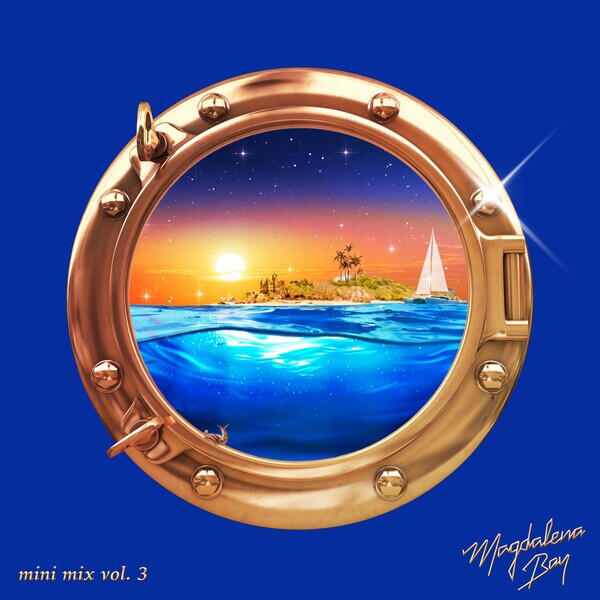
Best opener of the mini mixes. Far more than just an intro, it breams with optimism. Sweet, pleasant, almost ironically muzak. Extraordinary vibe setter, made all the best by the way the vibe is then immediately subverted. Gotta keep you on your feet, we only have so much time.EXO
Fuck yes. The song that made me truly fall in love with this band. Mirror image to Sawayama's XS, to me; the guitar adds a dirty, scrappy energy that elevates this song beyond its relatively humble status and runtime into an infectiously cool 2-minute environment. I hate to see you go. At least they experiment with guitar later down the line.2 Wheel Drive
While not as inventive as EXO, it earns its place in the album: particularly in the second half. Tight synths and tubular sound-scaping continue the accelerated momentum developed in EXO and indicative of this album. Are we at sea or cruising down the road? Is this Outrun by way of Sonic the Hedgehog, or Barbie Wave Race?Top Dog
Cool, vibey. Definitely not as exciting as the previous tracks but a good interlineal piece to maintain pace without overwhelming the ears.Tonguetwister
What sets out as conventional to the ears quickly double jumps into bonus level material, remixing itself on the fly with kaleidoscope precision, a foot cello taped to the accelerant pedal throughout.Wandering Eyes
And after that, we've reached out destination. Acoustic twangs and distinct percussion accompany dreamy lyrics and the occasional circus snap. The feminine-driven, minmax production sequel to John's Sgt. Pepper dabbling.Slug Song (Reprise)
And once more they've repurposed a prior melody for fade-out. I personally prefer more Slug Song and given the hyperfocused energy of MM3 in particular, it's welcome catharsis.

MERCURIAL WORLD (DELUXE CONTENT)
Magdalena Bay (2022)
(11/12/2025)
Secret 1
Uhm, not that secret if it's the first track, hm? Hmmm?The End
Uhm, not that The End if it is nearly the first track, hm? Hmmmmm?Mercurial World
Proper Sonic energy across this track. Secret Zone sound effects oscillate between ears, in and out of phasers. Has far more immediacy than anything from A Little Rhythm. Sounds straight-up conventional in places, with the bare amount of acoustic guitar hovering atop a cloud of texture. Synth-drvien but not synth-controlled. I feel a slight shadowing of 'Abba''s' material world, too, although they have alchemized that material into the mercurial, the magical and unearthly. Captures the experience of living in fluid instability: the 21st-Century.Unconditional
Math rock in places. Faintly Japanese with its instrumentals. Another song concerning insecurity, unconditional love being the focus, with the devotion being expressed with high-energy consistency via the bass. Delusional bliss. I enjoy the track quite a bit but can also recognize it's place as a re-sequenced extraneous single.Dawning of the Season
I'd say the running theme of the album so far is disillusion through dissolution, dancing through a haze. There's a distinctly Etsuko Yakushimaru audio aesthetic running through each song, though I can only guess as to how incidental that is. Otherwise, the song is a catchy and (for them) relatively sparse dance number about the almost imperceptible nature of some transitions paired with personal invisibility.Secrets (Your Fire)
Transition from the previous track into this was splendid - Popagon Infinity. This is one of the first songs I ever heard of there's, an intelligently produced layering of naturally resonating samples and flourishes. You can hear constant experimentation through the mix as Mica sings about closing off to rob another of power over her. One of the punchier tracks across the board.Secrets 2-9: medley
Cute experimental interlineal track: a collage of insecurities, detachments, dissociations. I have no issue with it within the context of the album but wouldn't actively seek it out otherwise. Hammers home the themes of the album more, though, that's for sure.You Lose!
Dark-synth swoops in, the bass and distortion levelled up to inject a much-needed spark of direct pressure to the mix. Popping the blown bubble-gum bubbles of earlier tracks with a punchy perforator is one of Magdalena Bay's signature trademarks, and it's achieved to great effect here. 8bit-crushed sound sampling accentuates the titular purpose of tethering simulated and actual defeat, the acoustic flourishes underneath providing a much needed rustic cushion to compliment the otherwise retro-styled gamer-track into something distinctly them.Secret 10
Uhm.You Lose! (8-bit)
Very cute reprisal. Not needed but cute nonetheless, it's inferior to the original track in every way but would still be one of the best songs ever released on the NES.Something for 2 - Cecille Believe Remix
Very cool remix that takes one of my favourite songs from the album and mutates it ever so slightly at first, with some minor sprucing and additional sampling, some extra harmonies increase the sombre at the cost of minimalist splendour. It's not until the second half that is distinguishes itself with the "Don't let it fall down" segment building transiently and aggressively into a sharper conclusion than the original mix. I prefer the simplicity of the original song, but the remix definitely deserves to exist. Nonetheless, the original literary vision is affected with an additional layer of anxiety applied in the remix due to the tense conclusion.Chaeri
Another of the few I've returned to. Has some phenomenal melodic layering, the call before the Chaeir line seemingly setting up a new response it only delivers upon via the second half's bombast. That sense of lacking resolution mirrors the textual meaning perfectly, leaving the listener with a feeling of building dissatisfaction at odds with the accelerating instrumentals and sampling. Brilliant song foreshadowing their later Imaginal Disk efforts with its audio-narrative assonance.Secret 11
Half of a glass would be a different sized glass. We're talking about the contents of the glass, not its direct physical dimensions. I bitch but I like this, has the same self-aware but blind pretentious energy as the interlineal tracks on my album - haha.Halfway
Transitionary tracks acting as a video-game checkpoint or book-bookmark, further accentuating the atmospheric and narrative components of the album to pleasant effect.Hysterical Us
From albedo to rubedo, Magdalena Bay alchemize the self-actualizing aspect of the album into a drum-enthusiastic pop-banger about existential dread and growing awareness. We have transitioned from the invisible and immaterial introduction (featuring an inversion of Abba's Material World, the imperceptible changing of the seasons) into a world of eyes and expectations; properties of being.Secret 12
One of my favourite inserts on the album.All You Do
Smooth guitar riffing and swooping strings make this extra track a winner, with particular appreciation addressed to the transition between verse and chorus. The strings really are the highlight, here, surprising each time they appear. "All you do / Is good" are the kinda lyrics I love from these two. Stupidly simple, prosaic in places, but to the point. Fantastic song.Prophecy - Synth & Strings
Sinister, with the darkest synths seen yet - borderline Stranger Things in places. Estranged beams of sound breach the darkness with only Mica's voice as a constant, an anchor. I wish they'd re-recorded her vocals a bit, as her performance doesn't always match the sophisticated orchestral collage behind her. It definitely brings itself together by the midpoint, assisted by the earthly-sound of an acoustic guitar to root it in something more coherent and understandable. Interesting experimentation that falters to the original but distinguishes itself with aplomb.Follow the Leader
Feels like Varien's Mirai Sekai in its reliance on vocal modulation and sharp, crushing dynamics to invoke a confident sound of futurism. The lyrics follow the by-line of self-actualization by questioning the self's individuality, conformity. They may be present, alchemized into being from the nothing, learned to stand, then walk: but are they awake or merely sleepwalking? The deep percussion and ephemeral vocal accentuations aim to distil the otherworldly sensation that accompanies apotheosis. One of the more unique tracks on the album, if not their discography.Secret 13
Uh. Neat byte to transition the high-end dynamics of the previous song into the next.Chaeri - Danny L Harie Remix
Appropriately placed, as this remix retains the darkwave aura Follow the Leader concludes with while pumping us directly into transcendental EDM. Very cool remix, pitch shifting Mica to helium-elevate her beyond the stratosphere for some DDR-phantasm. Operates as an awesome reprisal of Chaeri if you've signed up for the hyperloop audio-experience the deluxe edition aims to further.Chaeri - Piano & Strings
One of the largest sequencing misteps in the deluxe. I like this rendition - quite a bit, actually, with it reminding me of the prog-pop attitude of Steven Wilson's career. The piano and strings sound wonderful but don't adequately replace the original's instrumentals, while failing to reach the dynamics of the remix. It's better than the remix compositionally, accentuating the sombre elements where Chaeri focused on the ascendent.Domino - Spanish Version
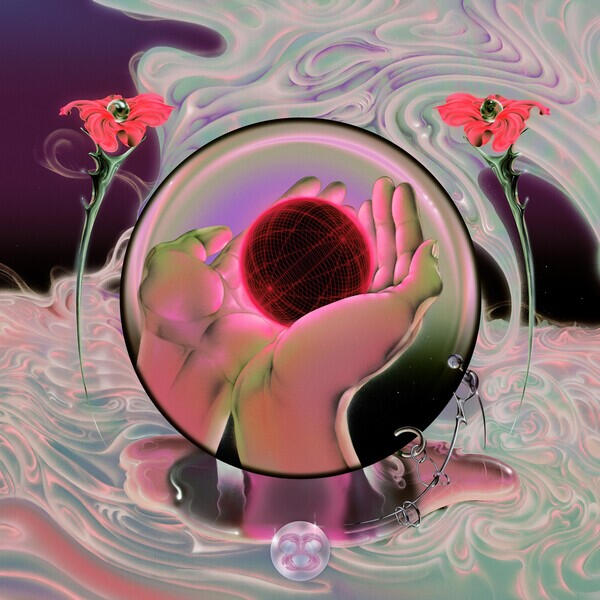
By reversing the Spanish and English they create a nice harmonious duality between the original and deluxe records, already invoked by their differing artwork and furthered by the deluxe edition's darker atmosphere.Dreamcatching
Kensuke Ushio dark and dirty synths accompany bubble-popping percussion, the perfect middle-ground between the album's darker and lighter qualities; a synthesis of sensibilities perfectly captured in the title: a net designed to capture transmissions between dimensions of reality. Ripping solos and vintage scratches and pops give this dance number anachronistic depth. Mystically cybernetic, minimalist and maximilist, insecure yet hopeful. It may not be my favourite song of theirs, but it's arguably one of the best distillations of their entire je ne sais quoi.Secret 14
Ouroboros, infinite return, reincarnation, cycles.The Beginning
Rainbow victory lap with hints of Random Access Memories broadcasts Imaginal Disk's concluding tracks, even down to the invocation of themselves (or Matt exclusively, here) to operate as a meta-narrative signature. Ends on a high-note, visually and sonically and mentally.Mercurial World - Piano & Strings
Eschewing the looping nature of the original album for an immediate reprisal of the first track creates an immediate sense of closure suitable for the deluxe issue's runtime (it's not as-designed for a loop, though still does satisfy that). I love this dynamic arrangement, though - there's a chance it surpasses the original for me, adding a wonderful amount of dramatic tension to the piece. Strings are the highlight, oncemore, but the piano cascades in a melancholic fashion that gives the strings their strength. Wonderfully purposeful re-arrangement.Secret 15
The addition of the secret tracks add a collective angle to an otherwise selfish album, globally echoing a communal responsibility of self-actualization (each of us) to express an idea of solidarity through individualism.
MERCURIAL WORLD
Magdalena Bay (2021)
(11/12/2025)
Secret 1
Uhm, not that secret if it's the first track, hm? Hmmm?The End
Uhm, not that The End if it is nearly the first track, hm? Hmmmmm?Mercurial World
Proper Sonic energy across this track. Secret Zone sound effects oscillate between ears, in and out of phasers. Has far more immediacy than anything from A Little Rhythm. Sounds straight-up conventional in places, with the bare amount of acoustic guitar hovering atop a cloud of texture. Synth-drvien but not synth-controlled. I feel a slight shadowing of 'Abba''s' material world, too, although they have alchemized that material into the mercurial, the magical and unearthly. Captures the experience of living in fluid instability: the 21st-Century.Unconditional
Math rock in places. Faintly Japanese with its instrumentals. Another song concerning insecurity, unconditional love being the focus, with the devotion being expressed with high-energy consistency via the bass. Delusional bliss. I enjoy the track quite a bit but can also recognize it's place as a re-sequenced extraneous single.Dawning of the Season
I'd say the running theme of the album so far is disillusion through dissolution, dancing through a haze. There's a distinctly Etsuko Yakushimaru audio aesthetic running through each song, though I can only guess as to how incidental that is. Otherwise, the song is a catchy and (for them) relatively sparse dance number about the almost imperceptible nature of some transitions paired with personal invisibility.Secrets (Your Fire)
Transition from the previous track into this was splendid - Popagon Infinity. This is one of the first songs I ever heard of there's, an intelligently produced layering of naturally resonating samples and flourishes. You can hear constant experimentation through the mix as Mica sings about closing off to rob another of power over her. One of the punchier tracks across the board.Secrets 2-9: medley
Cute experimental interlineal track: a collage of insecurities, detachments, dissociations. I have no issue with it within the context of the album but wouldn't actively seek it out otherwise. Hammers home the themes of the album more, though, that's for sure.You Lose!
Dark-synth swoops in, the bass and distortion levelled up to inject a much-needed spark of direct pressure to the mix. Popping the blown bubble-gum bubbles of earlier tracks with a punchy perforator is one of Magdalena Bay's signature trademarks, and it's achieved to great effect here. 8bit-crushed sound sampling accentuates the titular purpose of tethering simulated and actual defeat, the acoustic flourishes underneath providing a much needed rustic cushion to compliment the otherwise retro-styled gamer-track into something distinctly them.Secret 10
Uhm.You Lose! (8-bit)
Very cute reprisal. Not needed but cute nonetheless, it's inferior to the original track in every way but would still be one of the best songs ever released on the NES.Something for 2 - Cecille Believe Remix
Very cool remix that takes one of my favourite songs from the album and mutates it ever so slightly at first, with some minor sprucing and additional sampling, some extra harmonies increase the sombre at the cost of minimalist splendour. It's not until the second half that is distinguishes itself with the "Don't let it fall down" segment building transiently and aggressively into a sharper conclusion than the original mix. I prefer the simplicity of the original song, but the remix definitely deserves to exist. Nonetheless, the original literary vision is affected with an additional layer of anxiety applied in the remix due to the tense conclusion.Chaeri
Another of the few I've returned to. Has some phenomenal melodic layering, the call before the Chaeir line seemingly setting up a new response it only delivers upon via the second half's bombast. That sense of lacking resolution mirrors the textual meaning perfectly, leaving the listener with a feeling of building dissatisfaction at odds with the accelerating instrumentals and sampling. Brilliant song foreshadowing their later Imaginal Disk efforts with its audio-narrative assonance.Secret 11
Half of a glass would be a different sized glass. We're talking about the contents of the glass, not its direct physical dimensions. I bitch but I like this, has the same self-aware but blind pretentious energy as the interlineal tracks on my album - haha.Halfway
Transitionary tracks acting as a video-game checkpoint or book-bookmark, further accentuating the atmospheric and narrative components of the album to pleasant effect.Hysterical Us
From albedo to rubedo, Magdalena Bay alchemize the self-actualizing aspect of the album into a drum-enthusiastic pop-banger about existential dread and growing awareness. We have transitioned from the invisible and immaterial introduction (featuring an inversion of Abba's Material World, the imperceptible changing of the seasons) into a world of eyes and expectations; properties of being.Secret 12
One of my favourite inserts on the album.All You Do
Smooth guitar riffing and swooping strings make this extra track a winner, with particular appreciation addressed to the transition between verse and chorus. The strings really are the highlight, here, surprising each time they appear. "All you do / Is good" are the kinda lyrics I love from these two. Stupidly simple, prosaic in places, but to the point. Fantastic song.Prophecy - Synth & Strings
Sinister, with the darkest synths seen yet - borderline Stranger Things in places. Estranged beams of sound breach the darkness with only Mica's voice as a constant, an anchor. I wish they'd re-recorded her vocals a bit, as her performance doesn't always match the sophisticated orchestral collage behind her. It definitely brings itself together by the midpoint, assisted by the earthly-sound of an acoustic guitar to root it in something more coherent and understandable. Interesting experimentation that falters to the original but distinguishes itself with aplomb.Follow the Leader
Feels like Varien's Mirai Sekai in its reliance on vocal modulation and sharp, crushing dynamics to invoke a confident sound of futurism. The lyrics follow the by-line of self-actualization by questioning the self's individuality, conformity. They may be present, alchemized into being from the nothing, learned to stand, then walk: but are they awake or merely sleepwalking? The deep percussion and ephemeral vocal accentuations aim to distil the otherworldly sensation that accompanies apotheosis. One of the more unique tracks on the album, if not their discography.Secret 13
Uh. Neat byte to transition the high-end dynamics of the previous song into the next.Chaeri - Danny L Harie Remix
Appropriately placed, as this remix retains the darkwave aura Follow the Leader concludes with while pumping us directly into transcendental EDM. Very cool remix, pitch shifting Mica to helium-elevate her beyond the stratosphere for some DDR-phantasm. Operates as an awesome reprisal of Chaeri if you've signed up for the hyperloop audio-experience the deluxe edition aims to further.Chaeri - Piano & Strings
One of the largest sequencing misteps in the deluxe. I like this rendition - quite a bit, actually, with it reminding me of the prog-pop attitude of Steven Wilson's career. The piano and strings sound wonderful but don't adequately replace the original's instrumentals, while failing to reach the dynamics of the remix. It's better than the remix compositionally, accentuating the sombre elements where Chaeri focused on the ascendent.Domino - Spanish Version
By reversing the Spanish and English they create a nice harmonious duality between the original and deluxe records, already invoked by their differing artwork and furthered by the deluxe edition's darker atmosphere.Dreamcatching
Kensuke Ushio dark and dirty synths accompany bubble-popping percussion, the perfect middle-ground between the album's darker and lighter qualities; a synthesis of sensibilities perfectly captured in the title: a net designed to capture transmissions between dimensions of reality. Ripping solos and vintage scratches and pops give this dance number anachronistic depth. Mystically cybernetic, minimalist and maximilist, insecure yet hopeful. It may not be my favourite song of theirs, but it's arguably one of the best distillations of their entire je ne sais quoi.Secret 14
Ouroboros, infinite return, reincarnation, cycles.The Beginning
Rainbow victory lap with hints of Random Access Memories broadcasts Imaginal Disk's concluding tracks, even down to the invocation of themselves (or Matt exclusively, here) to operate as a meta-narrative signature. Ends on a high-note, visually and sonically and mentally.Mercurial World - Piano & Strings
Eschewing the looping nature of the original album for an immediate reprisal of the first track creates an immediate sense of closure suitable for the deluxe issue's runtime (it's not as-designed for a loop, though still does satisfy that). I love this dynamic arrangement, though - there's a chance it surpasses the original for me, adding a wonderful amount of dramatic tension to the piece. Strings are the highlight, oncemore, but the piano cascades in a melancholic fashion that gives the strings their strength. Wonderfully purposeful re-arrangement.Secret 15
The addition of the secret tracks add a collective angle to an otherwise selfish album, globally echoing a communal responsibility of self-actualization (each of us) to express an idea of solidarity through individualism.

MINI MIX VOL. 2
Magdalena Bay (2020)
(11/12/2025)
Live 4ever
Sounds like the better parts of the wistful pop features in the late 2000s. Simple drum loop and skating keys make up the majority of the track until the midpoint where it becomes a bipolar laser-show of bisexual lighting.I Don't Want to Cry Anymore
I love the expression ate wall of sound, though the claustrophobic mixing feels more like a fallback than a feature, here. Catchy as hell but, unlike MM1, some of the songs don't feel as finished. I wouldn't say they are unfinished, just not matching full potential. I say this because I love the titular chorus cry and wish it had more energy in the track.Sky2Fall
Wonderful solo. Teleports you to a dreamscape of dreamcasts and meanhooks. The transition into Body is solid.Body
One of the standout tracks, no doubt helped by Sky2Fall's build-up if you're listening to the full EP. Aurora in the emotional nightclub. Appropriately titled, as it serves as the spinal cord fulcrum to leverage this album of chords.Woww
Petulant in its h8 and immaturity, serves as a mopey mood-ring and doesn't overstay its welcome. Doesn't add too much, but certainly doesn't detract.Hideaway
Here it is: best track on the album. The Secret Garden of clouds is finally revealed towards the end of the album as we step out of the pastel petulance into the ether. Pretty production and softer vocalizations make it, perhaps, the most radio-friendly and sensitive song of the album.Sky2Fall - Reprise
And then they repurpose the melody of Sky2Fall, drowning us in a river of bit-crushed synths before fading us out.

A LITTLE RHYTHM AND A WICKED FEELING
Magdalena Bay (2020)
(11/12/2025)
How to Get Physical
Here it is, the album/EP I'm least familiar with, having heard it once. It avoids setting an atmosphere like the MiniMixes and day/night EPs did. It offers a collection of tracks moreso than a mood, though the mood is certainly there. This track possesses the trademark qualities of a good MagBay track without standing out, which sounds more negative than it is. Not a song I jump for, but one I'd leave on during rotations. Might be a grower.Story
Vocal delivery is unique here from Mica; more distinct and brought forwards with her letting words hang in a familiar 2000s singer-songwriter way. It's a different mix than we've heard before, the artificiality brought up to near-EDM levels in places. The woodwind and sound effects give this one a specific identity, but it's the apostrophized bass that stands out the most. Literally onomatopoeia levels of pop.Good Intentions
This song is a good demonstration of the efforts made between them in transitioning from shortform and infectious tracks to standard-length format. In the process, some of the virality is lost - these songs are all good, great maybe, but lack the special ingredient found in their previous EPs. Absolutely a learning experience, as their upcoming albums blend the two styles harmoniously. Catchy, well-meaning, featuring great production, but struggling to standout against the backdrop of their previous efforts.Airplane
Downtempo production off the back of the previous two, this song highlights a return to the airy and liminal experience of MM3 and night/pop, no doubt related to the transit-title. Of particular note: the bombastic uphook that occurs towards the end.Venice
Interesting use of glockenspiel and xylophone gives this song a uniquely twilight glitter and remains the melodic focus as percussion and bass join in. I appreciate Matt's ever-so backing vocals giving at an andro-touch whenever it appears.Killshot
The song I've returned to the most. It's singular in its captivating nature when compared to the other songs on this album. Many moving pieces, a building of energy alchemized between verse and chorus and accentuated by jangling keys in the most complimentary way possible. Melody and rhythm compliment each other, doing their own thing - together - which is perhaps a feature to many of my favourite songs of theirs. It's cool, and that matters.Stop & Go
Perhaps their weakest song, relying too heavily on its (admittedly nice) gimmick of repetitively snapping both vocal affliction and percussion. I also don't like the distinctly-mid-2010s instrumental thing in the background that's featured on Bieber's Sorry. I don't know what it is but it bothers me.Oh Hell
Continues Stop & Go's downtempo energy in a slightly better direction. Not a huge fan of either of their vocals blended with these instrumentals. I'm reminded of Owl City and Twenty One Pilots the like, when I know they can do better than that. Still a fine song, but nowhere near their heights. I do like the second half more than the first, with the increasing volume and synth exposure - but then it breaks down into the same mid-2010s texture I described before.

MINI MIX VOL. 1
Magdalena Bay (2019)
(11/12/2025)
Intro
Retrostyled collage of appropriate sounds to mood-match the album. Does its job perfectly.Afternoon in Heaven
This one is a personal favourite across their entire catalogue. It captures their sensibilities from the get-go, were you to begin here as opposed to day/night (like I prefer to do). Constantly building in its topography of sound, crescendo various stems and embedding them with oscillation and synthwaving to invoke a sense of turbulence. Radical and capturing.El Dorado
We've already been lured in, bought the package to this luxurious cruise, and this is the song that plays on the boat. Percussion is so sharp you could swear coconuts and clogs were involved. Mica's voice floats on the top like an angel caressing the front of a brochure.Turning off the Rain
More retrostyling. This time, 80's battle montage sound effects bring twerking Kurosawa to a dirty club. "Who wants the bass?" Me. That bubblegum smooth bassline works towards a tasty harmony. Short, sweet, unbelievably tasty.U Wanna Dance?
Sharper than the previous tracks, possessing more attitude and conventionality. I particularly love the downwards arpeggio with her voice towards the ending.Nothing Baby
Weakest track on the EP still manages to get me tapping my feet and nodding my head. It starts out with a fairly typical drum and bass emphasized trap beat before that chorus comes in. The second verse relents the first's ordinary nature, injecting an appropriate amount of alien to distinguish the two and elevate the song from mere club banger into a rad transitionary song.Mine
Possibly the most singularly accomplished track on the EP, radio ready at a moment's notice. Feels the most focused in its execution even if that does not make it a favourite.

NIGHT / POP
Magdalena Bay (2019)
(11/12/2025)
Neon
We jump straight into this EP's titular purpose: nightwave pop. And man, what a song. Both of their vocals harmonize wonderfully, the touches of sax and clanging bass add a noir atmosphere to compliment the piece. Its only downfall in my eyes if the artificial fade-out, itself a staple of nightwave vapourcore. So, can't be too mad.Drive Alone
It doesn't take a listener long to recognize they would have dead-ended themselves with this tame impala nightwave aesthetic, as good as it is and as needed the experiment ultimately was. Couldn't have reached later heights without dabbling. With all that said: what a damn track. Kavinsky for the timid bus-rider.Redbone
Appropriately placed cover within the context of the other songs on this EP, but I would have rather an original track. With that out of the way: they do make it their own, from the spacey introduction to the emphasis on isolated percussion and blasting synths. Down-tempo with delicate robo-vocals, it eschews the sensual for the dynamic; and in the process makes itself a weaker song, though still a good one. It feels like I'm playing Breakout for the Atari using club-dwellers as balls to punch bouncers out of the sky.Move Slow
The only song I've regularly returned to from this EP (though that will now change). Immediately has identity, coolness, glitter in the dark. Punctuative and swerving, it builds energy through two sets of verse and chorus before unravelling into a percussive breakdown, a boogie build-up, a rollicking guitar solo, and then a return to form at maximum vivacity. Immediate banger.

DAY / POP
Magdalena Bay (2019)
(11/12/2025)
Waking Up
One of the first songs they ever released (alongside Night's Neon). Matt's male vocals are more prominent here, the duo emphasised and highlighted on the artwork. It's a standard song with glittery production, the beginnings of their style - a style founded in blunt nostalgia, an open and earnest love for pop music without settling in terms of creativity. It's youthful, vibrant, and offers a nice vertical slice of their efforts in one song. I love the shadowing of Tears for Fears's Everybody Wants to Rule the World at the end - beautiful touch.Set Me Off
EXO's precursor. That jungle buildup to the guitar is fucking phenomenal. Sonic R music bleeds into Sonic Adventure 2 music. Rina Sawayama's riffs aren't even this punchy - blending them with a Lorde-esque vocal delivery gives it a If I Cant Have Love energy... Yet surpasses them both because of the lack of pretentiousness, its earnest simplicity and liminal high-school SEGA atmosphere.Head Over Heels
How on earth did I forget about this song? The bassline is incessant, a cartoon soldier's march across a sparkling dancefloor. Mica's vocal delivery is cybernetic tapping into Grimes's alien warbble without erring into the obnoxious. The powers that be wanted to make exactly this in the 80s but lacked the precise technology.#wastehistime
One of their most sincere songs lyrically, to me. Makes me want to cry with its much needed inversion to the contemporary androphobia prominent across pop music. Catchy, funky, endearing, and a wonderful closer to an EP I'd previously underrated - just as good as the minimixes.
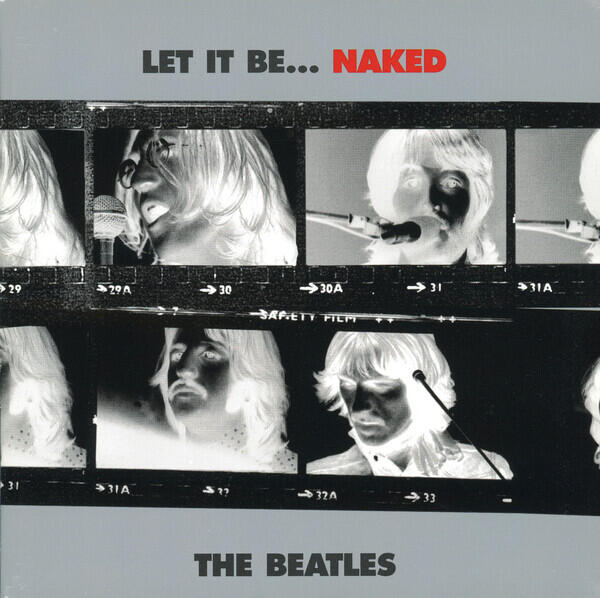
LET IT BE... NAKED
The Beatles (2003)
(06/10/2025)
Get Back
Basically the same song. Except I prefer the warm tone of the original and the dialogue CODA is too iconic to not be included. So, it's worse.Dig a Pony
Punchier, though I think I prefer the vocal performance of the original. Keys are more noticeable (were they in the original, even?). Drums have more of a kick and swing, blending with the guitar. Fine.For You Blue
Already good track has been elevated further with a pluckier mix, instrumental blending, and a smoother sound at the sacrifice of banter among the crew. There is still some of it, but it's definitely been hampered. The acoustic guitar inclusion makes this superior. Miss the dialogue.The Long and Winding Road
Holy shit. Perhaps the most obvious alteration from the original. Gone is the wishy-washy, swept aside by pretty keys. Major reduction on number of layers and their volume to let it breathe and posses a greater dynamic range. It's basically a different song, capable of capturing the emotional resonance core to the original without the overbearing orchestral music. Deserved credits music. Also, there's a jaunty key section partway through that sounds out of Band on the Wall which I think I like, but still question its inclusion.Two of Us
The introductory banter is gone, and the vocal lift is immediately apparent. Drums are nicer. Cleaner in general, but that's largely due to technological innovation. The other sounds more 70s due to its production, as opposed to this retrostyling. But in general it's an improvement over the original.I've Got a Feeling
Cleaner, the noise has been diluted to let the disparate elements shine in the mix more. Substantially better than the original without changing too much.One After 909
Slightly more tolerable than the original mix. I just don't like its insistence, the rustic imagery of a road trip paired with a half-assed ode about relationships. Torpid trajectory and disingenuous delivery.Don't Let Me Down
Brilliant little track nestled away in this here abyss. Fits in nicely and infects the ear.I Me Mine
Worse. The guitar isn't as urgent, the orchestral arrangements and choir backing tracks have been entirely eradicated, the drama toned down. It's a more traditional rock song, for sure, if that is what you want.Across the Universe
Sharper, airier. The levels have been sunburst, boosted into clarity and consequently lugging the tired beast out of it's wallowing pit after three decades. The psychedelic properties are exacerbated, the mixing improved and dynamics more apparent (neigh, existent). It loses something in the process... It trades the polluted quality of the original for a slightly faster, I think it's been moved up a semitone and that's why it's ten seconds shorter? Unsure. The fade out is nice. It feels too obvious. Probably 'better' but loses what I liked.Let It Be
It's brighter. Prefer the original. Harrison's reworked guitar bothers me, too sarcastic for the song. It's lost some of the orchestral aspects that made it more hymn-like to me. ALBUM NOTES: Overall, in the great pantheon of music (neigh, media) I wouldn't call the changes substantial enough for them to not fall within the same score of eachother. They both have their positives and negatives that outweight the experience. One has better sequencing but barely any choral or orchestral element, soul or sentiment; the other is occasionally imperfect but was the vision supported by 3/4 of the members. I think Paul is entitled to create his own playlists and officialise them as he has, but Let It Be is the album, and Naked will forever be an interesting addendum that could have surpassed its older brother had Paul more restraint.
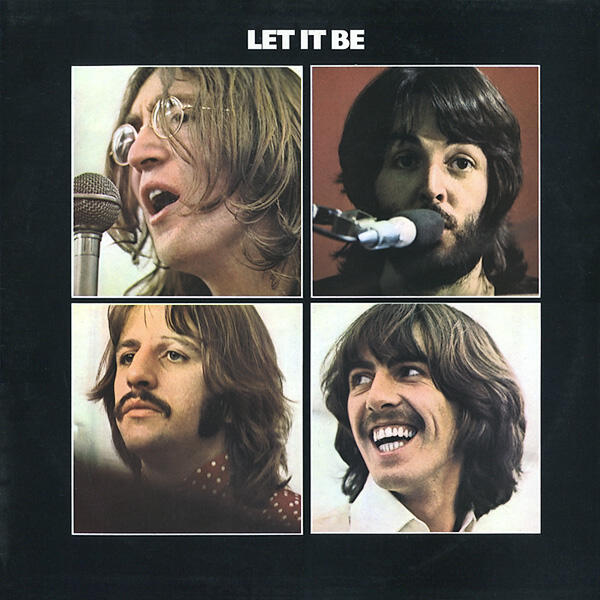
LET IT BE
The Beatles (1970)
(05/10/2025)
Two of Us
It's hard not to like this one. Overtly humdrum, tweedy and patterned. I'm talking grass-stained elbows. Nice and warm introduction to the group's strained and (compared to its predecessors) dynamically diminutive final album of songs.Dig a Pony
I appreciate recycling the cold finger rooftop remarks for the coda. The song doesn't do much for me outside of the "all I want is you." The solo satisfies but doesn't bedazzle, doesn't impress. Time signature on the riffs are slightly exciting.Across the Universe
It's lazy. The backing vocals are constant and near-emotionless. The lyrics are lethargic, the wah-wah modulation in the background feels so artificial it sounds straight out of Audacity with little in the way of further processing, and the strings are forced at the end. Yet, I enjoy it immensely for all those qualities. Plus it's undeniably catchy.I Me Mine
Quite the step up. Dramatic, bombastic, full of potential and purpose. It doesn't overstay its welcome, crescendo's nicely, has rad lyrics and an impassionate vocal delivery. Great song. Some of the mixing is noticeably drowned out, here. I appreciate the tempo switch-ups between choruses and verse, the bluesy-rock blend letting the various instrumental components shine. The brass is neat, accentuating Harrison's voice with the type of direct support we'd find mostly in his solo albums. Everyone impresses.Dig It
Ah, alright.Let It Be
An all time classic, stirring, moving with somnambulant grace, potent in subconscious comfort. The Guiding Angel of songs. I've always felt a majesty emanate from this track. Sincere without overstepping into pure corniness. It urges release and closure.Maggie Mae
Ah, alright.I've Got a Feeling
Another classic. They play it at the end of the Back anime, so it's gotta be a classic. Jamming, a constant oomph; an ode to that feeling - the wind at our sails, joy. They harmonize lovely, working as an ensemble neatly in a way that isn't as consistent elsewhere on this album.One After 909
Like, whatever man. I don't care. This song fills me with a weird apathy. I don't dislike it, but it's not for me, to put it bluntly.The Long and Winding Road
I do like it. WIth reservations. It's too wishywashy to be truly sensitive, too sentimentally obvious, or obviously sentimental, which stops it from packing the emotional strike they were going for. I think this could be something Naked might rectify, we'll see. Lyrics are narratively poetic, the imagery immediate. Undeserved credits music.For You Blue
Can't help but like this one. Wibbly wobbly bullshit, experimentative (kinda) and plain fun. The banter is also my favourite in the album, fits appropriately with the track's tone and character. It's just damn catchy.Get Back
One helluva song. Tasty idiom lyrics cushioned between hi-hat clashes. But unfortunately whiley they have passed the audition, they will not be continuing onto the next round.
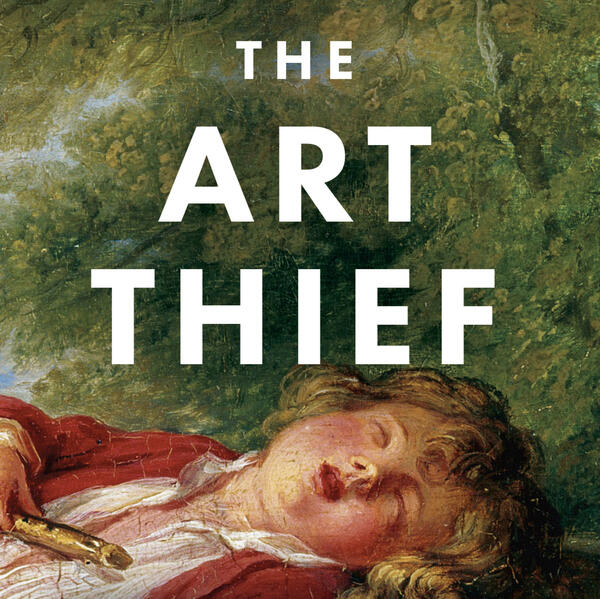
THE ART THIEF
Michael Finkel (2023)
(01/08/2025)
Five years ago, the YouTuber/writer Jacob Geller uploaded a fascinating video on art and museum theft (if you're unaware of the story, read this book first). The video introduced me to Stéphane Breitwieser. When I heard about Finkel's book, The Art Thief, I immediately pre-ordered it, awaited its arrival, and then ignored it for a couple of years. I wanted the right moment - a moment that came this month.The Art Thief is a thorough work of amazement. It eulogizes as it recounts a tale of two-hundred heists comprising three-hundred stolen works. Many of the pilfered works are left unnamed (what a boring list of a book this would be otherwise) and Finkel makes the wise choice to hyperfocus on particular works so we might feel the attachment and familiarity Breitwieser felt towards them. When the stealing reaches senseless new heights and less care is afforded, items taken are appropriately reduced to such a flippant list. In the blur, little stands out.Which makes me think of the culture we find ourselves in. We hoard digital goods, dwell in Dragon caves where gold goblets are Funko Pops. We save or download art, share it, illegally or legally. Our favourite contemporary release might not be fine art, but it's art, right? It invokes response, inspires Stendhal syndrome (if not, simply, awe). What about NFTs (rest in piss)? Am I hoarding books or creating a library? Some of my books were stolen. I've pirated frequently. I like to lie on the floor surrounded by books, compile data about books, input that data about books into spreadsheets and trackers. We all breathe a bit of art, now, don't we? They sell your favourite obscure artist on a shirt at HMV. Are these works truly imaginative? Or are they copies of a copies born from fancy? Do any of us own any art of someday discernible importance or have we been convinced we do? We're drowning in it all. What if you wanted exclusive intimacy with one-of-a-kind 'real' art but lacked the means?The book doesn't directly ask the question, but were Breiwieser's antics acts of art themselves? No, I don't think they were. His exploitation of cognitive blind-spots and misdirection, acute understanding of observation and illusion, capacity to enter a hypervigilant state of flow, and consistent success rate during a time where surveillance technology operated very differently to what we have now, do not make him an artist. He wrote his name upon each work (metaphorically, though sometimes literally) to add himself to a conversation he felt excluded from. Despite his selfish intent, I'd almost commend him for his enactment of will, his slyness, his artistic values, were it not for later events demoting my estimations of him as a thief, a critic, a person. There is something to admire about the determination. Like with Frank Abagnale Jr., the police caught Stéphane Breitwieser because the police could, and the police could because they couldn't maintain the illusion any longer. With no endgame, expect breakage.The prose is swift, certain, and empathetic, as Finkel deftly recounts the adventure chronologically, mixing varying tones with little dissonance. The chapters are short and concentrated as we ricochet from the romantic devil may care attitudes of the couple's caper early days all the way to its incendiary conclusion.
I wanted the experience to go further, last longer. I think Breitwieser might relate to that. There are some books we read and know ourselves to be its target audience. How lucky I am to not obsessively require a Finkel's master-copy, a final draft of The Art Thief to have for my own.
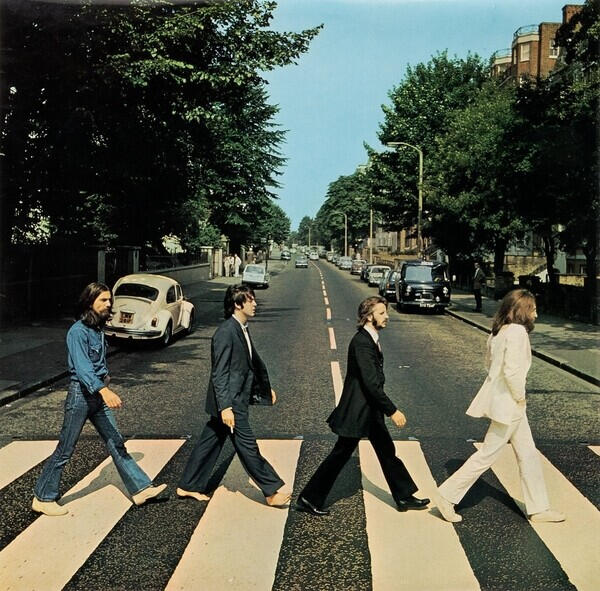
ABBEY ROAD
The Beatles (1969)
(24/07/2025)
Come Together
One of The Beatlest songs. Remarkably simple when broken down, particularly in the first half.. Jubilant in its intentions to unite, baked in a countercultural sun, and clearly effective given the band's capacity for harmonization, here. George's guitar work towards the ending, Ringo's off-kilter bash and use of snare, Lennon's prescient demands he be shot (his vocals here are impeccable). One of the earliest tracks I'd heard from them; an immediate synchronization. Is this a rock or a bluesy number? Both. The daisy chain joint rotation song.Something
My favourite aspect of this song (though not exclusive to it) is the interpolated melodies. This is a wonderfully whistful track which uses harpsichord and guitar to stellar affect. George's ability to make a guitar gently weep is reinforced through his earnest plucking and downcast riffs. He follows this up with a sliding, bending, yet remarkably simple solo. Subtle and understated in its delivery.Maxwell's Silver Hammer
I just listened to this track eight times and developed a greater appreciation for it. My favourite aspect is the cheeky, glossed-up lick in the background towards the end. It's another one of their narrative songs, another one of their theatrical and charming tracks. It's frivolous but doesn't skimp on sonic quality or infectiousness.Oh! Darling
They reached into the past for this one; dragged a charming ditty from an earlier album into the middle of the (Abbey) road to hit with new sensibilities and tricks at 150mph. It starts unassuming: there's an edge yet revealed, employed to sharp effect at the end of the first third. An edge juggled into the clouds by Paul's off-kilter crooning yell by the second half, accompanied by some mad man clanking keys, another mad man's eclectic string twinging, and a drummer.Octopus's Garden
The Yellow Submarine sequel. Ringo's voice is wonderful as usual, and I'm glad they never overused his vocals because it gives a warming character when heard. It's more competent than Yellow Submarine, and less sing-song (though I miss the soundbites), I like the idea of an Octopus's Garden. There's Octopolis in Wales? I think there's one in New Zealand, too.I Want You (She's So Heavy)
Simple variations, constant repetitions. Encroaching darkness; a downward spiral. Who is she, in this context, or are we loose with pronouns, like a fisherman with his boat? Is she a metaphor for... Anything? This is a song about compulsion and desire, for a woman or otherwise. Equal parts prog-rock and hippy groove, and a wonderful companion to the forthcoming song. Like many of their albums, themes of day/night, moon/sun recur, but never to such startling effect. Playback during the witching hour might repel the sun forevermore, locking the listener in a prison made of walls of sound. Simply extraordinary as a soundscape. Which track strays furthest from our cardinal star? Is this track at the apogee, or would it be Helter Skelter?Here Comes the Sun
Dreamy acoustic broken chords joyously welcome the song of the morn. Tiny instrumental flourishes throughout perfectly exemplify why they were unable to play these songs live. The production is just as much an aspect of the song as any compositional aspect might be. Maybe the perfect merger between their simple pop sensibilities and desire to make evolving, organic, transcendent sound. Synthesizer brings it to life, injecting a sun-warped tone to the bridging melody that possesses the vibrant intensity of a sunbeam. Wonderful.Because
Repurposing a different but slightly similar minor variation of the ascending/descending scale used for I Want You (but with a harpsichord) moves this song into the position of a 'sunspot,' casting shade on the positive emergence of its predecessor. Memorable in its stark eerieness, it's the synth once-more that steals the show: a simple and ponderous collection of notes to shadow the hanging melody. Then it stops. Onto the medley.You Never Give Me Your Money
Guitar and piano draw us in before the vocals hit. We're already immersed, the tiny Harrison flourishes accentuating the sadness with perfect detail before the high-toms come gently sweeping. And then, out of nowhere, we're in the thick of it, the guitar leading this time as we hit the midpoint with a revitalized energy unexpected from those sombre starting notes. We hear a repurposed aspect of the synth melody heard in Here Comes the Sun before the famous countdown, the divine promise that Good Children go to Heaven. Clearly a masterpiece of a song - like many on this album - that could have been broken up into a few masterpiece songs but couldn't settle to be apart.Sun King
The crickets from the prior track chirp behind a cascading guitar, a mellow bassline, a gentle but firm beat. Then the harmonies, the vocal chorus of a new day ushered in to being through organ devotion. Spanish gibberish; the Don Quixote spiritual godson of Michelle. The second part of the medley.Mean Mr. Mustard
You could argue the second half of this album portend the future we live in - a medley of short, punctuative portions of entertainment. It doesn't inspire too much discussion in me. The song moves with a quite deliberation and is doubtlessly catchy, but the narrative does nothing for me (it feels almost mean (Mr Mustard). It's a sinister sleeper with a catchy quality that never rises above itself. Given the next track's title, we presumably transition into it via Mustard's sister, Pam.Polythene Pam
The segue hasn't aged particularly well, twang-clashing the two songs together with the loosest affection. It's noticeably a different song, somewhat eliminating part of the appeal of a medley to me. Like the previous song, it's catchy (can they not write a catchy song? I believe they've literally grasped the mathematical, scientific accuracy of what chord arrangements and tempos can make a banger). Their ability to make something catchy is no longer in dispute. So, if what you want is a good time, a foot-tapping collection of grooves, then you could put their entire discography on shuffle. What, then, do I value in one of their songs? Whatever it is - it's missing here. Vague lyrics, inane repetitions, and a somewhat limp guitar solo towards the end (this is Harrison we're talking about so it still invokes attitude) all add up to an unmistakably well crafted but personally unattractive song.She Came In Through the Bathroom Window
Now that's how you do a transition. It's still rather abrupt, forced, but certainly transforms and mutates the energy of the previous track in sufficient enough time for the following melody. The guitar is once-more the winner here, that pre-chorus bridge that coincides with 'Didn't anybody tell her?' and repeated a couple times being my favourite aspect. I like the movement of the song, the tethering of real-life larcency with an emotion thievery is neat. It functions in the medley as the third part of a tryptic about ne'er-do-wells.Golden Slumbers
I truly do appreciate the first five parts to this eight part medley, but perhaps it's greatest aspect is as an emotional interlude. Golden Slumbers gets us back to what I appreciate. The transition from the previous track to this is tenuous at best, and I'd argue its existence breaks it into two medleys. Paul's strained vocals in the belter are as appealing as they are uncomfortably forced, but I wouldn't have it any other way. This song feels potent, vague enough to slip into humdrum poetry. It resets the emotional attitude, lyrical sensibilities, and musical tendencies seen in the previous three tracks, and continues that energy through to The End. This is two medleys, surely... Arguably three. If it's eight, then many contemporary albums are medley albums - and I somewhat disagree with that.Carry That Weight
Best transition of the lot, clearly. In fact, more than any of the others it feels as Golden Slumbers/Carry That Weight were a singular track split up. You could say that for You Never Give Me Your Money and Sun King, too. Anyway... Phenomenal. It relays the slumberous attitude of the previous track into a cathartic blowout that would be at home in Sgt Pepper's were it not for the luxurious restraint at hand, the mature desire to convey a perceived finality with a stoic register. Elegant and flamboyant, illustrating the dramaturgy of life, the drama of drama, without appealing to the carnival apparatus of its cousin, A Day in the Life. That was a slight and compliment rolled into one.The End
Paul's ran a line of fuse down the left leg of Ringo's pants to trail across the stage - and it's lit. Percussion is the goal here - how else are you gonna end with a bang? In character, the cardinal virtue of this ship of fools is extolled, repeated for the deaf man at the back in case he missed the subtext of their repertoire. LOVE. LOVE. LOVE. BALANCE. EQUALITY. Beauty is in the eye of the beholder; balance the eye for more beauty. It's a fantastic song, brought to import through the guitar work. Harrison shreds to the idea of love, enhances its power through riffage before coming to a quick breakdown, one last melodic and emotional switch-up before 'concluding' in silence...Her Majesty
I like it quite a lot, actually. Cheeky. The second half certainly possesses the carry-on energy of a singular movement, but breaks the continuity too much for me to consider it a fantastic medley. Not a single bad song is on this album, and I appreciate Side-B's inventiveness (which nicely carries on the punk attitude of The White Album with less abrasion).

DARK STAR RISING: MAGICK AND POWER IN THE AGE OF TRUMP
Gary Lachman (2018)
(21/07/2025)
In Dark Star Rising, Gary Lachman explains the direct links between Donald Trump, the alt-right, and the fake-reality, non-linear warfare spearheaded by Russian figures like Surkov, Putin, and Dugin - all fascist reality-distorters. Lachman begins with a convincing and somewhat thorough examination of Trump's connections with New Thought Positive Thinking guru Norman Peale. These influences have guided Trump to becoming a 'Right Man' – an individual so self-assured of their proven ability to steamroll other people's will with their own that they are, within their own reality tunnel, incapable of being at fault. In this way, Trump has tapped into the heart of Chaos Magick. Through sigilization, hyper-confidence, and probability-attuning techniques, he can peddle his grift and convince others of its validity, much like a true conman or illusionist. Steve Bannon, Trump's once chief strategist, is presented as a literary disciple of the esoterically inclined (and exceptionally xenophobic, anti-globalist) Julius Evola. What follows in the book are many pages detailing various occultic attempts at synarchy and esoteric fascism from the late 19th century through to the present day.If Trump did not have his orange face and distinctive hair, he might not be such an appropriate conduit for a malevolent thoughtform (egregore). Ever seen Hitler without his mustache? He looks like some guy. But beyond contrived aesthetics for memorability, Hitler's ability to become a 'will of the people,' to act as an antenna for their untapped wills, as opposed to using outright ritual, made him a natural medium for such an egregore. This same mechanism, Lachman suggests, is at work with Trump, exacerbated through the use of the internet (which I see as a digital scrying tool and manifestation of the collective (un)conscious, tampered with by riggers and frauds). Trump's ascension has been charged through the ritualistic propagation of memes, intended to bring about the societal, reality-altering desires of the 'web-magicians' who create and share them.We end the book (and this brief abridgement) with a meditation on the difference between 'imagination' and 'fancy.' Lachman argues that postmodernism is hallmarked by the latter, as we re-arrange pre-imagined ideas into bricolages of fandom and self-expression. He suggests - and apparently wrote a book I intend to read on this very subject - that imagination is not mere fantasy or escapism but a process of manifesting the unreal. This is something I feel quite intuitively, to the point I doubt how many people truly perceive imagination so reductively, and not as the 'blueprint liminal zone of creativity and planning' he suggests they fail to see it for. Or maybe I overestimate people.All in all: a good book! I still feel as if it's missing a large piece of the puzzle - a piece I'm recognizing only people of my age or specific understanding might be able to supply one day. GamerGate is given a passing mention, and there's not a single remark on video games. Both of these are absolutely crucial to understanding Bannon and Trump's influence on the youth of the 21st century, let alone the phenomenon of Wojacks. There is more work to be done, and more books to be written...(I recommend the documentary Feels Good Man for anybody disappointed in the lack of Pepe discussion.)
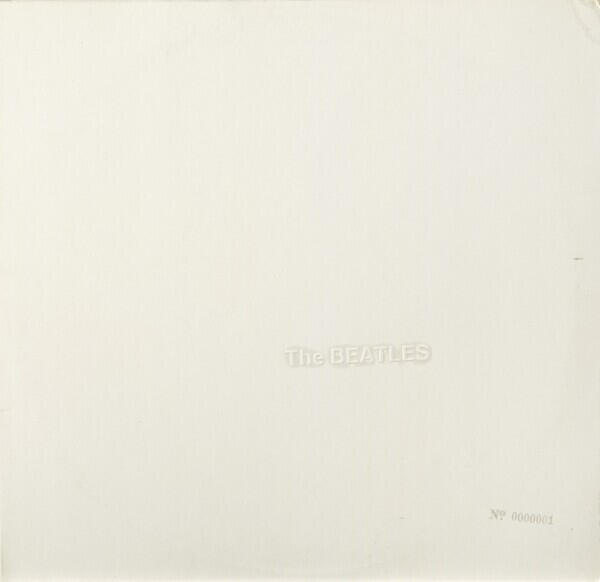
THE BEATLES
The Beatles (1968)
(27/06/2025)
Back in the U.S.S.R.
I like this far more than expected. They build on the jaunty elements seen in tracks like Roll Over Beethoven and Rock and Roll Music to provide a catchy ditty about the Red Scare. It's a toe-tapping introduction to the album with some truly infectious vocals from Paul. Catchy, short, sweet. The piano and guitar solos are standouts.Dear Prudence
Featuring a very pleasant crescendo, this song feels particularly evocative of the album art and title: it start with little and builds to much more. Out of the simple white, complexity builds into a storm.Glass Onion
The lyrics are fantastic. Reprising various characters, environments, concepts, and storytelling beats from their career to tell a story of perspective and delivery. Transparent layers, slices of life. The instrumental is both darkly orchestral and plucky rock. "Mum, quick, new Beatles lore dropped!"Ob-La-Di, Ob-La-Da
Enthusiasm epitomized. Candid in its flippancy, admitting the flippancy is the point. Laugh in the face of adversity. Life goes on. They've already proven they can make poignant meditative tracks. Why not exemplify enduring spirit forever pressured by the surreal experience of life through onomatopoeia and chanting - the gradually unifying chorus is the point. These characters do not exist in isolation but as part of a whole. I can hear this ship of fools, this odd job couple, march through my head.Wild Honey Pie
Clearly an interludinal track not designed for isolatory consideration. It functions as part of a whole. So, what is it? It's a dissonant, uncomfortable piece of shit. My ironic enjoyment is moderate, my respect for it is slim. Why does it exist? Perhaps as an inhouse commentary about the mundanity of some of the other tracks later on. Were I my most charitable, I would suggest this is McCartney's parody of Revolution 9 - a farmhouse pastiche, a collage of stuff. This is where RAM really started and Harry isn't ready to accept it.The Continuing Story of Bungalow Bill
It's impressive how they sequenced this album. Somehow, these disjointed tracks are able to flow into one another with varying degress of success despite the range of emotions, genres, and concepts. It's a mess, but certainly an orderly one. Like this song! An array of voices each adding their erratic stanza to the story of Bungalow Bill. Regardless of its zany sensibilities, there's still something rote and safe about the song. It's catchy - for sure - and they know how to write an earworm. Does that make it a good song, just because I enjoy it? There's not too much to latch onto outside the talking head segments. It applauds itself at the end, too, which I find slightly dissatisfactory and unearned. Not a bad song, but not a favourite. I can credit it it with forever taking me off guard enough to make me forget what track follows. Very Ween - ALL THE CHILDREN SING.While My Guitar Gently Weeps
Stellar. It marries the instrumental sweeps of Eleanor Rigby, the candid coolness of The Word's killer riff, the vocal delivery of a Sgt. Peppers track. This is a victory lap, a full rotation around the globe in a counter-cultural direction. George lets The Guitar have Its Solo. He wrote a love letter and a eulogy disguised as an instrument's plea - or is it a suicide note? Turn your focus to the solo to find a murder scene. It's stuck in the clouds but has its feet on soil. String theory rendered audible; the hypothesis being: "How fucking hard can we go?"Happiness Is a Warm Gun
I like it but it bothers me. The first third impresses me more than the somewhat repetitive other two. But the build up to that incessance is still infectious. Moody and wallowing before extoling about impulse? Or about seizing the day, firing the bullet and not letting the gun go cold? Are they bridging sexuality and violence? I'm not entirely sure what they're talking about, precisely, without research. It's an interestingly dynamic arrangement - with the distinct percussion standing out in particular. The vague abstraction of its lyrics endear it to me as much as it repels.Martha My Dear
I was destined to like this track the moment its silly showtune piano melody kicked in. It's a Mika Scissor Sisters precursor, dabbling in interchanging time signatures and theatrical instrumental arrangements to condescend through compliment and encouragement. Help yourself to a bit of what is all around you.I'm So Tired
I do enjoy the track, despite its malaise and exhausted concept. It's got some nice build ups, and a lovely delivery of 'stupid git' which shows the discontent in the overwhelmed narrator. Best part is 'I'll give you everything I've got for a little piece of mind.' Good but not astounding.Blackbird
Another minimalist Paul track with more heart than its simple composition would lead believe. The bird harmonies are the standout, but I also love the gentle percussion. Subject matter is important to me, so I wish there was one more movement or a couple flourishes (without detriment to the breezy sensation).Piggies
It's trying too hard to stick the landing. It's quirky, a bumpy earworm, sinister and catchy. The song is entirely okay, a loose Orwellian bender. Baroque harpsichord is the most remarkable aspect. And the Manson connections, of course.Rocky Raccoon
There's a lot to enjoy here. From the slow, acoustic build-up to the saloon-core bridge in the centre and conclusion. The narrative leaves something to desire, but I appreciate the memetic stickiness. The percussion mixing 45 seconds is so distinct and high I thought it was coming from the street outside my windows while I wore my headphones. A personal favourite from the album.Don't Pass Me By
Twee and cloying. That pendulum of a piano will drive me mad, I tell you. It's catchy, as most of their tracks are, but it annoys more than it entertains. It feels condescending and forced, a step backwards for the band. The lack of variety until the final, final section, is obnoxious. The strings are the best part because they're doing something.Why Don't We Do It in the Road?
Catchy but boring and lazy.I Will
Lovely and transient, but without as much meat on its lightweight bones compared to similar tracks by both the band and Paul by himself. It transitions wonderfully into Julia, reinforcing the familial connections core to the two tracks. I particularly like the clopping percussion in the left ear.Julia
Lennon's comforting ballad composed for his mother. Structurally and tonally simple, much like Blackbird and I Will before it, the song is mostly guitar and vocals with a wonderful, restrained mix that opens up in accordance to Lennon's voice.Birthday
Reductively simple in its derivative riff and creatively bankrupt based on concept alone. They wanted to make a birthday song because, well, The Beatles hadn't done that. This sounds like an insult, and it is, but I genuinely think the guitar kicks ass - punctuative and attitudinal. Particularly when paired with those backing vocals two minutes in. But don't get it twisted, this is not a good song. Paul winds me up, here.Yer Blues
Album really shows its length on this side. The guitar sounds vaguely frustrated, groaning in time to Lennon until it can wobble in discontent for the solo. They get some wicked tones out of it. Eclectic ennui in lieu of euphoria.Mother Nature's Son
Continues the string of weightless (but not gutless) compositions suitable for the album artwork. The obvious standout is the guitar, but the subtle horns elevate it somewhat. There's still something missing, a flippancy found mostly on this album - we've seen this song before, even if this iteration is also pretty. Paul's non-lexical vocalizations could be considered lazy but I enjoy them nonetheless. Doot doot doot. I was far more impressed with this a few years back, I recall. Though I still appreciate it, I can't help but feel this particular sound has overstayed its welcome (on this album alone).Everybody's Got Something to Hide Except Me and My Monkey
Percussion was distracting and desperate in the left ear. I like the bit where they scream C'mon at eachother like chimps behind bars. In fact, I really like that. Beatleschizophrenia. But this is clearly a throwaway track, which wouldn't be an issue if it weren't the length of a standard song. I'm running out of creative or novel ways to say the same thing. This album is a paradox of (in)consistency. If it weren't for that annoying fucking percussion in the left ear, I would consider this a sleeper hit.Sexy Sadie
Radiohead utilised the chord structure to convey discontent better in Karma Police but I do enjoy the specific saloon soundscaping here. This is not the first time I've described something in this album as 'saloon-esque' which made me realize this is the most American sounding Beatles album. From the Chuck Berry homage that kickstarts this album, to the various accents, concepts, and instrumental conventions peppered throughout which make the White Album feel worldwide. They bring it back home for Abbey Road. I think I understand that album's artwork more, now.Helter Skelter
I've got BLISTERS ON MY FINGERS! I love this track. Wild, organized chaos. Paul's laughing at the beginning, the chugging guitar and backing chorus, the scat harmonies, all designed to convey a downward spiral (and in fact, throughout NiN's own The Downward Spiral album one can find a host of similarities to this one). I like the cacophonous encore. It's not as heavy as it must have been at release but I still appreciate its rough tenacity. Manson stuff aside: man, son, we're near the final side.Long, Long, Long
Okay, I'm shocked how much this track has clicked this time around. I listened to it a dozen times in a row and it revealed itself more and more with each listen. It's got the dreary quality of an early Radiohead track, something I would have included in Organ. That simplicity I've remarked upon in previous tracks is here, but it doesn't appear to be missing anything. This is a cohesive, if not undersold, composition which relies on gentle atmosphere and dynamics. I'm a huge fan.Revolution 1
Conceptually, and in terms of the mixing, this belongs in the latter half of their discography. But the vocalizations, 'schoobadooba' stuff, and general malaise it's coated in give the impression of an earlier track. That's not to entirely discredit it - the lyrics are cool, the vibe works. But it's a bit empty. Maybe I'd prefer the single version more, I'm unsure.Honey Pie
A caught honey pie is better than a wild one - let's keep that shit in a cage, yeah? Wind instruments steal the show. McCartney's taken over a lot of this album. His voice is perhaps the clearest throughout, and not just in terms of vocals. Can't bring myself to love this one, though I can appreciate its finger tapping harmlessness.Savoy Truffle
Bombast trumpets punctuate a song about chocolates. I had a whole thing written about the cyclical nature of consumption but I think this song might literally be a song about chocolates. The mixing feels off, with the trumpet given emphasis. Perhaps to give it a clearer sonic identity, as without it the song sounds like a Revolver reject track. This was designed to be a B-Side for any other album. Harmless, actually quite catchy and interesting, but ultimately mundane in the grand scheme of their catalogue.Cry Baby Cry
Turns out the real scissoring sisters were four Liverpudlian lads all along. Chorus kicks ass, Paul continuing the falsetto affectation of Honey Pie to greater effect. This is a consistently great track, bearing the sentimental hallmarks of a Magical Mystery track with the dynamic restraint more indicative of Let It Be's offerings. Exclamative riff accentuate a song ahead of its time.Revolution 9
Nonary. The last stop before the void. Base-10. Three recurring. Nikola Tesla - 3,6,9: the Key to the Universe. Fascism, radio technology. A Signal gone awry. Noise and frequency interruptions. Feedback loop. The Fall of the Classic. Wavelengths warp at varying speeds. Time and space can be mutated. We are mutated by time and space. Aliens are inside our minds. Babies cry. We need to keep tuning our instruments, they fall out of tune when unobserved. A string can occupy two perceptual places at once. The double slit experiment revealed a thing can have two histories, two pasts. The difference between a harmony, a chorus, and a cacophony of noise, is so slight and subtle. Screaming is a thing we do when we are scared. Cinema is an attempt to project ourselves back at ourselves in a strange loop. All we can do is cut pieces of reality off to digest in a more reasonable fashion. Cars get faster, rockets go further, and I stay in my room. Monkeys. Mad monkeys. Why don't we fling shit at one another anymore? Oh. We do. We evolved from the physical to the metaphysical to compensate for all the excess data - we are facing corruption; a jpeg saved a million times has seen Hell. Number 9 is a place we can go. There are three of us in there. A triad of triads forever, the pyramid number, the tessellating tesseract digit - a Mandelbrot set fractalizing and breaking apart into frayed ends of string. So much shouting. We never left war, we just look away at war. War is a state of mind that is best understood through the body. The mind and the body score each other, dancing. Are we in a ballet? I suppose reality is all genres playing at once in in a musical collage of entwining nodes we can attune to. We give each other light, pass the torch, light the bonfire - all we do is give each other light, unbearable light at times. I can only imagine the way my Grandmother saw the radio. Remember hugging the television? It would hug you back with warm electrotickles. This is the way the song ends, this is the way the song ends. Whimper. Number 9. None of this means anything and yet all things mean everything.Good Night
Ah, the Golden Age of Disney. Can you feel the magic? I could imagine Ringo tucking in a cute animated puppet or donning a green dress to cast a spell upon a fairy castle. Seriously, though - this is a wonderful song. I love his voice here, a good usage of his deeper voice without veering into the occasional (un)intentional parody or pastiche. He's tapping into a Sinatra vein. I can foresee an emotional re-evaluation of this track once the Starr has faded away.
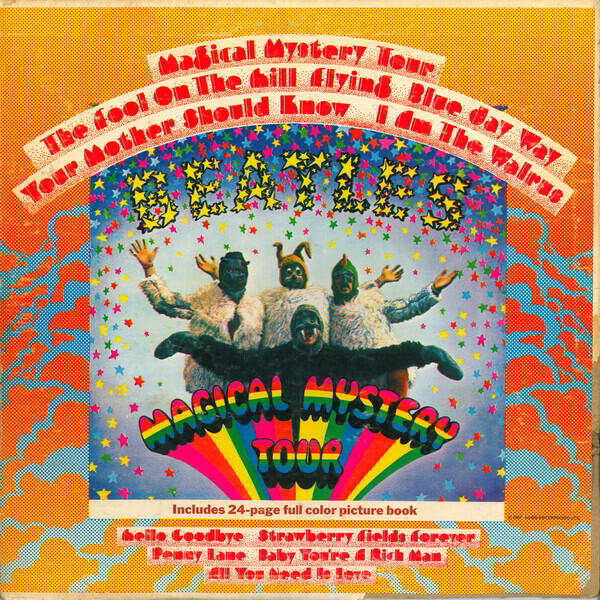
MAGICAL MYSTERY TOUR
The Beatles (1967)
(23/06/2025)
Magical Mystery Tour
It's catchy, excitable; the theatrical introductory track rivalling Sgt. Peppers. My favourite moments are when the vocals are absent, the rollocking instrumentals allowed to breathe outside of the repitition. That's not to say I dislike the vocals, or the lyrics, but I'm not particularly enthralled either. I very much enjoy the piano outro, the smooth dulcet bass tones fading us out into the second track.The Fool On The Hill
Massive improvement immediately. Woodwind and piano lure us into a blissful cottage, a dream - but it's a trap and what awaits is a mirror... Until that sneaky, cheeky little flute solo provides the relief required to pull the rug out from under us once more. I like McCartney's harmonizing in the third act. Proto-Ram, bouncing British country introspection.Flying
It's a sweltering Saturday and you've stepped off the caramel tram, pocket full of coins, onto the Magical Mystery station. You make a beeline for the attendant, weaving around the queuing rope to reach the kiosk. But nobody is there. And the train has left. And the station has become you. You exit the tram into yourself and fall into a seemingly endless chasm. Your coins fall out of your pocket.Blue Jay Way
Droning dissonant drawls, haunting string-works, an oscillating organ, maintained by a steady off-kilter tempo courtesy of Ringo. Equally everlasting and transient, repetitive but purposeful. Annoying yet captivating. Through the foggy tapestry we see something sacred.Your Mother Should Know
I'm inherently predisposed aversive to the message of the song but it doesn't detract from my enjoyment (looking at you Take Your Mama Out All Night - I have no inclination). It's a jaunty pop track which blends the poetic, sentimental sensibilities of their later career with the simple songwriting featured earlier on. It avoids flippancy with its variety and lovely organ backing.I Am The Walrus
Like other tracks on this album, Walrus is as sinister as it is silly - a bittersweet meta-song that doesn't pull any punches in its melodic and rhythmic delivery despite the whimsical subject. The hard cut in the middle disorients, perplexes the senses with its vacuous production. They hardwired experimentation, here, tuning the mix with eclectic and winding moments. It's a collection of moments, as all songs are. Warbling, fuzzy, and funky with time.Hello, Goodbye
The whimsical morning song for this album - a seeming tradition. The turning the leaf song. Delicate in its bombast, it's a positively reaffirming track that appears to end before diving into its outro - a celebration of welcoming what comes one's way with a smile.Strawberry Fields Forever
The spliced track, Frankenstein's audio hallucination; a collage of takes composed in a way that compliments the context. By recording music we capture scintilla of time and emotion. By editing those recordings in this cohesive yet colliding way, we can displace Strawberry Fields, forever, through sound and space and time. Those fields are ever changing - we cannot return to them as they were, exactly. Our memories are the shrapnel of a bullet exploding eternally. To comment on the instrumentation would require a book deal and a paycheck.Penny Lane
My previous inhabiting proximity to the titular locale doesn't persuade me to its whimsy. As someone prone to curtain-kept dwelling, unknown to hot beaches abroad, I'm not the intended customer, here. But I appreciate the sunny disposition driven by its candid and comfy lyrics, supported by horns and an ever jaunty piano that refuses to let you have a bad time.Baby, You're A Rich Man
Absolutely classic. Plays at the end of The Social Network - very appropriately. This speaks to me, as an individual who values comfort and contentment over wealth, though I'm undecided on how I feel about these millionaires telling me such. It's a well-meaning song with a snazzy instrumental in the background that doesn't overstay its welcome, though I prefer the verses to the chorus.All You Need Is Love
I'm not overly enthused by the introduction, it comes off as pretentious and needless given the rest of the track. But what a track! Catchy, enthusiastic, positively affirmative with a lovely marching melody accompanied later with some touching strings. It's the horns people are here for, though: as expressive as the vocals, they become a lyric themselves: "wom womm wom womm wommmm"-ing into the spectacular, maximalist outro. They finish it with a reprisal, reminding us "She loves you, yeah yeah yeah" before fading into the dark.

HOW TO ARGUE WITH A MEAT EATER (AND WIN EVERY TIME)
Ed Winters (2023(
(21/04/2025)
While I understand the necessity of such a book (a comprehensive catalogue of cohesively constructed comebacks to combat carnivore complaints), I found it a dry conventional read. It's intended for you to reference when in the midst of an argument (and an online one at that, unless you have good recall or your sparring partner doesn't mind you reaching for a book for your retort). I appreciate its rigorous source attribution, and the author's firm commitment to their principles (enough to critically evaluate them as they have). I'd recommend any reader dissatisfied with the structure check out Eating Animals by Jonathan Safran Foer.

PLAY NICE: THE RISE, FALL, AND FUTURE OF BLIZZARD ENTERTAINMENT
Jason Schreier (2024)
(18/04/2025)
How peculiar that I would read Careless People and Play Nice back-to-back. Bobby Kotick and Sheryl Sandberg were once a couple. They both run soulless empires and inside-hire. All the villains sleep with one another.I've enjoyed Schreier's books, but this one the least. Blood, Sweet, and Pixels and Press Reset investigate the difficulties of video game development. They concentrate on the human effort required to finance, create, or cancel expensive artistic projects. The two books make for inspiring reads: a collage of success and failure stories. Were one to plot the reader’s emotional journey on a graph, the peaks and valleys would be plentiful. Play Nice, is an (appropriately) colder book. The emotional trajectory parallels the company’s – a bell curve.We follow a corporation and tell its story as though it were a character. If you've read Joel Bakan's The Corporation, you can understand how appropriate that decision is for our contemporary climate. Our character, here, has schizophrenia: chronology is a mess; we bounce back and forth, rubber-banding through the company's history without stickiness, without the linear cohesive prose-glue required for me to internalize what I'm reading. I’m okay with disorderly narrative if it suits the book, but I’m not sure I can excuse it here. The order of events as told by the author is messy, concerned with capturing as many moments of the company's history as possible without distilled momentum. The footnotes capture Schreier's voice, but otherwise it’s shine is infrequent, reading more like a Brad Stone or David Kushner book. There are so many distinct voices, and I struggle to latch onto any (let alone the narrator's). This is without doubt due to the expansive perspective this book takes compared to the other two. This is a concentrated project.With that out of the way: what a fantastic and necessary accomplishment, a long overdue breakdown. I appreciate the lengths taken to show the turmoil experienced by many named ex-employees and empathize with how they were treat. The video game industry is coated in scarlet rot, and we need these investigations and exposés for it to stand any chance of recovering. Then we purify and clean by burning the disease away before healing. We do this by capping the income of people like Kotick and Sandberg, by tearing down empires; by identifying careless people and replacing them with careful people; by stopping the entropy symptomatic of exponential growth and replacing the exponential growth with steady growth. We decrease illth and increase wealth and play nice, for a chance. I’m so sick of billionaires.Jeez, it's only video games... Right?
CARELESS PEOPLE: A STORY OF WHERE I USED TO WORK
Sarah Wynn-Williams (2025)
(07/04/2025)
I'll keep this short.Careless People is a good book - and largely a confirmation of what we already knew or assumed. The juicy revelations (mainly concerning Mark's growing interest in politics, data, and power) come towards the end. The bulk of the exposure is directed towards Sheryl Sandberg. Rightfully so: she sounds awful. There's a lot of dragon-sickness in this tale. From the CEO to the COO to the government officials, to the author herself who refuses to leave for quite some time due to the pay decrease. I can only assume, given her position and time at the company, that she made quite a bit of money mingling with these people.Which brings me to my issue: the author. We're given ample anecdotes to explain her compliance, but none of them satisfy me. She begins the book remarking on a shark attack she experienced early in life, with major focus dedicated to the apathetic and inconsiderate responses her parents offered as she came close to death. She follows this with multiple descriptions of childbirth and injury. I do empathise - I feel emotion for any human who goes through pain. After all, she interspersed these segments precisely so we might remember she's human and not dislike her choices, particularly her choice to continue receiving fat cheques and compromise principles she proports to have in the process.I feel I'm being too harsh. I did enjoy the book. I do appreciate the whistleblowing (though let's not get carried away, she's not Snowden). I think if you are a millionaire, or wealthy as sin, and want to blast your ex-company: go for it. I don't remotely hate you, Sarah, and I'm glad you spoke your story. But I think it takes a lot of wilful ignorance to take so long in realizing Facebook and Zuckerberg are corrupt. The writing wasn’t on the wall: it was in the sky; it was spelt in fire on every grassy surface. There are, like, five instances of the author saying they wanted to leave their job but could not. As if they had a gun to their head. They had to live in the affluence they had accrued via her association to Facebook and the rich. Then they wrote a bestselling book about it.Become a Common People? Not an option.
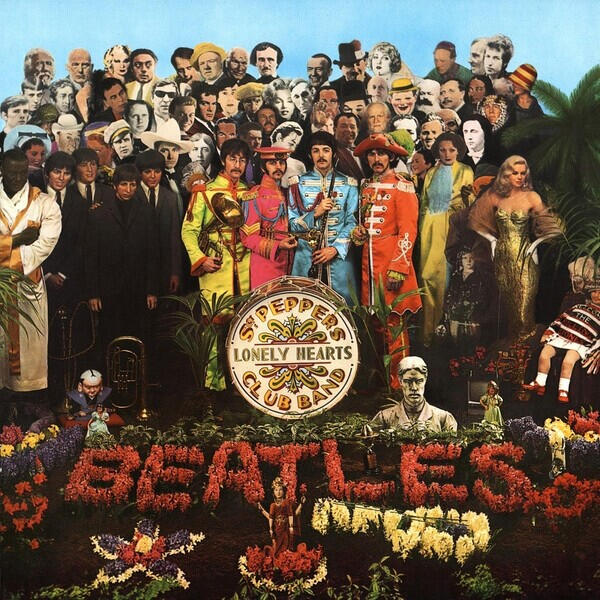
SGT. PEPPERS LONELY HEARTS CLUB BAND
The Beatles (1967)
(06/04/2025)
Sgt. Pepper's Lonely Hearts Club Band
I've heard of 'wearing your influences on your sleeve, proudly' but this takes the biscuit. I love the parasocial atmospherics applied through the titular first track, with applause, laughs, and other sound effects cushioning the music to provide a 'live' sensation. Quite fitting, as most would never see the Sgt. Pepper's Lonely Hearts Club band - a meta-corporate alter ego - live. It's a fantastic opener, driven heavily by its drumming and jaunty guitar (and occasional brass).With A Little Help From My Friends
One of those songs. Optimistic, cheeky, and loveable; a song that transcends itself to become part of the cultural zeitgeist, absorbed into the miasma of music. I love the vocal delivery, the overt simplicity in its direction, and more than anything: its closure. Each chorus is lovely, each verse a delight, but that end is one of a kind - a distinct celebration, a moment of gorgeous harmony that only serves the song's point further.Lucy In The Sky With Diamonds
It feels so unbelievably quaint to imagine a world even as recent as twenty years ago, where one would need to subtly insert a drug reference and leave room for doubt. I would repeatedly be asked, "Did you know it stands for LSD?" because it was rare to see, rare for that underground culture to be so close to us surface dwellers. This was their guerrilla ontological attempt to slip it into the conscience of many, driven by the (correct) paranoia that the government might even supress it - that, one day, the world might forget the effects of LSD. So they fired off a hypersigil, a memetic talking point, and wished for the best. The song is trippy.Getting Better
Designed to be on a million film soundtracks; obnoxiously happy in a way only rivalled by ELO and MIKA. Falsetto but not false. Toe. With its clinking keys and twitchy fretwork, it brims with an optimistic energy rife with new-leaf energy.Fixing A Hole
I love that lazy guitar lick. You know the one. This is a brilliant track heavily overshadowed by its contemporaries. It's exceptionally McCartney (feels like a solo work, most of the time). Ringo had long mastered his drums by this point, I don't remark on him enough because he effortlessly slips into the mix without attention being called to him too often (like a good tempo keeper should be).She's Leaving Home
One of the rare times I would call a song by them 'pretentious,' honestly. It doesn't feel like it deserves that lovely classical instrumentation. It lacks oomph, remarks on the unremarkable without adding enough remarkability. I like Paul's homely lyrics, but atop these layers they feel precisely as Lennon may have heard them. It's a good song, don't get me wrong - but it doesn't hit as I'm sure they intended.Being For The Benefit Of Mr. Kite!
An absolute masterpiece; a circus orchestrated celebration of synaesthesia; a wormhole opens in one ear, another in the other, and a parade of elephants appears between them. You can't see their trunks: they are in my mind.Within You Without You
Harrison is given the opportunity to flaunt his big brain. I half-joke. As holer-than-thou as the lyrics are, they aren't wrong. The strings are gorgeous, a collage of different styles and progressions layered upon one another. The second half is extraordinary: a simple arrangement layered in a complex fashion. My favourite part comes 03:20. Simply divine, I've completely 180'd on it.When I'm Sixty-Four
Some lovely lyrics here: a perspective granted through humility and delivered without condescension. The best part is at the 40s mark, where it's briefly haunted. Lovely song. Lavly.Lovely Rita
God, this song does nothing for me. It does nothing for me. Except maybe the last twenty seconds. I like its presence in the album. I like the first twenty seconds, too. But everything between those twenty second chunks disinterest me. Boring, flaccid, annoying.Good Morning Good Morning
No one is listening to this.Sgt. Pepper's Lonely Hearts Club Band - Reprise
Not as good as the other, but a lovely reprise nonetheless.A Day In The Life
An incredible stroke of genius. Equal parts musique concrete and bombastic orchestra, yet without stepping out of the range achievable by a cosey British boyband. This is their singularity: all four of them are imploding, exploding. It tears itself apart - sonic chiaroscuro, a blending of shades: shadows and lights. McCartney's whimsy, Lennon's stoic sadness, Ringo's discomforting and occasionally nervous drumming. A song about parasocial disconnection, media hysteria; of the numbing desensitization brought about by bread and circus and celebrity. Fittingly, it portends Lennon's fate - if not precisely, emotionally. One of the best songs ever composed and it took me far too long to realize it. Few artistic projects are capable of expressing such shallow depths, such deep superficialities, with this much vision. Radiohead aim for this synthesis.
REVOLVER
The Beatles (1966)
(02/04/2025)
Taxman
I am not sure if it will ever stop annoying me how open, empty, the right channel is on this track; a cowbell, some coins, a bit of shake. At least in the first half, as Harrison's soloing and the harmonizing backing track pick up some of the slack. But not enough, considering how much pressure is on my left ear. But enough about that: this is a corporate critique, a decreeing of then-Labour government pound pinching, and inspired heavily by their recent business dealings within the band. It's a great introduction to the album, a classic with an awesome beat and melody behind it - but not a favourite-favourite.Eleanor Rigby
Lyrical genius despite its simplicity. Wonderful mixing and channel distribution unlike Taxman (to me). Strings are the highlight, obviously, but the Father MacKenzie lines are some of the best in their discography. I heard it late in my life in the perfect location.I'm Only Sleeping
The chorus is divine, the lyrics are humble yet poignant. I really like the backmasking, the reverse-tracking of Harrison's guitar in the middle and conclusion; they neither intrude or overstay. It's a good message, a familiar and obvious message to take one's time. We're in such a rush. Fantastic song.Love You To
Exceptionally Hindustani - the most it's sounded, yet. Harrison's gorgeous string work is the obvious hallmark, but the vocals and Ringo's lovely drumming is what makes it powerful. As a solo instrumentation, it's fantastic but lacks a depth provided by percussion and lazy chanting. It relaxes as much as it invigorates; a timid bedlam; a cacophonic cornucopia of klaxon tones and sultry string atmospheres.Here, There And Everywhere
Another winner, per usual. This carries the dissociative theme established in the death to sleep sequencing of Eleanor Rigby and I'm Only Sleeping (and furthered by Love You To). Dreamlike and lightweight, and largely balanced upon the harmonizing backing vocals, it floats by without trepidation, rolls in waves, and ends without compromising its simplicity.Yellow Submarine
Another classic. Joyous, hopeful, surreal, and - more than anything - narratively amazing. The atmosphere is stellar: the listener really is in a yellow submarine. Occasionally at a dock... I don't know what else to say, honestly. It's whimsy incarnate.She Said She Said
Lyrics concerning ego death are awesome, but the melody can grate after repeated listens. Harrison's guiitarwork is impressive both because and in spite of its messiness in this track. It drags more than the last few songs but it's still a masterpiece.Good Day Sunshine
The best part is when it ends. And that's not me throwing shade, I just think the fade-out works impeccably, here. It's Mika McCartney, everyone's favourite Gay Beatle. Quaint and preppy, a theatre jock's favourite ballad - it's weaker than the previous songs... Which is saying a lot because it's a bloody great track and a precursor to this album's follow-up.And Your Bird Can Sing
I know they're a pop band, but this is maybe the most pop I've heard from them. The naughty guitar licks segueing into the fade-out is what makes it distinctly Beatles. It's hard to precisely place what I mean. It strands out from the rest of the album, a carry-over from the old era with the attitude of the new era.For No One
Brass aside, this is a beautiful, romantic ballad. But that tooting, soft horn makes this song what it is. Of particular remark is the lack of guitar, the thick and gorgeous bassline in the left ear, and the haunting keys floating to the right, all synthesising into a short but stupidly sweet song that manages to fit five minutes of song into two.Doctor Robert
Revolution in the Head implies Lennon was talking about Timothy Leary, subconsciously, here - which is one of a few judgemental or conservative remarks made throughout the book. But I also can buy it. Either way, sonically, this song fulfils the same obligation laid out by Taxman at the beginning. It doesn't fit, here, to me. The sequencing is off. Or it's just me. Lennon's vocal delivery isn't overtly impressive to me, and the guitar plods along somewhat... I've long wished I could like this song more than I do, for some reason. Maybe because it has my Dad's name in it.I Want To Tell You
Those chaotic keys are my favourite aspect, elevated by everything else keeping a constant tempo. Layered beneath the bluesy guitar lick and kicking drum is an escalating tension; an approach to a precipice, a step too close to the ledge for comfort. It's a wonderful demonstration of their self conscious song-writing: unspoken feelings, lingering regret and resentment, and that ever-emerging dissociation, hiding beneath a veil of theatrics. Britain.Got To Get You Into My Life
Bombastic yet controlled. Each member brings their A-Game, here. They build energy to an awesome conclusion, a crescendo that would only be beat come Abbey Road (perhaps). McCartney's belting and the delectable guitar solo 3/4s through the song take the cake. The way the guitar takes over the mix, coming front and centre, certifiably verifies, arrogantly ensures, its place in the listener's memory. This could have been the album ender, except they still had some juice in the tank for the encore...Tomorrow Never Knows
What the fu-

THE BENDS
Radiohead (1995)
(03/02/2025)
Planet Telex
Immediately a remarked improvement upon most of the tracks found in Pablo Honey. The chirping transmission feedback beneath a nocturne swoon is instantly iconic, and sounds particular Blur in their 13-era. Much like the rest of the album: some of the best britpop has to offer.The Bends
The guitar is ran under the chipper in this one. The build-up to the middle explosion is my favourite aspect of this track, which is punctuated by multiple different climax riffs that all kick ass but never manage to drop it into an all-time-favourite status.High and Dry
Fantastic early-era track which demonstrates their dynamic range without missing a moment. Tender, emotional, yet also danceably rocking. Acoustic chord structure with minor electric guitar accompaniments make this a soft yet a coarse listen which doesn't overstay its welcome, Thom's insecure falsetto conveying a sense of earnestness that would quickly define them. Everything clicks into place to provide an arguably perfect track, depending on how forgiving you are of its pop-factor.Fake Plastic Trees
Organs and violins complete this starry ballad, propelling it from a simple acoustic rock track into a transient, guitar-focused gospel anthem. It's got the rustic concentration of a Paul McCartney song with the depersonalized, modern, and depressed lens that only Thom could bring to the table.Bones
I've always thought Bones has a nice vibe, a good riff... But Thom's voice doesn't do it for me entirely, here, sounding slightly more strained and rockstar than I'd like. And none of the instrumentals are able to entirely save it. I enjoy the song but would never consciously go back to it like I would some others. Even Jonny sounds somewhat on autopilot with his strumming, which I'm sure is intentional but doesn't help its humdrum delivery. Again, I genuinely like this song but something is clearly not up to snuff.(Nice Dream)
Absolutely gorgeous acoustic introduction dives into the electronic guitar seamlessly. The trilling little riff in the background is addictive, the acoustic blends as well as it does in High and Dry, except the chorus hits with more impact due to the unbelievable strings. The 'if you think that you're strong enough' segment is a highlight of the album, alongside the sudden divebombing into a hard-hitting guitar and drum solo that snaps the dream asunder with a thunderous time signature up-kick. Then it ends as peacefully as it began. Back to sleep. You can hear the REM Cycle waves whisking you elsewhere in the fade-out.Just
In this song, the guitar is the backing vocalist, sliding along to Yorke's dulcet tones throughout the verses before imploding in the chorus. That's not to mention the rad, delicate acoustic interlude. Perhaps the defining element of this album is the balance of warbled electronic guitar and acoustic guitar, something tangibly missing in the messy younger brother album. And the outro is badass.My Iron Lung
It's a great 90s rock song with a killer groove, brilliant yet simple bassline, replete with multiple riff climaxes and a rad, warped guitar technique. But something about it has always kept it at great, preventing it from excelling further in my mind. The last minute comes pretty damn close, though. OK Computer precursor.Bullet Proof... I Wish I Was
Transcendent blend of vocals and guitar with a scaling bass and consistent drum; telecommunicating through a painted night-sky; as alien as it is human and human as it is alien. After the juvenile Pablo Honey, it's impressive how much restraint, control, and emotional power they were able to conjure for their follow-up. This isn't rock anymore, it's Radiohead.Black Star
The gradual fade-in has always personally bothered me. Some beautiful chords punctuate verse stanzas, but the drum feels overplayed throughout. I love the prechorus riff more than the chorus itself. It's a great track let down by a general rock malaise that they overrule in following releases. Again, I really like this song: but if I'm nitpicking, it's in the lesser half of the album - the rock-oriented Pablo Honey 2 songs that are superior to the first album in every respect, but fail to live up to the core emotional acoustic/electric element displayed in their softer songs. When they experiment, they're at their best - as we know well.Sulk
Preachy, annoying, and only saved by the memorably melody and interesting guitar. It's the Stop Whispering of The Bends.Street Spirit (Fade Out)
One of their best songs: a synthesis of their emotional crescendos, a thesis on tight melodic guitarwork; tempered, patient drums and Yorke's wrought vocal delivery presented atop a cloud of grieving strings. This is the end of old Radiohead and the beginning of their identity of non-identity. No Logo. They've faded from the Britpop competition, the tournament for a number one spot on the radio, the Boy Band is dead, their artistic spirits free to explore unforeseen sonic avenues. One thing I've realized I love about Radiohead is the depth of their sound, and hearing these tracks straight after The Beatles stereo-mixing makes it all the clearer. Bullet Proof has gorgeous audioscaping, a field recording quality that they only improve by A Moon Shaped Pool.
RUBBER SOUL
The Beatles (1965)
(02/02/2025)
Drive My Car
One of the best openers of their career. It's as cheeky as it is groovy, with the beep beep harmonies rolling the song out in the close with equal humour. The guitar and piano are the stars here, really. The cascading notes through the verse and the amazing string solo courtesy of Harrison. Ringo's percussion simply drives the track forwards. Another banger.Norwegian Wood (This Bird Has Flown)
And then straight into this phenomenal classic. I could speak at lengths about the jumpy downward scaling sitar instrumental of Harrison's, the vineyard drunk and sloppy daydream conjured through its preppy melody coupled with narrative lyrics (some of the best heard yet). It's smarmy, slimy, yet undeniably snazzy. We're two tracks in and on a streak of perfect songs.You Won't See Me
Oooooo-oooooo ooolala. One of my favourite parts of this track is the drumming, particularly the kick and snare. But everything works here, really. The Beatles have found themselves and are making extremely unique tracks.Nowhere Man
Yet another goddamn banger. This one has stuck with me for a while and hit quite hard this time around. Dissociative, alienating, empathetic, contemplative, and incredibly memorable. It's not a regular listen but if it comes on, I keep it playing.Think For Yourself
Another banger. Side-A is fantastic, replete with perfect song after perfect song. It's got good lyrics, good instrumentals. I won't belabour it.The Word
What a fucking fantastic song. The lyrics are so direct I'm sure they made past-me cringe, but I can't help but adore the follow-through. They didn't have to stick such a nasty, fantastic guitar line but they did. I really love this song.Michelle
Despondent and wistful; a letter to a lover conjured via song. Moonlight dream guitarwork, soft rhythmic drumming, the occasional French. The lyrical delivery matches the romanticism of the production: earnestly layered behind vintage fuzz.What Goes On
My word, that guitar is addictive. The definition of a positive earworm, particularly when coupled with the percussion driving home its jaunty, broken jangle. Lyrics are good but the delivery isn't overtly remarkable, though the drag on Paul's voice is pleasant and the chorus doubles the catchiness down.Girl
The seething exhalation balances the levitating and impatient 'doots' to create a haunting ballad wrought with regret. The solo is simply fantastic, punctuative and insistent, intuitively fading us out on a harsh, grieving note, urging the listener to click repeat. Beautiful.I'm Looking Through You
I need other descriptors besides 'catchy' because they've already proven they're the Kings of clawing a composition into a cerebrum. There's nothing straightforwardly impressive about this song, but it excels at everything it does. Much like the rest of the album, squiggling strings are scribbled across its texture. And here, it's brought to the forefront - and is by far the most remarkable element of an otherwise solid but humdrum song.In My Life
Where the fuck did that come from. Inspired touch to add that little solo, I'm glad the band listened.Wait
Percussion is playing a different game to everyone else and it's awesome. It sounds like Ringo has heaphones in and is sorta-winging-it: in the best way. What a cool track. The verses are far more my speed than the choruses but the bridge is solid, too, and a foreshadowing to Abbey Road slightly.If I Needed Someone
Beautiful starlit guitar balances a simple, wholesome message. It doesn't waste your time, and is lightly tinged by pschedelia. The prechorus and chorus tug at my heart, and the harmonics halfway through are delightful. Moreso than most tracks in this album, this foreshadows their future.Run For Your Life
I don't care if the lyrics are odd, misogynistic, and so candid it could be put on trial for harrasment, this song is fucking fantastic; instrumentals, melodies, rhythmic elements, and entire composition borders on punk - if not straying directly into its territory. Who who?
HELP!
The Beatles (1965)
(01/02/2025)
Help!
Tour de force transitionary tract that's equally hopeless and hopeful. This is maybe where the modern Beatles song gestates; a direct to-the-point and earnest delivery about interdependence: lovely without the sap. Of particular remark is the closure which threatens to dive into heavy material but bait and switches into a pretty ending. Bipolar as heck.The Night Before
Another one of those songs that achieves nothing extremely special but manages to be great, regardless; a non-complex dance number with a sardonic tone. I like Lennon's keyboard smacking in the background, and the solo is cute (though not exceptional).You've Got To Hide Your Love Away
Stripped back and acoustic, with Lennon's voice standing out in particular here. The lyrics are interesting (are they about homosexuality?) and it doesn't outstay its welcome.I Need You
Some weird, starry things are happening with the guitar pedal in the right ear. It feels disconnected and disoriented (in a good way). Ringo is given his stick and pot but, this time, makes it work - adding a minor amount of percussion in the chorus. There's a direct earnestness to it, though it's slightly held back by a lack of development.Another Girl
I'm not overtly a fan of the lyrics but I can't deny it's a catchy tune. It's good, not great, and has some interesting elements without elevating itself beyond somewhat throwaway (which, for The Beatles, can nonetheless be effective).You're Going To Lose That Girl
See previous song notes. I like it but can't feel anything from the melodies or lyrics that reach out to me, in particular, beyond ease of listenability. Ringo's percussion is a bit of a standout, surprisingly.Ticket To Ride
Did later-era The Beatles teleport themselves back in time a few years to compose this? It's psychedelic, heavy in places. Ringo's drumming is consistently entertaining, Harrison is allowed to go crazy with his guitars and pedals, the vocals and lyrics are tight, and everything clicks. Yet despite all that, it has a humdrummery to it: it's not as varying or exciting as some of their other psych tracks, nor early ballads. It's an obvious classic, and an absolute trendsetter, but they've not entirely embraced the weird, only dipped their toes in.Act Naturally
Entirely harmless - and I really like the lyrics. Straightforward bumpkin sadness with a consistent tempo and succinct length. Memorable, catchy, and while not instrumentally extreme or experimentative manages to convey intent and emotion effectively.It's Only Love
I realized why modern people (myself included when younger) struggle with older albums: production. This is the album where they tighten everything. If you listen to earlier records, they have spotty and loose moments where you can tell they've not figured out how to fit all the ingredients in the pan, how to balance and blend phrases and transitions. Most modern ears expect music to possess an audio quality conforming to studio or industry ideals recognized as 'correct' where anything else is 'incorrect.' You can see this in contemporary nit-pick discourse which concentrates on mixing and production. Their earlier records sound 'amateur,' and non-standardized in hindsight, as they helped set the standard throughout their discography. But I can appreciate Van Gogh's simple earlier drawings as much as his surrealist experimentations with yellow.You Like Me Too Much
There are some enjoyable elements hidden behind the otherwise drab lyrics. The keyboard playing is the highlight, with the melody being catchy.Tell Me What You See
Happy but trivial, juvenile, and boring (despite the otherwise fun keys and percussion).I've Just Seen A Face
Immediately impressive guitarwork segues into a country rock romp romance. Gorgeous - a deep cut masterpiece.Yesterday
...Dizzy Miss Lizzy
How fucking annoying of them.
BEATLES FOR SALE
The Beatles (1964)
(31/01/2025)
No Reply
Simple and effective storytelling. I like everything about this track. Lennon's singing is gorgeous, particularly atop Harrison's guitar. The drums are some of the tightest they have ever been. So many melodic and rhythmic switchups for so succinct a track. Brilliant intro.I'm A Loser
Clearly, a good song, but not heavy hitting. The chorus is catchy and I like the jaunty guitar and harmonica accompaniment. But there's a hollowness (?) to it I cannot ignore.Baby's In Black
Not entirely for me. Too inane, nursery-rhyme, country-bumpkin-esque for me to regularly want to listen to it. There's a pandering element to it - a humdrum over-tendency towards trivial lyricism and easy, catchy instrumentals. I'm also not fond of Harrison's guitarwork, here, either.Rock And Roll Music
Standard rock souns throughout. An interesting cover which places Lennon's vocals somewhere between desperately parched and intensely enthused. The piano is probably the highlight, with everything else balancing it out nicely. It's not remarkable but you can't deny it's catchy.I'll Follow The Sun
Short and sweet and reminiscent of Simon and Garfunkel with its soft, transient string-oriented melodic strumming. There's an element of Nick Drake there - with the electro interlude providing a beautiful twang towards the close.Mr Moonlight
Undeniably catchy. I enjoy the vague, luminary lyrics. But the organ is the takeaway, here. Harrison provides a relaxing, campfire consistancy with his strumming, occasionally letting out a few hard notes to bridge into the chorus. It's an unusual song, and were it not a cover I'd consider it preludial to their later psychedelic offerings.Kansas City / He-Hey-Hey-Hey
Heard it ten times in a row. Forgotten it.Eight Days A Week
Corny but undeniably lovely. There are lots of moments of this timid, tiny ballad to enjoy. It's harmless and great.Words Of Love
Again, orny but undeniably lovely. There are lots of moments of this timid, tiny ballad to enjoy. It's harmless and great.Honey Don't
It's a shame they use the lamest, most limp-wristed bass line and percussion for this track because the vocals kick ass (particularly the Harrison hype-beasting into a solo). But the solo is fairly weak, and the lyrics are lame.Every Little Thing
That timpani make me thirsti. There are a lot of things to like here, from the crispy vocals to the pleasent lyrics. But the stars here are George and Ringo, pulling out a beautiful drum/guitar c-c-combo breaker. Why is it so sinister?I Don't Want To Spoil The Party
Another one of those classic rock songs that are great but not extremely special. When I hear it, I jive and enjoy every bar. Particularly the chorus (and the pre-chorus in particular, where the drums kick in and the snare is snuck up). I'm not sure if some of the words I used then should have been used as I used them fork.What You're Doing
Wow, what a fun track! I like the harmonization throughout the first verse, the recall and reprising, and particularly the slimy little solo in the middle (Paul on the keys). It's a twangy salloon track. We be barnyard romancing, baby.Everybody's Trying To Be My Baby
I enjoy some of the wordplay, and the overall organization of the track, specifically Harrison and Ringo's synthesis - something that truly formed in the bellies of this album. The two of them work together splendidly, here, in a way I didn't find outwardly remarkable in the previous albums. Ringo has became an extraordinary drummer, but I can feel a rift between Lennon and McCartney that wasn't there in previous albums. And, as we know, it only becomes more pronounced later. It's a good song, but nothing that personally wows my socks off.
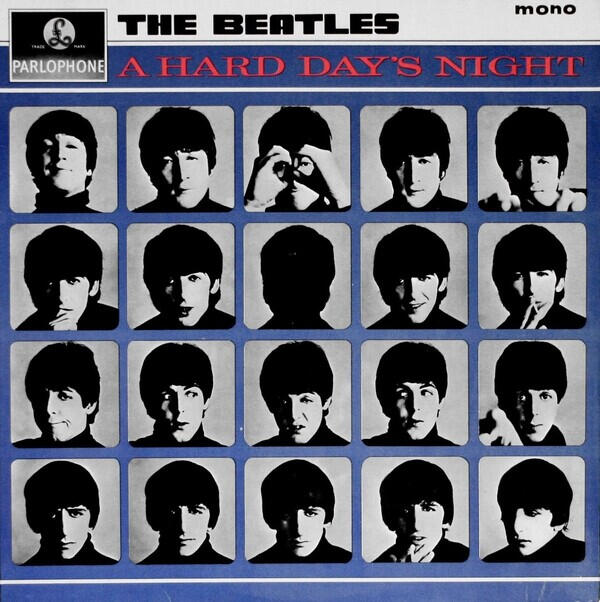
A HARD DAY'S NIGHT
The Beatles (1964)
(30/01/2025)
A Hard Day's Night
Another simple banger. It's got that jangling repetition without annoyance. I love the call/response arpeggiated fade-out for the closure of the song; and Harrison's minor solos throughout. Everything clicks here - and it's recorded in mono which is weird (I was able to hear the majority of the track in one ear). Smashing and charming.I Should Have Known Better
The harmonica returns! But it's not got as much of the jamming euphoria exhibited in their first album. The lyrics are subpar but harmless. It's not a particularly memorable song - with the majority of the instrumentals sounding on autopilot, co-ordinated but arguably insincere.If I Fell
Even repeated listening fails to elevate this track beyond mediocre for me. It doesn't possess enough hooks or likeable, momentous, elements for me to latch onto. It's a soft, sweet, slightly empty ballad, that consistently plays out with little variation. I enjoyed the first ten seconds before it lapses into a lazy walk towards the finish line. [ 30/01/25] Update: Okay, I like it a bit more. I would call it a good song and leave it there, hence its 70/100 placement on my masterlist. Good song.I'm Happy Just To Dance With You
OO-OOO! First banger. I love the guitarwork. They're giving Harrison a lot to work with. I think the backing vocals add an awesomely sardonic energy to the romanticism. I've found a new favourite. Drums are an exceptional highlight, here, too! Everyone is bringing their best. It gets better and better throughout the song and with relisten.And I Love Her
Has always been a favourite of mine; a masterpiece in simplicity, blending the minimal percussion into the perfect guitarwork. Sincere, personal, intimate. McCartney's voice, here, atop the tranquil instrumentals is a clear precursor to tracks like Yesterday and Junk.Tell Me Why
It borders on annoying in the way I love from these guys. The falsetto ring-offs and backing vocals kick ass here. It's just a catchy clashing rock number.Can't Buy Me Love
Another all-time great. It swings continuously until its memorable and catchy chorus. Again, everything works here - they synthesize seemlessly. Harrison steps back a bit and provides guitar for that added jaunt. The scream into the solo is one of the best in rock. Simple, to the point, cool.Any Time At All
God, that piano interlude is gorgeous, and the guitar sounds fantastic. But the drums and lyrics and vocals drag it down a fair amount. They're not maintaining a cohesive effort in this track. But I do love the titular call-out pre-chorus. Everything is over and done with too quick, here.I'll Cry Instead
I like it, but we've broken the streak of great songs now. It moves from A to B without much interchange, development or further depth. This is standard The Beatles. It's okay.Things We Said Today
Another winner. I love the sound of this track - a solemn march towards a Billy Joel-esque piano heavy chorus. It's bipolar, liminal. I love the lazy tones behind the 'dreaming' lines. My biggest nitpick is the lack of activity happening in my right ear. This could be a consequence of their stereo/mono experimentation.When I Get Home
Harmonized chorus is awesome. Proto-Crush 40. All of their crooning works for me. It's catchy, quick, and entertaining - without enough variation to make it truly standout. It's a shame because their chorus kicks ass.You Can't Do That
It's a shame the guitar is so good because everything else sucks. The lyrics and vocals are flat and uninspired, and the percussion is abhorent. They gave Ringo a stick and a pot and told him to piss me off. The only major miss of the record. Prophetically titled.I'll Be Back
I couldn't stop listening to it. I came around to every element I erred on during my first listen. I like every aspect of it - we have another winner; a solemn, melancholic, hopeful, and adult closure to a surprisingly fantastic album.
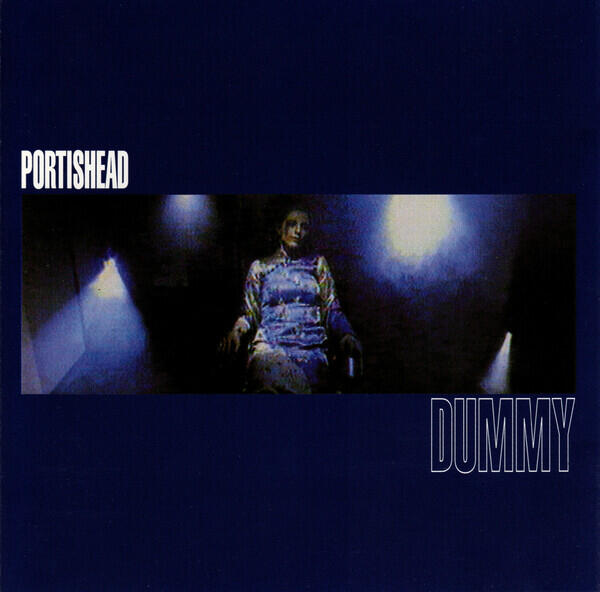
DUMMY
Portishead (1994)
(29/01/2025)
Mysterons
Simple dulcet guitar tones and a downbeat kick and backbeat snare. Apparently Geoff Barrow intentionally warped the vinyl to produce those textures. He'd leave them in the sun or intentionally scuff to create surface noise. Those claustrophobic distortions hyper-elevate Beth Gibbon's voice which, with the looping, hypnotic qualities of sampled Hip/Trip-Hop, created a sinister yet seductive tone. Welcome to the Scooby-Doo! nightclub: leave your dog at the door.Sour Times
If Mysterons didn't compel the listener to think of cinematic soundtracks, a spy-thriller erotica in rain-sodden Bristol, then Sour Times just might. Bond-powered guitar riffs steadily count us through a regular clinking sample-loop, like wind-chimes blown by a lungy skeleton. Portishead have a knack for sorrowful simplicity. What do we mean when we say Beth has a soulful voice? Every word, each syllable is a concentrated effort, a sonorous death rattle pushed out effortlessly before the next. I can hear her ghost slip between her lips into the pop filter, careen the grille mesh and fade into the mix.Strangers
We're thrown from the train into a dozy midday lunch in a terracotta cutlery kinda Café, to a busy train, a midnight nightclub, back to bed. Which is to say in lieu of the previous suspense, we're offered a hurtling transitionary set-piece hallmarked by its soft midpoint turn into the daylit soulful. This track is hard-hitting and rough, a dirtily mixed mood-piece somehow equally positioned 'where the morn meets the dew.'It Could Be Sweet
We're back to night-time cruising. Sultry crooning atop a cloud of simple sound samples, onomatopoeia buddies, some lonely keys and mechanical percussion. Wonderful song, drags its heels somewhat towards the close, as if it doesn't know how to put the fizzy, bubbling atmosphere back into the bottle. So, they let it slowly drip out.Wandering Star
Some of my favourite lyrics from them. Stellar disk scratching and heavy kicks help paint an inky picture of solitary workings, Beth's spectral voice whispering cadences through fog.It's A Fire
And from the fog we wander pews. Only a simple groove and an organ accompanies Gibbons, here, elevating her voice from dive bar and café, from nightclub and motorway, from the sheets to the altar. This track provides a spiritual core to the album, a semblance of piousness to an otherwise sordid affair. Conceptually and sonically harmonious with the rest of the album despite its sharp-left turn from Trip-Hop lullabies to a Gospel hymn.Numb
Welcome back to the Scooby-Doo! nighctlub. Dogs allowed. This and Wandering Star make a binary-system of wanton loneliness. Never has nocturn wallowing had such a thump, a kick and clash. Dull bass tones provide a suitably numbing atmosphere, the scratching and sampling there to laugh at Beth as she spills ink across the mix.Roads
One of their masterpieces. The guitar tones and how much they reverberate say more than any sentence could. Despondent trepidation; alienated, at a crossroads. Beth's delivery is heart-breaking, her mouth so close to my ear yet so delicate, frightened to frighten me off. By the time the song opens up at 01:40, I'm already viscerally, bodily, emotionally involved. The additional strings and pedal fuzz, accompanied by a steady upbeat rhythm provide a shred of hope, a suggestion of direction to a tune of turmoil. Then the bridge happens: a concerted effort to emotionally move with a mix so clean despite copious fuzz and noise. Sing at me grave, Gibbons, into the soil. Make my bones shake.Pedestal
The album simply would not be complete without a sax solo. Squeaky and jovial, it completes the aesthetic of the album. Barrow's is given ample scratching opportunity, the bass drowning out every straggler note to be left behind. Because of this, there's a distinctly 'live' quality to this track, the instruments competing with each-other for dominance. Gibbons battles echoes of her own voice, even. It's a nice reprieve from Roads but certainly not an album highlight despite the saxophone.Biscuit
The death march sinister qualities are back in full force, haunting samples simply hopping across broken keys and interrupted strings. We're in the antique shop of despair, offered a biscuit at nan's funeral. Last one in the box.Glory Box
Perhaps their most popular, renown song. And for good reason. Their most dynamic, rocking, sweeping, passionate performance. This track channels every aspect of every song remarked so far: the gospel, the sordid, the pious, the dark, the gloomy, the loving and seductive, the sinister. It repeatedly manages to outdo itself across its five-minute runtime, refusing to stay, to heed, sauntering to a crushing statement: our broken-Bond love mission's only possible if you give me a reason to love you.
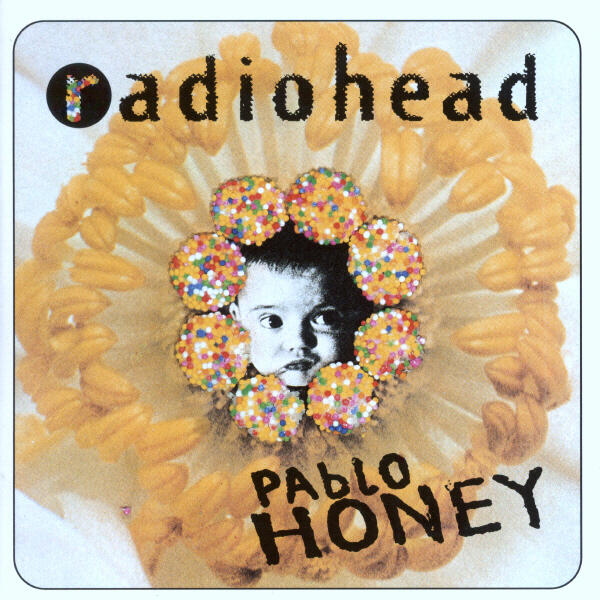
PABLO HONEY
Radiohead (1993)
(22/01/2025)
You
As Cobain as Thom ever gets. Grungey, clugging. Greenwood's guitars are an absolute delight and the song only gets better with relistens, in my opinion - though it is juvenile in places and never reaches the heights of their later works.Creep
The song. I really don't have much to add right now.How Do You?
Nearly intolerable - it wanders the outerlands, the middle lands, where curious mistakes linger, judged neither good nor bad. It has some good guitarwork in places, but Thom is unbearable. They sound like a garage band in a very small garage.Stop Whispering
Far more competent than I recall, with some legitimately fantastic guitar and drum moments throughout. Thom still hasn't struck the right balance with his voice, here, but the breakdown towards the close is surprisingly decent. I enjoy it.Thinking About You
Kinda lame. Just lame. I don't feel Thom's voice works here, and never have. I like the instrumentals but they're also very simple and are improved tenfold in The Bends. Some of the - uh - impassioned line deliveries remind me of David Brent.Anyone Can Play Guitar
One of the most alright songs ever, to me. It's never impacted me the way it has others, beyond the admittedly cool title and awesome outro. It never goes where my brain wants to and I'm not a big fan of the lyrics. I do like the texturing and mixing, though.Ripcord
It's never been my tempo despite the, again, awesome guitarwork. It's catchy as heck and insists to be heard but doesn't do too much with the time it has.Vegetable
Doesn't do it for me and drags with little meaning or reason. Not as health as a vegetable but just as low on carbs. Though, again, that guitar - Jonny is driving their direction right now. Without him, they may not have figured the rest of them out. This album shows how integral he is to the identity of the band (not that the others aren't).Prove Yourself
Wow, I'm surprised. This might be the first time this song has worked for me - I'm noticing moments throughout I hadn't in the past. The lyrics still leave something to be desired, and it's a bit limp-wristed in the introduction, but when the guitar kicks in the melodies explode thoroughly. Particularly at the minute mark with the 'prove yourself' chant and the solo following that. Great stuff.I Can't
Fundementally boring to me. I somewhat like the breakdown in the latter half but it's not enough to save a 90s stinking rock song that leaves little impression on me. Wailing and whining; even the guitar fails to entirely impress me here. I can't.Lurgee
Everything here bothers me but not enough for me to hate it but not enough for me to think it's middling but maybe it is so let's put it below average because the backing vocals are pretty good in the second half, the song.Blow Out
This is where they find their sound, foreshadowing the next two decades of their creative evolution. It's relaxed, chaotic, claustrophobic, breezy, and emotional. It doesn't sound juvenile - surprisingly sophisticated given their age and how early the track comes in their career. This wouldn't be out of place amidst the track list of In Rainbows with minor tweaks.
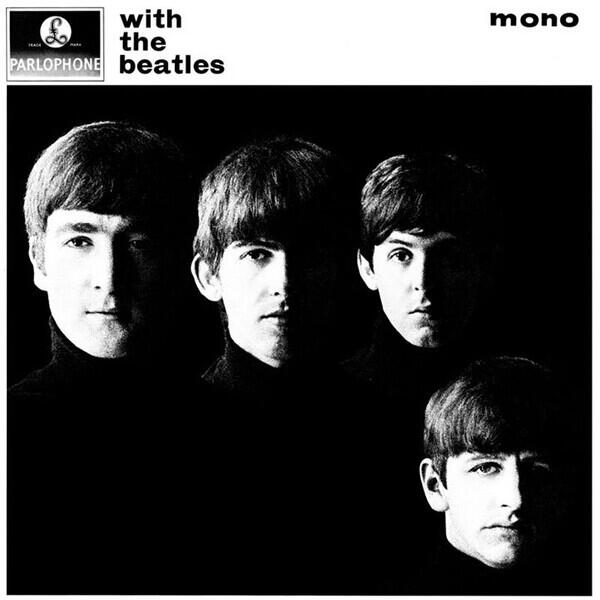
WITH THE BEATLES
The Beatles (1963)
(22/01/2025)
It Won't Be Long
Lazytown guitar in my left ear. Call and response 'yeahs' are either obnoxious or charming. Or both. It's a simple little ballad that feels more bombastic than some of the tracks from the prior album but lacks a punch.All I've Got To Do
I think Lennon's voice shines here, and that's saying a lot because the drums and guitar are wonderfully synchronized in this song. It's downtempo, hopeful. I love Lennon's humming in the outro. The lyrics may be somewhat cliché but I prefer to see them as earnestly honest. That said, the drums do feel slightly overbearing - not mixed well?All My Loving
Slightly repetitive, with the tremolo picking in my left ear not possessing enough variety. I'm not huge on the lyrics or the crooning, but do like the melody. It's a great song but doesn't leave much of an impression.Don't Bother Me
Well. You can tell this was written by Harrison. Honestly cold and indifferent, antisocial but still charismatic. It's an outwardly dismissive song with far more maturity to it than Lennon's Misery. I've found a winner. Everything about this is cool.Little Child
The Return of the Harmonica. Unfortunately it's more accompaniment and doesn't hit as hard nor have the melodic focus featured in the prior album. I do love the 'I'm so sad and lonely' line a lot. It's catchy and fun with some staying power but no major impact.Till There Was You
A beautiful, if not perfect cover that I've now heard nearly 20 times. Beautiful in all senses, with everything coming together into a dreamlike composition, romantic and sentimental and endlessly wistful. Absolute winner for me.Please Mister Postman
Absolutely inferior to the Motown OG and the Carpenters cover, but that doesn't devalue it as a track. Lennon's voice gives it a raggedy vibe more befitting for a Postman's voice, as opposed to a woman waiting for a Postman. Postman Lennon. All of the instrumentals feel walled in, tepid, like a school performance. It's saved by the ingenuity of its creators moreso the innovations made by The Beatles, heard here.Roll Over Beethoven
Berry-esque guitar sounds scratchy in a way I'm not a huge fan of, and I similarly dislike the handclapping for percussion. It feels empty for a song promising to deliver revolution. I like the bridge but otherwise it's more good than anything.Hold Me Tight
This song actually annoys me and I might hate it if not just dislike it. I don't like most aspects of this song, from the clogging chugging guitar, the handclapping, the repetitively and cloying lyrics. Not good for me.You Really Got A Hold On Me
Neither entries to the Hold Duology impress me. They're both plodding, eager but meagre, tacit in their approach and annoyingly incessant.I Wanna Be Your Man
They sound exhausted here. The enthusiasm has been left in the dessert, parched and drying and left for vultures. They wanna be my lover (?) and my man (?) but I mean clearly they don't - liars. I like when they go Rolling Stones a minute in but otherwise it marches on.Devil In Her Heart
This second half is a snoozer. Catchier than the previous song and nowhere near as grating, but still a disappointing continuation of a disappointing streak.Not A Second Time
Still quite downtempo, but far better than the preceding tracks which brought me down despite not intending to. It's still quite boring, all things considered, but far more listenable. The composition comes together neatly but it's the repetitiveness that I struggle to forgive. Not enough variety in the mix or direction.Money (That's What I Want)
At least they end with a hit.
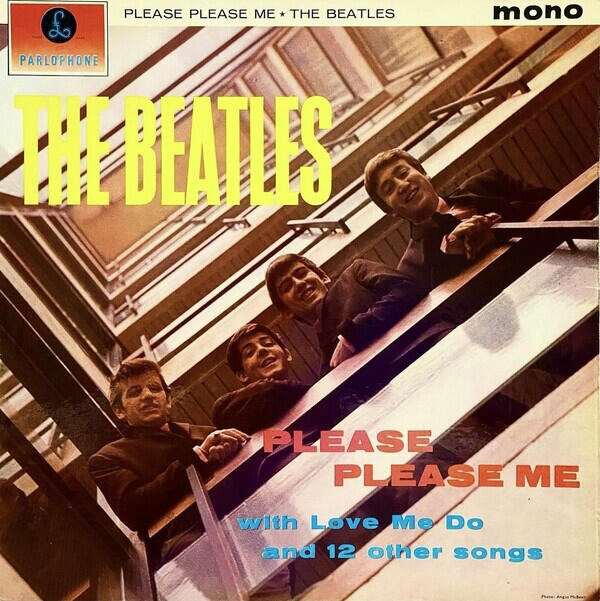
PLEASE PLEASE ME
The Beatles (1963)
(18/01/2025)
I Saw Her Standing There
Starts with "Well, she was just 17, you know what I mean" but it doesn't matter because it's catchy as hell and the croons delivered at the end of the choruses kick ass. I also enjoy the solo - it doesn't intrude and has that familiar summertime vibe twang of early electric steel stringed guitars prior to Pete Townsend. Doesn't do much, but does make you shake your ass.Misery
I love the piano, I like the lyrics (depressed teen in the 60s). It's a jaunty piece, but I'm two songs in and can already see Ringo is the weakest of the four (he plays the tempo with few fills or shake-ups: solid drumming but everyone else is popping off). Also, the lalala at the end. 37 seconds in there is an artificial increase of volume and an immediate drop-off and it's so beautifully charming in its own technically low fidelity waAnna (Go To Him)
This is one of the songs I was most excited for because of its name, but I'm not a particular fan. I like the simply looping guitar melody in the left ear, but the clear patriarchal undertones somewhat ruin it. The harmonies are lovely but can be found in better places elsewhere, and the mixing outright annoys me in places. The drums are so milquetoast I could scrape butter on them. It's sweet in the way a brain licker is.Chains
I'm torn. On one end, this is the blandest track yet (and another cover). The harmonies are off in the right ear (charming and slightly funny if you hear Harrison's falsetto). The harmonica introduction feels like an Arabic tragedy. They shout chains, over, and over, and over. It's very indicative of the 20th Century Angry Man spelt out by the John Osborne stageplay Look Back in Anger. Harrison Ford made a career off this attitude. I think I love it for all of those reasons.Boys
Not keen on (McCartney's?) voice here. I like when he does this style later or in his solo career, but it feels pretentious. The guitar is the guiltiest component here. I can smell the washboard surfer abs on that scale.Ask Me Why
I like Lennon's croaking voice, the sudden vibrancy of the guitar at the minute mark, the punctuating clashes in the left ear, the crossing guitars at 1:26 - it all feels far more sincere than Anna. Jaunty. This has that Barbershop flair to it. All the boys are cheering Lennon on. The lyrics are fairly sweet. This is a simply pretty winner.Please Please Me
That Lennon sleepytown harmonica permeating through the piece is absolutely wonderful, like something from Animal Crossing. I think the finisher is impressive for a song this short, and the drums are awesome - some really good fills and it has energy. And: it's not a cover! The "C'mon" parts kick ass. It's a crooning pop rock banger.Love Me Do
So much fucking harmonica and it kicks ass. Wonderful stuff. You can hear McCartney's barnyard DIY solo career take root in this track (their earliest as a four-piece post-Pete Best). It's so much fresher than their covers. I never realized this track came from their first album - I assumed it was a B-Side somewhere, or a cover. Staple of 1900s cinema soundtracks. Everything here pops.P.S. I Love You
I absolutely love McCartney's expanding romantic proclamation of 'you, you, YOU!' - in fact, I love his voice in this entire song. I like the Maracas (?) 'cha, cha, cha-ing' in the background - it sounds like a dancing metronome. Another jaunty love ballad that actually works for me. It's not outstanding but it is remarkable.Baby It's You
The 'shalala's couldn't win me over. They felt too weak and unenthused from the first second, which admittedly does provide it's own lazy energy, but doesn't match Lennon's voice. The plucky guitar bothered me and felt like compensation for the lackadaisical energy throughout. I do love the little piano (I think?) interlude towards the latter half, though. Like, that almost redeems it entirely... Hm.Do You Want To Know A Secret
MAN! I feel betrayed by the first ten seconds, somewhat. What an awesome introduction that foreshadows their more abstract offerings later down the line. I'm not a huge fan of the lyrics, the crooning, the backing vocals, and basically anything but Harrison's guitar which is consistently catchy. He's actually the standout of this album. That, and Lennon's harmonica. McCartney has some nice vocal moments and provides good accompanying guitar but the harmonica and Harrison guitar are where it's at.A Taste of Honey
Wow, what an eerie song, driven by personality and character-driven theatrics. It's so confident, dreamlike, and foreboding - perfectly exemplifies the dreary sensibilities and thematics of the play (an underrage pregnancy sparks strife between the titular character, their materialistic mother, and gay best friend (who promises to raise a baby with her) and largely inspired the early days of Coronation Street or Eastenders. There's an element of The Dear Hunter to it - burlesque, sexy, but similarly sinister.There's A Place
Short song, and a good song. It doesn't do anything more impressive than what's heard elsewhere in the album, but there's a warm wobbliness to this song that makes it appealing. It also feels like it'll divebomb into sadness at any moment despite being an uplifting track about self-control and actualization. The harmonica is nice but underutilized.Twist And Shout
So much better than the original. His croaky, broken voice does wonders. This song is a classic, and even better within the context of this analysis. The plucky Harrison guitar, the warbling 'ooos' and lazy backing vocals; all of these individual elements synthesize everything heard so far into an explosive conclusion to this surprisingly exciting and joyously romantic album. It may be replete with covers, but this baby is designed to get you under them. It's missing a harmonica, though.


CASE STUDY
Graeme Macrae Burnet (2021)
(27/08/2023)
Collins Braithwaite, an angry young man who sees himself in Jimmy Porter from Look Back in Anger is a man corrupted (?) by nihilistic ideals on sociological dramaturgy and construction of the self. He becomes a therapist against the status quo, building his carrer on a foundation of ego death and schizoidism - untherapy: 'Kill Your Self.'He takes on a new client, an enigmatic young woman - the narrator - who seeks retribution for the death of her sister under the guise of consultation. In the process, her identity unravels and we, the reader, are invited into the realm of psychonalysis and assumptive reasoning.She's a perfectionist; scrupulous to the most minute detail; pedantic and superficial; constantly observing others and projecting upon the world. She's also part-delusional, fancying up opportunities and circumstances that she would never enter (out of a perceived superiority over such activities). Many of these tendencies were inherited and taught by her mother, who died in a tragic way when the narrator was young. Or else, they developed via trauma related to men / her sister.Is she our case study? Or is he? Or are we?
This book was a captivating exploration of the influence a therapist possesses over their patient (and vice-versa), drawing on existential philosophy (Braithwaite himself being a Heathcliffe, Lord Henry figure, fused with Lecter and Ligotti) and modernist concerns towards psychoanalysis (or, 'shrinks') to burst the bubble of a 'normal person.'Often horribly relatable in theory, with Braithwaite himself proving a damnably convincing character at times (and reprehensible in others). Complex and fascinating.

HOW TO MAKE THE WORLD ADD UP
Tim Hardford (2020)
(22/08/2023)
REVIEW:How To Make the World Add Up is an inconsistent reminder to slow down when assessing and verifying statistical information. It's riddled with fascinating trivia and humdrum common-sense, entertaining as often as boring the reader. Nonetheless, it's a firm reminder of the potential to be found in statistics, drawing on numerous historical examples where they've helped us - by extending our lifespans, improving living conditions, and providing a greater picture of a whole.As I said before, it's an inconsistent book; jumbled and fragmentary. The artifice of ten commandments is - by self admission - completely superfluous, and I felt he stretched what he had to say to fit within those perimeters. We could have had a slimmer, more direct book, here: one that strives to explain why we should continue to trust statisticians. Particularly in this day and age.SUMMARY:Introduction
Harford starts the book by discussing his time working for BBC's More Or Less, where he discovered the joys of not just debunking false statistics but delineating and understanding honest statistics. Upon realising how much skepticism is imparted upon statistics (and statisticians), he decided to write a book intended to counter the negativity and hopefully remind the reader of their importance (and occasional beauty).
He uses the Doll and Hill study (which proved the correlation between smoking and lung cancer) as an example of statistics helping us in the long run. In response to these studies, the tobacco industry consulted one another before arriving at the perfect counter strategy: they would 'muddy the waters' using scapegoat studies, sleight of hand, questioning of research, and generally manufacturing doubt. This has lead to a half-century war between capitalist spin professionals working on behalf of corporations, designed to increase skepticism and foster inattentional blindness. And so we have the modern day disbelief and disregard for statistics (a trauma indicative of a lifetime of being lied to.)[...] Disbelief flowed more fluidly than belief. [...] Doubt is also easy to sell because it is a part of the process of scientific exploration and debate. [...] A lobby group seeking to deny the statistical evidence will always be able to point to some aspect of the current science that is not settled, note that the matter is terribly complicated, and call for more research. And these claims will sound scientific, even rather wise. Yet they give a false and dangerous impression: that nobody really knows anything. [...] The techniques of the tobacco industry have been widely embraced.14 They are used today most obviously by climate change deniers, but they have spread beyond scientific questions and into politics. Robert Proctor, a historian who has spent decades studying the tobacco industry, calls modern politics ‘a golden age of ignorance’. Much as many smokers would like to keep smoking, many of us are fondly attached to our gut instincts on political questions. [...] As Donald Trump’s former right-hand man Steve Bannon infamously told the writer Michael Lewis, ‘The Democrats don’t matter. The real opposition is the media. And the way to deal with them is to flood the zone with shit.’Rule One: Search Your FeelingsWhen we encounter a statistical claim about the world, and are thinking of sharing it on social media or typing a furious rebuttal, we should instead ask ourselves: ‘How does this make me feel?’We confront Rule One with an anecdote on forgery. Namely, the art critic Bredius, famous for discerning countless Vermeer's and hundreds of Rembrandt's, falling for a fake Vermeer, Christ at Emaus, which then instigated dozens of Vermeer rediscoveries (all fake)."It was an event that should have strained credulity. But it did not. Why?"Eventually, two European officers knocked on the door of a man named Han van Meegeren - an artist and dealer who was being trialled for selling Vemeer's to Herman Göring during the War. He cracked, admitting to not just selling them, but painting them fraudently himself.‘Fools!’ he sneered. ‘You think I sold a priceless Vermeer to Göring? There was no Vermeer! I painted it myself.’In short, Harford surmises that Bredius had wanted to be fooled, to have 'difficulty controlling [his] emotion' in the presence of an authentic Vermeer; and Meegeren was a talented (artist?) fraud capable of exploiting that desire: a desire to be right, and have our suspicions confirmed.[...] it’s enough to understand that his deep knowledge of Vermeer’s paintings proved to be a liability rather than an asset. [...] We often find ways to dismiss evidence that we don’t like. And the opposite is true, too: when evidence seems to support our preconceptions, we are less likely to look too closely for flaws.This is the 'ostrich effect,' wishful thinking, and motivated reasoning in effect; two biases that heavily skew data interpretation.It was wishful thinking that undid Abraham Bredius. The art historian had a weak spot: his fascination with Vermeer’s religious paintings. Only two existed. He had discovered one of them himself: The Allegory of Faith. He still owned it. The other, Christ in the House of Martha and Mary, was the only Vermeer known to portray a scene from the Bible. Bredius had assessed it in 1901 and concluded quite firmly that it was not a Vermeer. Other critics disagreed, and eventually everyone reached the conclusion that Bredius had been wrong, including Bredius himself. Stung by that experience, Bredius was determined not to repeat his mistake.[...] Wouldn’t it be wonderful if another biblical work were found after all these years?Nonetheless, van Meegeren got away with his fraud while living lavishly in a Nazi occupied Amsterdam, spinning his case into one of rebellion and Nazi resistance despite the evidence. Much like he'd duped Bredius, he convinced the courts and got away free.After being found guilty of forgery, van Meegeren was cheered as he left the courtroom. He had pulled off an even more audacious con – a fascist and a fraud successfully presented himself as a cheeky hero of the Dutch people.Rule Two: Ponder Your Personal Experiences
This chapter concerns the incongruencies that can occur between observational evidence and statistical evidence. That is, how our eyes can deceive us; and how statistics can deceive our eyes.Many people on television are richer than you and me. Almost by definition, they are more famous than you and me. [...] When we reflect on how attractive, famous and rich the typical person is, we can’t help but have our assessment skewed by the fact that many of the people we know, we know through the media; they are attractive, famous and rich. [...] Psychologists have a name for our tendency to confuse our own perspective with something more universal: it’s called ‘naive realism’, the sense that we are seeing reality as it truly is, without filters or errors.It's always important to remind oneself of the reality of their circumstance and not rely on a faulty bias formed through parasocial engagement. Harford also establishes how the UK government shortened doctor waiting times -There was the time the UK government collected data on how many days people had to wait for an appointment when they called their doctor, which is a useful thing to know. But then the government set a target to reduce the average waiting time. Doctors logically responded by refusing to take any advance bookings at all; patients had to phone up every morning and hope they happened to be among the first to get through. Waiting times became, by definition, always less than a day. [...] ‘Any observed statistical regularity will tend to collapse once pressure is placed upon it for control purposes.’ (Or, more pithily: ‘When a measure becomes a target, it ceases to be a good measure.’)Also found out about this site (https://www.gapminder.org/dollar-street?) which shows qualtitative statistics alongside quantiative - the incomes of various families globally, and the differences in their living conditions shown via photography of common everyday objects and experiences.Rule Three: Avoid Premature Enumeration
He begins this chapter with a discussion on infant mortality rate discrepencies, and a case wherein there was none at all - but the statistics reflected two different groups recording their own data via different metrics, therein creating a discrepancy.many of the problems I encountered were because people had taken a wrong turn right at the start. They had dived into the mathematics of a statistical claim – asking about sampling errors and margins of error, debating if the number is rising or falling, believing, doubting, analysing, dissecting – without taking the time to understand the first and most obvious fact: what is being measured, or counted? What definition is being used? Yet while this pitfall is common, it doesn’t seem to have acquired a name. My suggestion is ‘premature enumeration’.In essence, this chapter concerns thinking about what the metric is, what's being measured, and what terms are being applied and what they mean specifically. It's about taking a step back to assess the stat from a linguistic angle, dissect it, and engage in curiosity beyond the statistic - research, consideration, etc. Simple in theory, difficult in practice.Rule Four: Step Back and Enjoy the View
Rule Four concerns perspective. He discusses how the timeframe for measurement limits and determines what is considered 'news' -Consider the financial news. There is a big difference between the rolling business coverage of Bloomberg TV, the daily rhythm of the newspaper the Financial Times (my employer), and the weekly take of The Economist [...] Now imagine a much slower rhythm of news: a twenty-five-year newspaper, say. What would the latest edition say? [...] How about a fifty-year newspaper? [...] How about a hundred-year newspaper? The perspective changes again. Thinking about readers who last consulted a newspaper in 1918, you might decide to offer a leading story about the miracle of safe childhood: ‘Child Mortality Falls by a Factor of Eight!’ [...] For a two-hundred-year newspaper, the editorial board might take yet another angle: ‘Most People Aren’t Poor!’ [...] between 600 and 700 million now live in what we call extreme poverty [...] That’s not far from one in ten of the world’s population. But in the early nineteenth century, almost everyone – nineteen people out of twenty – lived in that state of destitution. That’s wonderful progress, and it becomes apparent only if we step back and change our perspective.He also introduces us to the Gini coefficient - it’s easy enough to picture a country with a Gini coefficient of zero – there, everyone gets exactly the same income. Likewise, we can readily imagine a country in which the Gini coefficient is 100 per cent – there, the despotic president has cornered all the income and everyone else gets precisely nothing. He also recommends keeping a few 'landmark numbers' in mind to ground oneself when consulting large numbers. For instance: distance around the Earth is 40,000km or 25,000 miles; population of the US is 325m people, UK is 65mil, and world is 7.5b; and the length of a bed is 7 feet.Rule Five: Get the Back Story
Here, Harford demonstrates how we tend to only publish and pay attention to surprising results. He explains how, statistically, you're likely to receive no funding via Kickstarter (let alone reach or surpass your goal) yet survivor bias of the ones that succeed lead us to believe it is a profitable venture. Likewise, we don't remark on the damage to planes that have been shot down - as they have been shot down - and so planes that return, beaten and damaged, are nonetheless successes. Yet, still, efforts are taken to adjust planes so they return in perfect condition. He then compares this to experiments and studies, and how many are rejected on the basis of finding no replicability or, adversely, finding no correlation. This creates a feedback loop of affirmation without testing or confrontation.If you read only the experiments published in the Journal of Personality and Social Psychology, you might well conclude that people can indeed see into the future. For obvious reasons, this particular flavour of survivorship bias is called ‘publication bias’. Interesting findings are published; non-findings, or failures to replicate previous findings, face a higher publication hurdle. [...] If you have a result that looks publishable but fragile, the logic of science tells you to try to disprove it. Yet the logic of academic grants and promotions tells you to publish at once, and for goodness’ sake don’t prod it too hard. So not only are journals predisposed to publish surprising results, researchers facing ‘publish or perish’ incentives are more likely to submit surprising results that may not stand up to scrutiny.This chapter was a profound examination of why research becomes popular, even if the study was flawed.The famous psychological results are famous not because they are the most rigorously demonstrated, but because they’re interesting. Fluke results are far more likely to be surprising, and so far more likely to hit that Goldilocks level of counterintuitiveness (not too absurd, but not too predictable) that makes them so fascinating. The ‘interestingness’ filter is enormously powerful.It mentions Nassim Taleb a few times. I found his book, The Black Swan, to be highly informative, but the author himself snide and condescending. There are also parts on Daniel Kahneman, whose work I appreciate quite a bit.Rule Six: Ask Who is Missing
This chapter concerns the countless products and trials performed and accepted that nonetheless marginalise. For instance, Solomon Asch (and many other) were convinced by the data of conformity rates despite not testing on men. Likewise, police safety vests are regularly created without breasts in mind, health apps ommit menstrual tracking, etc. It's easy to generalize or paint in broad-strokes, but all data are nuanced. When you hear a sweeping statement, it's best to analyse for exceptions or outer-variables not accounted for.[...] in 2012 Boston launched a smartphone app, StreetBump, which used an iPhone’s accelerometer to detect potholes. The idea was that citizens of Boston would download the app and, as they drove around the city, their phones would automatically notify City Hall when the road surface needed repair – city workers would no longer have to patrol the streets looking for potholes. It’s a pleasingly elegant idea, and it did successfully find some holes in the road. Yet what StreetBump really produced, left to its own devices, was a map of potholes that systematically favoured young, affluent areas where more people owned iPhones and had heard about the app. StreetBump offers us ‘N = All’ in the sense that every bump from every enabled phone can be recorded. That is not the same thing as recording every pothole. The project has since been shelved.‘N = All’
Rule Seven: Demand Transparency When the Computer Says "No."
This chapter details examples where algorithms can compromise data and impact day-to-day opporations, even ruin lives.An example with more serious implications was described by Janelle Shane in her book You Look Like a Thing and I Love You: an algorithm that was shown pictures of healthy skin and of skin cancer. The algorithm figured out the pattern: if there was a ruler in the photograph, it was cancer. If we don’t know why the algorithm is doing what it’s doing, we’re trusting our lives to a ruler detector. [...] Just like people, algorithms are neither trustworthy nor untrustworthy as a general class. Just as with people, rather than asking ‘Should we trust algorithms?’ we should ask ‘Which algorithms can we trust, and what can we trust them to do?’Rule Eight: Don't Take Statistical Bedrock for Granted
I mean... What it says on the tin, really. He provides numerous examples where outliers or unforeseen circumstance can upend previously trustworthy statistics. This and the previous chapter were far denser than the six before, and not as immediately gratifying to read.Rule Nine: Misinformation Can Be Beautiful, T

AMAZON UNBOUND
Brad Stone (2021)
(13/07/2023)
I was very excited to read this book the moment I saw its title and cover, as there are so many incredible stories concerning online culture that I've yet to see adapted into book format (though YouTube, etc, is rife with such narratives). There are large chunks of Fancy Bear that I enjoyed - particularly sociological or cultural - but the moment it swayed into ten-page breakdowns on systems of hacking and techno-lingo, I zoned out. It's exceptionally dense in places, which would be fine, except there's little equilibrium between those dense moments and the lighter, more scandalous aspects.Shapiro admittedly researched the topic intently, and wants to show his learning, but I was disinterested in understanding the precise technicalities of hacking or security systems. Moreso, I was here for the Paris Hilton hacking, first worm virus, history of the Trojan, and the story of the Dark Avenger. And those sections are fantastic (enough to make me willing to try Shapiro's next book).
FANCY BEAR GOES PHISHING
Scott J. Shapiro (2023)
(09/07/2023)
I was very excited to read this book the moment I saw its title and cover, as there are so many incredible stories concerning online culture that I've yet to see adapted into book format (though YouTube, etc, is rife with such narratives). There are large chunks of Fancy Bear that I enjoyed - particularly sociological or cultural - but the moment it swayed into ten-page breakdowns on systems of hacking and techno-lingo, I zoned out. It's exceptionally dense in places, which would be fine, except there's little equilibrium between those dense moments and the lighter, more scandalous aspects.Shapiro admittedly researched the topic intently, and wants to show his learning, but I was disinterested in understanding the precise technicalities of hacking or security systems. Moreso, I was here for the Paris Hilton hacking, first worm virus, history of the Trojan, and the story of the Dark Avenger. And those sections are fantastic (enough to make me willing to try Shapiro's next book).
CHASING VENUS: THE RACE TO MEASURE THE HEAVENS
Andrea Wulf (2012)
(08/07/2023)
Part detective narrative, part art history; captivated me from start to finish. I read it alongside four other Gogh-centric books and found this to be the best (followed shortly by the fictional Lust for Life). It primarily focuses on his Arles days (which, consequently, result in discussion of his Paris days and meeting of Gauguin). Exceptionally well-written (and occasionally quite intimate).
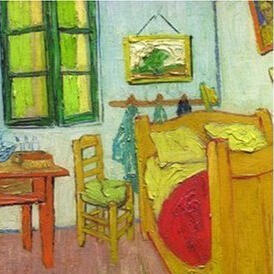
THE YELLOW HOUSE
Martin Gayford (2006)
(06/07/2023)
The Yellow House was one of my least favourite Gogh-centric reads. As noted by others, all of the paintings and illustrations are in a low quality grayscale - which baffles the mind when discussing colour as a book on Gogh should. Martin also repeats himself and breaks chronology incessantly, refusing to stay focused on The Yellow House or Arles, resulting in another Gogh biography without much insight. There's little revelatory material here, but the occasional letter excerpt I hadn't read illuminated some aspects of Theo x Gauguin x Vincent's relationship. Unfortunately, the prose didn't do me any favours, with me needing to read paragraphs repeatedly. All in all, I was quite disappointed with this book and would recommend a number of others - particularly if you're looking for a book focusing on titular building.
THE MASTER AND HIS EMISSARY
Iain McGilchrist (2009)
(21/06/2023)
"[...] there is, literally, a world of difference between the [brain] hemispheres."
Fantastic thesis and conclusion with a large amount of repetitive evidence inbetween. Can't complain too much, as that evidence was compelling and fascinating. My favourite takeaway are his thoughts on the planet as a brain, split into two hemispheres that interpret the world differently but in tandem. My jaw dropped at his proposal of a Western/Eastern division similar to the brain's. As such, I found PT II of the book to be far more approachable, understandable, and captivating.However, as interesting and mind-reeling as some parts are, I can't recommend this book. It's simply too boring, and occasionally takes large leaps in logic or assumption (though often admitted). And, writing this a few months after having read it, I need to admit that a vast amount has fallen out of my head - trivia, mostly. It's a compelling argument, a fascinating read, and may well be spot on, but it left me unfulfilled and - honestly - confused. What does one do with this information? Especially if they've already decided a life of science or experimentation isn't for them.Some of these books feel religious in nature; as if the author has dedicated their life to try and convert you to their way of thinking. I agree with a large amount of this book's content, was astounded at the depth and breadth throughout, compelled by his evidence and brainstorms. But am unwilling to convert, entirely. There's far more to understand, but I greatly appreciate McGilchrist's steps and feel one day (far from now) they may be looked at as pivotal.
VAN GOGH'S EAR
Bernadette Murphy (2016)
(16/06/2023)
Part detective narrative, part art history; captivated me from start to finish. I read it alongside four other Gogh-centric books and found this to be the best (followed shortly by the fictional Lust for Life). It primarily focuses on his Arles days (which, consequently, result in discussion of his Paris days and meeting of Gauguin). Exceptionally well-written (and occasionally quite intimate).

THE EVERYTHING STORE
Brad Stone (2013)
(14/06/2023)
While occasionally dry, The Everything Store was far more entertaining than I'd expected. It documents Bezos formation of Amazon from its earliest beginnings through to the early 2010s. But it also pays attention to his family and confidants, as well as his other ventures - involving clocks and rockets among other things. It humanised him while also paying close attention to his callousness and work ethic. I don't particularly like the man from what I know, nor his projections for the future. However, it's looking more and more likely that's where we're heading - via his brute force whole-market approach and attempts at monopoly.
Good to know your enemy, good to know your friend.
Good to try to know.
MAGNIFICENT REBELS
Andrea Wulf (2022)
(12/06/2023)
"None of this mattered to Novalis. He fell in love easily, and over the past couple of years he had flirted with several young women. The pages of his diary reveal a man wrestling with bodily urges as he doggedly records his sexual arousal and masturbation. One day he noted ‘sensual again this morning’, a few days later ‘lewdness raged from morning into the afternoon’, two days later ‘much lewdness’, less than a week later ‘took lewdness a little too far’ to finally ‘this morning’s lewd phantasy caused an explosion in the afternoon’. He praised himself for not giving in to his desires, ‘I was rather good today.’"I just found this quote very funny for some reason.Magnificent Rebels is many things. Part 18th/19th-Century novel about love and friendship in the shadow of Napoleon's rise, part factual (and heavily referenced) review of the rise of Romanticism in Jena in Germany, following the French Revolution and the enlightenment. And partly, a narrative detailing the subtle rise of a cult of personality, built around Kant, Fichte, Goethe, Caroline, Novalis, and others (the latter of whom even urged for the creation of a new religion founded upon the principles the group fostered and developed). Wonderfully written, it caused me to reflect often on my ego, self, will, and agency. It also operated hand-in-hand with McGilchrist's The Master and his Emissary, which I'm currently reading and outlines the division of the hemispheres and how they might reflect in contemporary discourse. Particularly the overdominance of the left-hemisphere and our collective tendency to appeal to reason over rationality (or even feeling)."What connected all this was imagination. It was the most important faculty of the mind, they insisted, because reason alone was not enough to grasp the world. Without imagination there wasn’t an external world at all. This new approach provided the bridge between Isaac Newton, who had explained that rainbows were created by light refracting through raindrops, and the British poet John Keats, who would declare twenty years later that Newton ‘had destroyed all the Poetry of the rainbow, by reducing it to a prism."It's by reading this, alongside studying William Blake (and, specifically, Urizen) that I have come to understand my stance on intellectualism. I'm a strong opponent to anti-intellectualism, but also a supporter of emotion trumping absolute reason. Reason and intellectualism are great tools, but not the raison d'etre of human experience. That would be, to me, predominately: emotion and feeling; nature, and becoming one with the environment.
I've struggled with my romantic inclinations throughout my life, and particularly due to those inclinations opposing my depressed, reclusive, and antisocial tendencies. I'm wondering lately how this tug-of-war inside myself, between absolute rationality and absolute emotionality, might best be resolved or remedied. As it stands, I am at odds with myself, rebelling against my romantic nature with antisociality; rebelling against my antisociality with romanticization bordering on delusion.I could say many things about this book. If you're interested in romanticism, emergent ideals on love and the self, or the history of philosophy: I'd recommend this book. Likewise, if you enjoy books with an expansive bickering cast of characters replete with twists and turns.EDIT: another user reviewed this book and described its contents as 'gossip' and I'll now paste some of what I had to say in response to that:What is gossip? Is it not valuable?
Does that not provide insight into a sociological or cultural dynamic, if not an amalgam of relative dispositions on a certain point of time?
Gossip is extremely important to cross-reference for historical reasons, a myriad.
But even then, Magnificent Rebels isn't just 'gossip' -
We're shown the interplay between some of the foundational members of a hugely influential movement; how they see one another and their work, supported with an outrageous amount of references and sources (like, 20% of the book substance). All of the dialogue was directly sourced from letters, and in cases where statements can't be corroborated, Wulf says as much.
If anything, your insight is a valuable one if you perceive them all as gossiping. If you've read to the conclusion you'd understand why: they were all judging one another on conduct in a time where conduct conformity was in the air, and it tore them apart. Gossiping - as is made manifest in the quote I'll add - can lead to fracturing.
They were, on the fly, creating new interpretations of self-evaluation. How would that NOT lead to bickering, gossip, and self defence mechanisms one-hundred years before the phrase 'self defence mechanism' existed?
"As he grew older, Goethe began to look back on his life. He started (but never finished) an autobiography, pulling together materials from his past – recollections, letters and other manuscripts. ‘I seem more and more historical, even to myself,’ he wrote to Wilhelm von Humboldt. He also edited and published an eagerly awaited volume of his correspondence with Schiller. When August Wilhelm Schlegel read these letters, he was shocked to discover how viciously Schiller had talked about him. That Schiller had disliked them, he had known, but not that his ‘implacable hatred’ had been so bitter, August Wilhelm wrote to Ludwig Tieck."
'Gossip' is, if anything, an extension of the self in a social climate - and worthy of evaluation in all cases, but PARTICULARLY, when illustrating the lives of the first romantics.

THE COSMIC DANCE
Stephen Ellcock (2022)
(10/06/2023)
I have an ensō tattoo brushed on my arm; wrote a short-story collection about... Well, a lot relevant to this book, but for the sake of simplification, ends with a short story called 'O'; and I'm working on a re-write of Beowulf in the vein of Milton with William Blake archetypical characters. So, I was going to like this book. And I knew that the moment I dropped £25 for it after seeing it for the first time.Nonetheless, it's ostensibly an artbook with brief statements aside. Many of the facts are stuffed together in a string of connected but overwhelming trivia-bytes that, sometimes, feels like a random philosophy history fact book. Which it kind of is.But, man, it excels at that. The book is beautiful, the prints high-quality, and if you collect books of this nature (symbolism, synchronicity, symmetry, synergy, sibilance, s, etc) and looking to lose yourself in some beautiful art -
Well, yeah.PS. I found out the title of this book used to be 'The Cosmic Dance: A Visual Journey from Microcosm to Macrocosm' and while that doesn't sound as compelling, I'd argue it's more accurate.PSS. To those who know me and want to see the inside of my brain: this is a near amalgam of my ruminations.
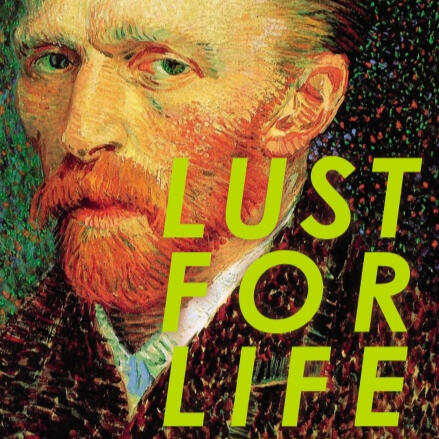
LUST FOR LIFE
Irving Stone (1934)
(09/06/2023)
“I know, Roulin, but I feel more and more that we must not judge God by this world. It’s just a study that didn’t come off. What can you do in a study that has gone wrong, if you are fond of the artist? You do not find much to criticize; you hold your tongue. But you have a right to ask for something better.”
“Yes, that’s it,” exclaimed Roulin, “something just a tiny bit better.”
“We should have to see some other work by the same hand before we judge him. This world was evidently botched up in a hurry on one of his bad days, when the artist did not have his wits about him.”Lust for Life is a wonderful, life-affirming, if not upsetting work. It depicts Van Gogh through his 20s and 30s, and paints a broad illustration of his life. Irving researched the correspondence and journals left by the artist to painstakingly develop a picture of his struggling romantic endeavours, artistic career, and mental health.“I have to make my drawing right so that my drawing will be right.”We're shown his youthful working as an art dealer for Goupil & Cie; his missionary work in Petit-Wasmes (featuring some of the most poignant writings on miner-work I've read); his family life in Etten; his burgeoning understanding of Dutch art, and isolated example of domestic life, while in The Hague; his awakening to colour, impressionism, and ukiyo-e artwork while blossoming in Paris; and his eventual downfall in Arles, the land of yellow that took from him as much as it gave.He was getting more and more into the habit of dashing a thing off, getting down his impression of the scene before him in one great splurge of passionate energy. What had struck him most about the old Dutch pictures was that they had been painted quickly, that the great masters dashed off a thing from the first stroke and did not retouch it. They had painted in a grand rush to keep intact the purity of their first impression, of the mood in which the motif had been conceived.Occasionally, I groaned. Passages wrought with early-1900s romantic writing tested my tolerance and sensibilities on multiple occasions. The parts concerning Christine certainly tell their age. Likewise, truthfully, with most romantic segments; though the underlying instability still shows, as intended by Stone. And, well, this book is certainly guilty of purple prose. But I can forgive it for its passion, emotion, and earnestness. This is a book written for lovers of lovers of art. I found every other page inspiring, thought-provoking; or, towards the end, heart-breaking.Pain did curious things to him. It made him sensitive to the pain of others.
[...]
“Anyway,” he said to himself, “a canvas that I have covered is worth more than a blank canvas. My pretensions go no further; that is my right to paint, my reason for painting.”
[...]
“Very well, Vincent,” said Zola with a smile, “you have been nominated for the cult of ugliness. Do you accept the nomination?”
“Alas,” said Vincent, “I’m afraid I was born into it.”In particular, I was enchanted by the uplifting quotes on atypicality; on being an Other; on striving to maintain a vision of the world forever shattered and stomped on.His health and his work picked up slowly. He had known before that one could fracture one’s legs and arms, and after that recover, but he was rather astonished that one could fracture the brain in one’s head and recover after that, too.
[...]
“You are a grand nerveux, Vincent,” Doctor Rey had told him. “You never have been normal. But then, no artist is normal; if he were, he wouldn’t be an artist. Normal men don’t create works of art. They eat, sleep, hold down routine jobs, and die. You are hypersensitive to life and nature; that’s why you are able to interpret for the rest of us. But if you are not careful, that very hypersensitiveness will lead you to your destruction. The strain of it breaks every artist in time.”
[...]
There came a time in every man’s life when it was necessary to fling off suffering as though it were a filthy cloak.
[...]
It's so easy to love. The only hard thing is to be loved.And Irving Stone's dedication to his craft needs to be commended. I can feel the attention to detail, line to line - with only minor exceptions. Stone really wanted to capture the artist, dead only a few decades before the book was published. He tried - and for the most part, completely succeeded. I was transported to London, Nuenen, The Hague, Etten, and particularly Petit-Wasmes. The characters were incredible. Theo may be one of the greatest brothers in art history.“Very well, what painters must learn to portray is not a thing, but the essence of a thing. When the artist paints a horse, it should not be one particular horse that you can recognize in the street. The camera can take photographs; we must go beyond that. What we must capture when we paint a horse, Monsieur Van Gogh, is Plato’s horsiness, the external spirit of a horse. And when we paint a man, it should not be the concierge, with a wart on the end of his nose, but manness, the spirit and essence of all men. Do you follow me, my friend?”
[...]
“The ordinary human brain thinks in terms of duality; light and shade, sweet and sour, good and evil. That duality does not exist in nature. There is neither good nor evil in the world, but only being and doing. When we describe an action, we describe life; when we call that action names—like depravity or obscenity—we go into the realm of subjective prejudice.”
I knew a fair amount about Van Gogh before reading this, but had never entered his mind so continuously. Granted, I haven't seen any of the films about him. This book gave me a firmer understanding of the artist, despite the occasional anachronisms, inaccuracies, and dramatic hyperbolising.When the fall rains came he worked outdoors on oil torchon and captured the effects he wanted. He quickly learned that a colourist is one who, seeing a colour in nature, knows at once how to analyse it and say. “That grey-green is yellow with black, and hardly any blue.”I appreciate the structure. The first half of the book - before Paris, when he discovered impressionism and the beauty of vibrancy - is squalid, dark, miserable, and melancholic. You can almost feal the coal rubbing off on your skin. The prose takes on a texture. But slowly over-time, colour seeps into the text until we arrive at Arles, where colours are precisely described.
Waves of indigoes and purples and Prussian blues overtake the text until conclusion. When Gogh is at his most hypermania, absinthe-addicted, or even love addicted, the language borders on (intentional) uncomfortably. It captures his oscillating mental states with dizzying accuracy.And, lastly, my favourite part. The magical realist motif of the blackbirds, prominent in one of Gogh's final works (Wheatfields with Crows) which, here, symbolises mental instability and masochistic collapse in a way reminiscent of Kafka's Vulture:Kafka:
Now I realized that it had understood everything; it took wing, leaned far back to gain impetus, and then, like a javelin thrower, thrust its beak through my mouth, deep into me. Falling back, I was relieved to feel him drowning irretrievably in my blood, which was filling every depth, flooding every shore.Stone:
Vincent stood perfectly still.
A rush of blackbirds came out of the sky. Thousands of cawing, beating blackbirds. They swooped down on Vincent, struck him, engulfed him, flew through his hair, into his nose, into his mouth, into his ears, into his eyes, buried him in a thick, black, airless cloud of flapping wings.---PS. Reading about Gogh's fascination with Ukiyo-e woodblocks stunned me. It was so obvious, it hardly needed illustrating for me. The colours of Gogh are a middle-ground between Neo-Impressionism and ukiyo-e (Hokusai & Hiroshige). What is Starry Night but The Great Wave off Kanagawa seen through delirious, Western eyes? After the Sakoku policy was overturned, and Japan loosened its borders to the West, we saw a merging of cultures unprecedented. It's only natural the vibrant palettes of various Japanese artistic movements would have affected the West. I never would have thought it so intrinsically caught up in the Impressionists, however. But it truly is obvious Seurat, painter of A Sunday Afternoon on the Island of La Grande Jatte, would have seen imported art that would have made a La Grande Impression on him. Likewise, Henri Rosseau's primitve animals certainly look as though they were crafted by hands that had held a Sharaku. Who knows...
(I want to know. Someone direct me to (or write) a book on how West and East art integrated one another from when the Sakoku ended to WWI. I'd appreciate that.)PS.S. Van Gogh OG weaboo?

PORTABLE MAGIC
Emma Smith (2022)
(06/06/2023)
Not all books are The Very Hungry Caterpillar, although that book’s physical playfulness also sounds a note of caution. Eric Carle’s first proposal was for a book about Willi the Worm, a bookworm nibbling through pages: this early iteration gives The Very Hungry Caterpillar a symbolic quality, in which what is being gobbled eagerly up is not so much the – to me in the 1970s, unspeakably exotic – pickle, watermelon, salami and cherry pie, but rather the book itself. Carle’s allegory of reading makes clear that, as the caterpillar discovers, hungrily consuming books can give us stomach ache.I've been foreshadowing this realisation for a while, gorging myself on books and art until, as happens with all addictions, I became sick and withdrawn. I needed to read that.Otherwise, truly unfortunate wording here:Birdwatchers are alert to the particular, distinctive combination of avian affect, movement and presence that they call jizz: I’ve tried to transfer that delighted awareness of the specific to my account of books. I hope that Portable Magic will make you more appreciative of all the book jizz, the bookhood, of your own life and library.Chapter One conveys the invention of movable type and the printing press, drawing from a number of familiar instances throughout history I'd encountered in the book, Index, by Duncan Dennis. What I learned this time around is how skewered our perspectives on the emergence of printing have been. Some of the earliest printed works include the Gutenberg Bible, Robinson Crusoe, and islamophobic and anti-Lurkish tezrs. As such, the development was tied to narrative's of European dominance to re-inforce a status-qup of Christianity surviving after the middle ages.
I also learned this awesome term:This phenomenon of new technologies aping their predecessors is called skeuomorphic design.Chapter Two concerns how the Council on Books in Wartime affected American reading, with it's prioritisation of nationalist literature and censoring of topics or concepts, all to bolster discipline. On the plus side, plenty of soldiers were given free literature to read and were extremely appreciative in general.For some now-classic titles, the reach offered by the Armed Services Editions transformed their standing and readership. Six times the print run by Scribners between 1925 and 1942, 155,000 copies of Fitzgerald’s The Great Gatsby were reprinted in this format. Maureen Corrigan notes that in 1940, the year of his death, Fitzgerald’s publishing royalties amounted to a meagre $13. Armed Services Editions found for the laureate of the gilded age a new and eager readership, contributed to the rediscovery of Fitzgerald in the 1940s and beyond, and established the enduring reputation of a book which has never been out of print since.
[...]
But during the war the Armed Services Editions proved to doubters that books could be effectively remarketed as a high-volume, low-profit commodity. They turned the paperback into a mass-market and global phenomenon. In 1939 there were fewer than 20,000 paperbacks published in the US. By 1943, that figure had exceeded 40 million. In the UK, Allen Lane began with a print run of 20,000 copies of each of ten titles and was selling millions by the mid-1940s. The book market would never be the same again.
[...]
And by the 1950s, the CIA was operating an extensive clandestine cultural programme across Europe, supporting artists, writers, conferences, theatre productions and concerts, and underwriting the publication of magazines and books under the auspices of the Congress for Cultural Freedom. So, paradoxically, the industrial technologies and networks that enabled the mass circulation of books also restricted their access.Chapter Seven is on religious books, and how Christianity's constant growth helped accelerate the printing press. It also focuses on Codexes and their distinguishing from papyrus scrolls, and incidents of book burning. Mostly, it focuses on how all books can be bibles, Bible etymologically deriving from Biblio, and how religion and literature can create one another.But the new technology of the book – gathered sheets folded and fastened at the back or spine, often protected by covers – made a different kind of reading experience possible. Readers could immerse themselves and interact in new ways with the text: skimming, flipping back and forth, or flicking through pages to find a particular bit. Neuroscientists have investigated the ways we use smartphones to explore the human brain’s plasticity and the interconnectedness of the fingertips and cortical processing in the brain: their professional ancestors in the early centuries of the Christian era might have used books for similar experiments.Here, the Codex was ‘discovered’ in the nineteenth century (like many narratives of discovery before and since, this seems to have involved a European traveller coming across something of which a local community was well aware and then appropriating it).Chapter Eight doubles down on the previous chapter: book burning.This trope of ideological theatre has persisted. At least two waves of burning have targeted J. K. Rowling’s Harry Potter novels in the twenty-first century. Both conservative and progressive communities have focused on the material book as the symbol of disapproval.‘A prelude only, that. Where men burn books, / They will burn people also in the end.’Chapter Eleven shared some extremely illuminating passages concerning Mein Kampf. Perhaps the most surprising chapter, as I knew very little about public reaction to the book at release beyond tidbits. For instance:An abridged American edition of Mein Kampf translated by E. T. S. Dugdale was published in the USA as My Battle in 1933, the same year as the book-burnings. It prompted widespread public criticism of its publisher, Houghton Mifflin, in part for giving voice to Hitler’s ideology in any form but then, more specifically, for releasing an edited text. The American edition whitewashed the ideology by omitting some of its most extreme manifestations. Dugdale cut Hitler’s text from 780 pages to just under three hundred. F. D. Roosevelt wrote on the flyleaf of his copy, ‘This translation is so expurgated as to give a wholly false view of what Hitler is or says.’ [...]
George Orwell called out the translation as ‘edited from a pro-Hitler angle … to tone down the book’s ferocity and present Hitler in as kindly a light as possible’.And the last chapter concerns 'what a book is' and goes to some wacky, metaphysical places in an attempt to answer that question.
Which is all to say, if any of these facts interested you: you'll like this book. It's fun, packed with information, and flitters between subject matters and time and pace with ease. Some chapters interested me more than others, but I did end up surprised with the ones I thought would roll off my back.

OTHER MINDS
Peter Godfrey-Smith (2016)
(05/06/2023)
Other Minds chronicles the emergence of deep sea consciousness (and our consciousness) starting with E. colin and eukaryotes, cataloguing the emergence of nervous systems with action potential. The first chapters focus (rightfully so, for a book on cephalopods) on cnidarians (anemones, coral, jellyfish, etc) and mollusks. It really gripped me when discussing Ediacarans, like Kimberella and Spriggina. My mind reels at the prospect of radially symmetrical creatures like the jellyfish succeeded by bilaterian creatures.It's in the Cambrian periods that mollusks developed their shell in reaction to the 'the invention of predation,' crawling along the sea floor on a solitary foot before rising up and entering the water column. These early cephalopods then evolved their foot into a multitude of tentacles, using instead their siphon to jet to propel themselves forwards. This evolved them to become predators themselves. Peter illustrates wonderfully, using isomorphic metaphors to compare aerial industrialisation to underwater revolution.Once aloft, the “foot” is no use for crawling, so the zeppelin-cephalopods invented jet propulsion, by directing water through a tube-like siphon which could be pointed in several directions. [...] As well as zeppelins, a range of cephalopod hovercrafts and tanks probably prowled the sea floor – some of the shells from this time seem too unwieldy to carry in the open water. [...] The zeppelins were challenged, and eventually vanquished, by airplanes.The only ancient cephalopod survivor is the nautilus. Contemporary cephalopods are split into two branches (eight/ten-armed), all representing an evolution of that shell in favour of mobility: cuttlefish retained one internally, squids formed a pen, and octopuses abandoned their shells altogether. And so, we arrive at a species without a definite shape, lacking both shell and skeleton, and capable of a plasticity beyond immediate comprehension.The usual debate is between those who see the brain as an all-powerful CEO and those who emphasize the intelligence stored in the body itself. Both views rely on a distinction between brain-based and body-based knowledge. The octopus lives outside both the usual pictures. Its embodiment prevents it from doing the sorts of things that are usually emphasized in the embodied cognition theories. The octopus, in a sense, is disembodied. That word makes it sound immaterial, which is not, of course, what I have in mind. It has a body, and is a material object. But the body itself is protean, all possibility; it has none of the costs and gains of a constraining and action-guiding body. The octopus lives outside the usual body/brain divide.There's a large section dedicated to the discussion of subjective experience in animals; ultimately, the presence of a 'soul' or consciousness beyond sentience. I admit little of this section was news to me - not even the 'white noise' to describe animal relativity in terms of frequency metaphor. Such ideas are common to cognitive neuroscience literature on the subject. I appreciate all of the new studies I hadn't seen before, however.
Though, I did find it hard to follow in places. We're led through an array of dramatic subject (each possessing their own branches of literature) at a breakneck pace to reach the octopusColor vision – using this system – requires at least two. Most cephalopods have only one. Behavioral tests have also been done on some species. Can a cephalopod learn to make a distinction between two stimuli that differ only in color, and in no other way? Apparently the ones that have been tested cannot.
This is baffling. These animals are doing so much with color. They are also superb at matching the color of their surroundings, for camouflage. How can you match colors you cannot see?
[...] photoreceptor genes are active in the skin of a particular octopus species (Octopus bimaculoides). Crucially, it also showed that the skin of this octopus is sensitive to light and can change the shape of the chromatophores, even when the skin is detached from the body. Octopus skin itself can both sense light and also produce a response that affects the skin’s color. I think these animals have a sophisticated system designed for camouflage and signaling, but one that is connected to the brain in a way that leads to all sorts of strange expressive quirks – to a kind of ongoing chromatic chatter.Experience Compressed was by far my favourite chapter, dedicated to entropy and the nature of natural decay. I particularly couldn't stop thinking about how time is perceivable via entropy and thermodynamics, and how octopuses in deep waters survive longer than their comparative neighbours. Likewise, sharks are incessant and constant, and cold-blooded. Pressure and temperatures are key to time perception, and perhaps time's entropic affects on the body and nervous system. I'm just spitballing here, but can't stop thinking lately about this chain of thought. Trees live for hundreds to thousands of years, though they're colonies moreso animals or creatures.Someone might say: we must wear out eventually, just as an automobile does. But the automobile analogy is not a good one. An automobile’s original parts will indeed wear out, but an adult human is not operating with his or her original parts. We are made of cells that are continually taking in nutrients and dividing, replacing old parts with new ones. Even a cell that stays alive for a long time is continually turning over its material (most of it, anyway). If you keep replacing the parts of an automobile with new ones, there is no reason why it should ever stop running. [...]
Deep waters are usually very cold (and I can’t help being reminded of the fact that the one time I went scuba diving near Monterey I was colder than I’ve been in my life). Much of life runs in slow motion in cold water.And the last chapter, Octopolis - detailing an unusually active social network of octopuses returned to throughout the book - is an amazing insight into the potential psychosocial evolution of the creature. Are they currently forming a small society? Is it incidental or structured?
Fascinating.Anyway, I'll leave my notes and thoughts there.
This was a brilliant deep dive into our underwater nervous system companions, combining naturalistic observation with rigorously compiled studies to provide a compelling thought-piece on cephalopod evolution. I appreciate the meanders and deviations, and the effort towards comparative psychology with a species so unlike our own.
TEN ARGUMENTS FOR DELETING YOUR SOCIAL MEDIA
Jaron Lanier (2018)
(04/06/2023)
VALUABLE INSIGHTS:We modify each other’s behavior all the time, and that’s a good thing. You’d have to be insensitive and uncaring to not change how you act around someone in response to how that person reacts. When mutual behavior modification gets good, it might be part of what we talk about when we talk about love.It’s just not right to call direct manipulation of people advertising. Advertisers used to have a limited chance to make a pitch, and that pitch might have been sneaky or annoying, but it was fleeting. Furthermore, lots of people saw the same TV or print ad; it wasn’t adapted to individuals. The biggest difference was that you weren’t monitored and assessed all the time so that you could be fed dynamically optimized stimuli—whether “content” or ad—to engage and alter you.Unfortunately, manipulators can’t get any result they want with equal ease. You can’t pay social media companies to help end wars and make everyone kind. Social media is biased, not to the Left or the Right, but downward. The relative ease of using negative emotions for the purposes of addiction and manipulation makes it relatively easier to achieve undignified results. An unfortunate combination of biology and math favors degradation of the human world. Information warfare units sway elections, hate groups recruit, and nihilists get amazing bang for the buck when they try to bring society down.[Similarly,] the internet in itself doesn’t give you any place to store even a small amount of persistent information, any way to make or receive payments, or any way to find other people you might have something in common with.
Everyone knew that these functions and many others would be needed. We figured it would be wiser to let entrepreneurs fill in the blanks than to leave that task to government. What we didn’t consider was that fundamental digital needs like the ones I just listed would lead to new kinds of massive monopolies because of network effects and lock-in. We foolishly laid the foundations for global monopolies. We did their hardest work for them. More precisely, since you’re the product, not the customer of social media, the proper word is “monopsonies.”Some have compared social media to the tobacco industry, but I will not. The better analogy is paint that contains lead. When it became undeniable that lead was harmful, no one declared that houses should never be painted again. Instead, after pressure and legislation, lead-free paints became the new standard. Smart people simply waited to buy paint until there was a safe version on sale. Similarly, smart people should delete their accounts until nontoxic varieties are available.When Facebook emphasized “news” in its feed, the entire world of journalism had to reformulate its standards. To avoid being left out, journalists had to create stories that emphasized clickbait and were detachable from context. If owning everyone’s attention by making the world terrifying happens to be what earns the most money, then that is what will happen.The social media we had back then amounted to little more than commenting, just a bunch of people adding their text. But I noticed something horrifying all those years ago. Sometimes, out of nowhere, I would get into a fight with someone, or a group of people. It was so weird. We’d start insulting each other, trying to score points, getting under each other’s skin. This happened so often that it became normal. Not just for me, but for everyone. It was chaotic human weather. In order to avoid falling into asshole behavior you had to make yourself fake-nice. You’d have to be saccharine polite, constantly choosing your words super carefully, walking on eggshells.
That sucked worse!
Of all the ten arguments in this book, this is the one that really gets to me viscerally. I don’t want to be an asshole. Or a fake-nice person.What if listening to an inner voice or heeding a passion for ethics or beauty were to lead to more important work in the long term, even if it measured as less successful in the moment? What if deeply reaching a small number of people matters more than reaching everybody with nothing?Can you imagine if Wikipedia showed different versions of entries to each person on the basis of a secret data profile of that person? Pro-Trump visitors would see an article completely different from the one shown to anti-Trump people, but there would be no accounting of all that was different or why. This might sound dystopian or bizarre, but it’s similar to what you see in your feed.Algorithms behind companies like Facebook and Google are stored in some of the few files in the world that can’t be hacked; they’re kept that secret. The deepest secrets of the NSA and the CIA have leaked, repeatedly, but you can’t find a copy of Google’s search algorithm or Facebook’s feed algorithm on the dark web. Part of the reason is that if everyone could see how present-day artificial intelligence and other revered cloud programs really worked, they would be alarmed. They’d realize how arbitrary the results can sometimes be.Hippie techies were fearsome advocates of making everything information-related free, but that’s not the only ideal they loved.
Techies also practically worshipped hero entrepreneurs like Steve Jobs. Tech business leaders were maybe not as smart as hackers, as far as hackers were concerned, but they were still considered visionaries. We liked it when they got rich. Who would want a future that was designed by some kind of boring government or committee-like process? Look at the smooth and shiny computers that Steve Jobs brought to the world!
So, two passions collided. Everything must be free, but we love mega tech founder heroes. Do you see the contradiction? Everything is supposed to be free, but everything is also supposed to be about hero entrepreneurs, and entrepreneurs make money.We’re talking about an industry that supports some of the richest companies the world has ever known, and it’s all driven by data that comes from people who are often being told that they’re about to be obsolete, that they’ll need to go on the public dole with a basic income system. It just isn’t right to tell people they are no longer valuable to society when the biggest companies exist only because of data that comes from those same people. Lately, this approach to the future of digital economics has become known as “Data as Labour.”While I was writing this book, a new social movement known as #metoo arose, announcing a rejection of sexual harassment of women. Algorithms are devouring everything about #metoo right now, as I type. How can it be turned into fuel to empower some asshole somewhere to annoy someone else in order to make everyone more engaged/manipulated? How will activists be goaded into becoming less sympathetic? What prospects will be discovered by manipulator/advertisers who are trawling/trolling to find ways to ruin the world?Your understanding of others has been disrupted because you don’t know what they’ve experienced in their feeds, while the reverse is also true; the empathy others might offer you is challenged because you can’t know the context in which you’ll be understood.The purpose of life, according to [social media], is to optimize. According to Google: “Organize the world’s information.” But per the typical Silicon Valley worldview, everything is information. Matter will be hacked, the human body will be hacked, and so on. Therefore, Google’s mission statement reads, within tech culture, as “Organize all reality.” That’s why Google started all those weird Alphabet companies. You might not have thought about Google’s worldview or mission, but you buy into it when you optimize your presence to rank high in search or optimize your video for views. The purpose of your life is now to optimize. You have been baptized. [...]
Usually Google has had a way of coming up with the creepier statements, but Facebook has pulled ahead: A recent revision in its statement of purpose includes directives like assuring that “every single person has a sense of purpose and community.” A single company is going to see to it that every single person has a purpose, because it presumes that was lacking before. If that is not a new religion, I don’t know what is. [...]
Google famously funded a project to “solve death.” This is such a precisely religious pretension that I’m surprised the religions of the world didn’t serve Google with a copyright infringement take-down notice.
Facebook also plays the game. The Facebook page of a deceased person becomes a shrine that one can only visit as a member, and to be a member you must implicitly become an adherent.
Google’s director of engineering, Ray Kurzweil, promotes the idea that Google will be able to upload your consciousness into the company’s cloud, like the pictures you take with your smartphone. He famously ingests a whole carton of longevity pills every day in the hope that he won’t die before the service comes online. Note what’s going on here. The assertion is not that consciousness doesn’t exist, but that whatever it is, Google will own it, because otherwise, what could this service even be about? [...]
This is not just metaphysics, but metaphysical imperialism. If you buy into any of this stuff, explicitly or just through practice, you cannot even call yourself an atheist or agnostic. You are a convert. [...]
It’s completely normal to hear an executive from one of the biggest companies in the world talk about the possibility of a coming singularity, when the AIs will take over. The singularity is [social media] religion’s answer to the evangelical Christian Rapture. The weirdness is normalized when customers, who are often techies themselves, accept AI as a coherent and legitimate concept, and make spending decisions based on it. [...]
And so, business is interwoven with a new religion that grants empathy to computer programs—calling them AI programs—as a way to avoid noticing that it is degrading the dignity, stature, and rights of real humans.
HOW TO READ WATER
Tristan Gooley (2016)
(04/06/2023)
Writing a review of any kind for this type of book would be difficult. If you're interested in the subject, buy it! It's a scrutinising review of water written almost as if for aliens in it's attention to detail. That is also a detriment: it's reader unfriendly in places. I got what I signed up for, really.Having read this book, would I consider myself a master water-reader, an isharat wielder capable of sensing the sea? Not exactly.
But I do now know a lot of really cool things that I've logged in my reading journal!
I'll be keeping my eyes open.Here are some interesting pieces of information from the first couple of chapters:Traditional Arab navigators had a word for a body of knowledge that allowed one to read the physical signs in water. Those possessing this ability possess the 'isharat'.Giraffes are the only mammals that cannot swim.You can judge the size of a raindrop by looking at the colours in a rainbow: the more red the bigger the drops.One can infer a relationship between a flooding river and the way water in a glass in not perfectly straight but contours to the glass (meniscus).Capillary action is the process of water travelling against gravity by bonding to chemicals and materials absorbent or attractive to H2O. That's how the tallest tree leaves receive water. And also how woven materials absorb water. The best towels have a higher capillary action potential.Pollution and air pressure affects water level. When air pressure is lowered due to an oncoming storm, the water saturating higher up the bank via capillary action will drain back into the rivers and streams. This heightens the chance of flooding.
THE SOUL OF AN OCTOPUS
Sy Montogomery (2016)
(03/06/2023)
If you took the monsters’ point of view, everything they did made perfect sense. The trick was learning to think like a monster.I learned plenty of amazing things reading The Soul of an Octopus. It's filled with information. From octopus beak dimensions, to prose illustrations of their amazing electric skin camouflaging, to this:Not only can they grow new arms when needed; there is evidence that, on occasion, an octopus chooses to detach its own arm, even in the absence of a predator. (Tarantulas do this too—if a leg is injured, they will break if off and eat it.)I was surprised by the book's sentimentality. Montgomery is very empathetic to all animals (including humans) as she pays an equal amount of time and attention portraying characters that entered her life while studying the titular creature. I do feel as though they 'got in the way' on occasion, but that's mostly because of how fascinating the octopuses were.We spend a lot of quality observational time with a few enclosed Octopus, particularly Octavia - who I grew attached to as I read. But the book also chronicles: the burgeoning friendship between a group of aquatic-enthused individuals, Montgomery's first diving lessons and subsequent experiences swimming with octopus, the interactive relief to come from sharing time with octopuses, and the renovation of a Giant Ocean Tank.Also, three books in a row have mentioned Emily Dickinson after something significant in my life involving her has happened. This is getting frightening:
Octopuses are highly individual. This is often reflected in the names keepers give them. At the Seattle Aquarium, one giant Pacific octopus was named Emily Dickinson because she was so shy that she spent her days hiding behind her tank’s backdrop; the public almost never saw her.
The book's title is quite grandiose compared to the contents, which comparatively tackles the subject with humble humour. There's very little metaphysical or psychological inquiry here, but Montgomery does a convincing job demonstrating the evident soul present in octopuses (and other creatures).I sound like I didn't like the book because I can't muster an enthusiastic tone right now. I very much liked this book and wasn't disappointed. It's a wonderful eulogy and love letter to a select few octopus friends Montgomery made during her quest. I enjoyed the reflective, simple, and fast prose. More than anything, I appreciated feeling underwater with these beautiful monsters.

INDEX, A HISTORY OF THE
Dennis Duncan (2021)
(31/05/2023)
Index details the friction and fictions existing between concordance and subject indexing. That was a sentence.I learned a few things reading this witty, often incredibly dry and academic, book. I came to realise indexes (obviously, if one thinks about it) exist only with the invention of the codex and page numbering. Scrolls, etc, would have still been arbitrary. And they were formed in museums; universities for studying and admiring the muses.They have evolved dramatically with the CTRL+F function (as I know quite well). Being able to search a digital text based on a few words provides precise triangulation across all editions of the same text, where page numbers vary indeterminably. And AskJeeves helped the world adapt to index searching via search engines, by engaging the user with natural syntax as opposed to keyword searching. It was replaced as we developed, collectively, at searching.We explore the invention of the art; from Cicero and Pliny the Elder, through Google (now 'Alphabet') to the adaptation of the #pound symbol into contemporary hashtagging, and how this functions as a form of indexing: folksonomic (a classification system defined on the fly by 'folks') and therefore flexible. For better or worse.The book concludes with a note on Dickinson, who is following me.The envelope poems remind us of Dickinson the eccentric, the recluse, but also Dickinson the inveterate correspondent; the poet who would never leave her house, who spoke from behind closed doors, but who sent herself into the world through gifts, flowers, letters. The index is a wry gesture, imbued with the character of its compiler, the artist sorting shapes, dreaming up an order – a new alphabet – where columns come before arrows, diagonal text before crossings-out. It is warm and witty, respectful but not slavish towards this most idiosyncratic of poets, alive to her peculiar domesticity.
NABOKOV'S FAVOURITE WORD IS MAUVE
Ben Blatt (2017)
(30/05/2023)
Nabokov's Favourite Word is a collection of essays analytically evaluating more than a hundred acclaimed authors to detect their textual tics and preferences. It's extremely illuminating - though the sample pool could have been even larger (fanfiction exempt) and insights even more developed.
IE: there's room for a sequel.
I particularly loved the James Patterson cliché evaluation.
We all feel it. It's nice to see the maths agree. Haha.Things to keep in mind:
> Less adverbs (-ly).
> Less gendered language and stereotyping.
> Less exclamation marks.
> Less suddenly.> Less thought verbs.
> Less 'not' (not honest > dishonest).
> Less qualifiers (rather, very, slightly, little, pretty).
HOW TO READ POETRY LIKE A PROFESSOR
Thomas C. Foster (2018)
(29/05/2023)
I'll definitely be picking up his other books for his wit and engagement, alone. I enjoy a book that helps me love something by simply hearing a lover explain why they do. You can feel Foster's enthusiasm throughout, as he drifts from Homeric poetry through to Bob Dylan and Scarborough Fair discussions. He retains a contemporary sensibility, reaffirming me as a writer and reader of poetry, and constantly reflective of the relativity of art/poetry. I particularly appreciated the emphasis on Emily Dickinson, whose poetry I've been reading recently.There's not much to say, really. It's a quick book filled with a few handful of examples, and operates as a good beginners guide. My biggest problem concerns order (for anyone who doesn't know what a stanza is, I'm sure they don't appreciate being told 100+ pages into a book rife with usages of the word) but...
Who knows. Beautiful poems.
TEN THINGS VIDEO GAMES CAN TEACH US
Jordan Erica Webber, Daniel Griliopoulos (2017)
(26/05/2023)
This book is, ostensibly, a beginners crash course on theoretical philosophy. The 'Ten Things' are not as clearly delineated as the title suggests - why must every non-fiction book strive for Buzzfeed clickbait titles, now? I appreciate the exception.I felt rather condescended, because I actively think about and reflect on the games I play, and so I didn't really learn anything about a single game mentioned (of which I've played 90%+). Jordan and Daniel basically summarise interesting contemporary (mostly, rightfully, indie) games. You could read the Wiki articles and make the same conclusions.Tim Rogers's videos will help you learn about video games, and our relative dispositions to them as art (or umwelts, reality mirrors reflecting ourSelves). Hell, YouTube in general offers a more profound array of insights into video game philosophy while providing footage.

SUPER-INFINITE: THE TRANSFORMATIONS OF JOHN DONNE
Katherine Rundell (2022)
(17/05/2023)
Super-Infinite is electric, occasionally insulated by clunky prose and unusual chronology. You can feel Rundell's passion for the man in every aspect of her prose. So much so, that she becomes a looming and ever-present entity throughout the text, refusing to stay in the shadows and permit Donne the limelight. They share the spot together, throughout, and this isn't necessarily a criticism. Her energy and enthusiasm pounces from the page.Dividing Donne's life into different characters, and then studying those characters in isolation, was quite a genius move for a biographical subject of this nature.By the end, I felt I understood the man on a surface level, yet his intimacy eluded me outside moments of suicidal ideation. Otherwise, he still felt obscured by time; there was an environmental presence lacking throughout. She should have wrote more about London and the place around him, so as to better cement his presence. But I digress.
This was a great read - read on a whim - that I'd recommend to any interested in the 1500s.
LITERATURE AND EVIL
Georges Bataille (1957)
(07/05/2023)
Favourite sections include -Bronte meditations on her seclusion and how it supported her writing.
Study of Baudelaire, particularly Les Fleurs du Mals, and how it reflects a non-harmonious understanding of evil in the culture it was bred. But also, how we must come to terms with ourselves in order to love ourselves. That includes understanding our 'evils.'
The surprising essay on William Blake and his mythology - always pertinent to me; and once more, synchronicity strikes.
And, speaking of, it concludes with a discussion on Kafka (and he opened this collection mentioning him, too).Really competent and interesting collection of essays that, if you permit them, can provide a better understanding of one's ego. Nonetheless, definitely shows its age in a number of passages concerning psychoanalysis and is openly mystical in moments. Really good, though.
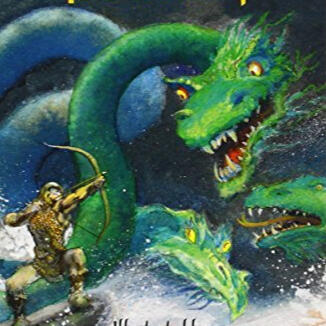
BEOWULF
Michael Morpurgo (2006)
(29/04/2023)
Morpurgo's novelisation of Beowulf removes many of the nuances that I adore - Unferth, swimming, poetry, scop, Beow, Scyld's funeral, etc - and plays the interpretation explicitly safe. Even to the point of including illustrations which rid the reader of their own relative ideation of the characters, striving to paint an accurate and dogmatic image of every aspect of the text. The prose is fantastic, though, and aims to adapt the narrative style and flow of the poem in a way universally understandable. It's trope-laden (even moreso than the defining source material), and removes many of the graces of the original, but is perhaps the best novelisation I've experienced so far.This was a quick summarisation of my thoughts, as I'm researching Beowulf for my upcoming trilogy of grimdark fantasy epic poems: KING MONSTER.
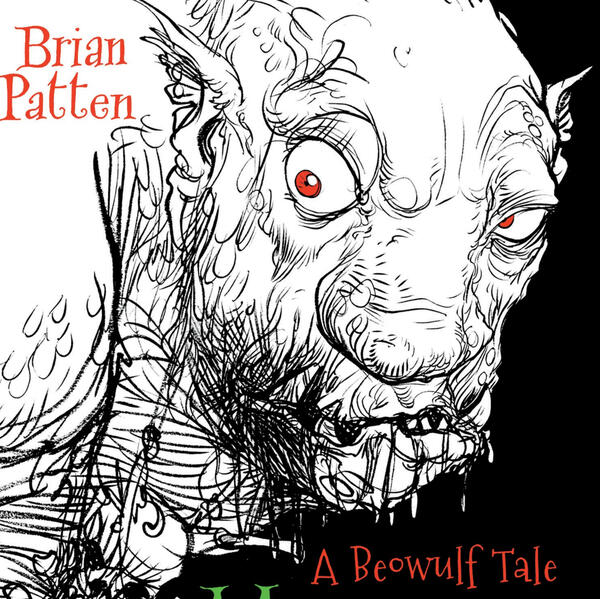
MONSTER SLAYER
Brian Patten (1999)
(29/04/2023)
I read this while researching for King Monster. Grendel's depiction is derivative, and the three riddle stones - while interesting - add little mechanically or thematically to the original narrative. Additionally, it concludes 2/3 through the story, furthering the erasure of the dragon that has became popular since Tolkien. It also ends anti-climactically, and Hrothgar is boring. There is no Unferth showdown, and many characters are removed to simplify the structure for children. That's good, as it rapidly conveys many of the story-beats during the Grendel and Hag segments, but removes so much in the process while adding tropes I feel needn't be there.Sorry if this didn't make much sense, I'm just writing my thoughts rapidly.
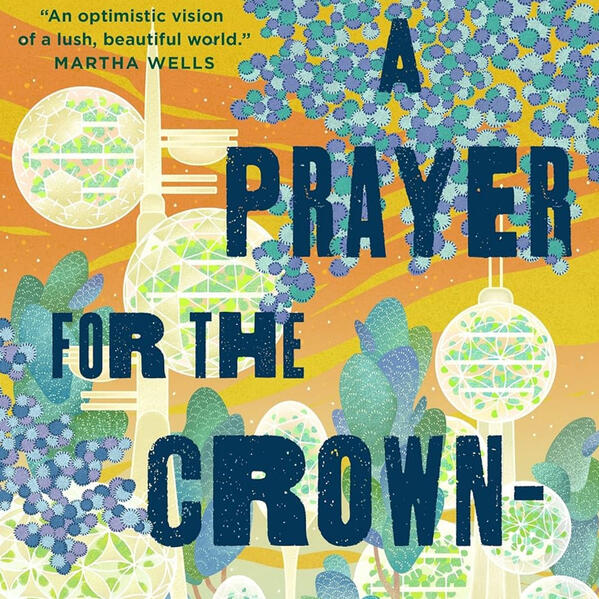
A PRAYER FOR THE CROWN-SHY
Becky Chambers (2022)
(04/03/2023)
While not as effective as the first book, A Prayer nonetheless delivers on the characterisation that novel set up. I'm eager to see where we go from here, as it definitely felt like a build up. While this conclude at a trilogy? I'm unsure - there's so much potential for this sparse yet evocatively colourful world, and I've enjoyed every second I've spent in it.

THE HIDDEN SPRING
Mark Solms (2021)
(28/02/2023)
Introduction
Solms introduces this (beautiful looking) book with his rationale for exploring the origin point for our consciousness. He disagrees with the general consensus of the cerebral cortex seating consciousness, and instead argues it 'arise from a part of the brain that humans share with fishes.'NOTES CONTINUE HERE

COINCIDANCE
Robert Anton Wilson (1988)
(26/02/2023)
I wish I'd known this centered around Joyce's Finnegans Wake so much before going in, as I would have read it beforehand. As it stands, I'll be returning to this book upon reading that one; such is the charismatic, intellectual power of this book. At times as absurd as it is prophetic, it encapsulates on many of the liberties of the counterculture movement to provide a truly mind-boggling exploration of synchronicity. One day, I hope to rival it - God knows I have the materials, already. Another stellar book from Robert: I may bump it up upon re-read, we will see.---Part One
The essay on synchronicity and isomorphism in Finnegans Wake is equal parts absurd and inspiring. Some of the connections are genuinely profound, others seemed stretching - but what do I know? I've only just ordered the novel, now. Either way, I've been recognising more and more overlaps between the writings of Joyce and I. Portrait and Dubliners are also on the way. Either way, I appreciate this essay. It's a brilliant demonstration of synchronicity and strange loop recursiveness (and, perhaps, some apophenia).
Werewolf Bridge kicked ass for a lot of reasons.
He opens The Motherfucker Mystique discussing his first book - the Playboy one on naughty words - and now disappointed he is with it's final form. This chapter comprises some of the erudite and witty parts cut from that book at the editor's request. I love the anecdote on Stagolee - I've got a tombstone disposition and a graveyard mind. I'm a bad motherfucker and I don't mind dyin’ - and Shine - You're the king of the ocean, the king of the sea, But you gotta be a swimmin' motherfucker to outswim me particularly entertaining.
How to Read / How to Think is rife with fascinating and cutting commentaries, moments that make one stop and reconsolidate what they know with what they're learning.It is so short because No Governor is a very tiny magazine and cannot print long pieces; it is so mordant because I wrote it at a time when I was beginning to suspect that the younger generation of Americans are so ill-educated that one virtually has to write in baby-talk before they can understand anything one is saying.and, of course, funny. He dissects interpretation - the purely superficial and the extracted latent content - via Henry James's The Turn of the Screw
I'm just going to make a collage of my favourite quotes:Yeats's great poem on the 1916 Irish rebellion contains the line, "A terrible beauty is born." Stress "terrible" when reading it aloud; then stress "beauty." Which meaning did Yeats intend? Or did he intend both? [...]
Blake wrote, "May God us keep / From single vision & Newton's sleep." Leaving aside for the moment his animus against Newtonian mechanics, could "single vision" refer to what I have been calling mechanical reading and mechanical thinking? [...] "To ascribe predicates to a people is always dangerous.”
—Nietzsche, unpublished note, 1873 [...]
"all women," "all men," "all plumbers," etc. are fallacies because the world consists of a phalanx of individuals. In Korzybski's handy notation, we never meet the groups; what we encounter are woman1 – woman2 – woman3 – etc. [...]
One Zen master, when asked what Zen "is," always replied with the single word, "Attention." What the hell did he mean? [...]
In San Francisco I read a review of John Huston's recent movie, Victory, which described it as "exciting." In the Irish Tribune yesterday I read another review which described it as "dull." Is the excitement or dullness "in" the movie, or was it in the nervous systems of the reviewers?
Colin Wilson argues that when we say, "Life is boring and meaningless," it means that we are boring and meaningless. Can there be any truth in this? If it requires work and re-reading etc. before the reader finds the clues that reveal the narrator is (consciously or unconsciously) deceptive, is that "unfair" to the reader? Is it unfair to try to provoke the reader to work and thought? Should all books be for the lazy?Kaddish is a fantastic closer to chapter one.Lord Lord Lord caw caw caw LordPart Two
He begins chapter two with a lengthy, incredible sequel essay concerning Joyce once more. Then he segues into three essays from The Realist - which comprises insulting Death of a Salesman (I can't disagree with his takes) and praising works which stare death, reality, and life in the eyes (Saturn Devouring his Sun, King Lear, Moby Dick)."All these people who go around protesting against the nuclear tests," a friend of mine once said to me—"they never have the guts to face the problem in the only place where it can be handled—by facing the thing in themselves, in all men, that wants the Bomb to go off."The Marat/Sade essay is viciously good. I didn't understand large swathes of it, unfortunately (unacquainted with the subject matter), but have had my interest piqued quite a bit.
Equally fascinating is Wilson's portrayal of Marilyn Monroe as 'one of the great artistic engineering feats of U.S. history' - how Norma Jeane Mortenson evolved herself through force of will into the 'Goddess' of design she envisioned (and how this façade concealed the real Normal, nonetheless suffering). This spirals into, ostensibly, a series of conspiracies involving Leary, the Kennedy's, and LSD rife with mafia involvement. Believe what you want of it - these are only coincidances, of course.
The following chapter, The Physics of Synchronicity is perhaps the best chapter yet. In it, he denotes numerous examples of coincidences. Now, what astounded me and my father, is that when I read the part on Freud and Jung's synchronicity experience in 1909, me and my dad experienced a moment of 'coincidence' involving the postman. My father was quick to reject it as coincidence, but I broke down the chance until he was willing to concede the probability of what happened happening as it did when it did had a higher probability than he first assumed.
Only to return to the text and find similar incidents of people experiencing coincidence midway through reading the same anecdote. Uncanny.
Kammerer's work seems fascinating, it's a shame Jung and Pauli never read his work -He concluded that coincidence represents an acausal principle in nature, as distinguished from the causal principles science had hitherto studied. He compared the acausal coincidental principle (ACOP, we shall call it for short) with gravity, noting that gravity acts on mass, while ACOP acts on form and function. [...] The ACOP (acausal coincidental principle) Jung and Pauli called synchronicity because they assumed it was at right angles to causality and structured in space, not time. That is, the synchronicities (from the Greek, syn, together, and chronos, time) happen at the same time. The relation between synchronous events, according to Jung, is basically psychological. [...] ACOPs are by no means only synchronous. They are often separated by days or even years.He then goes onto discuss Bell's theorem on entanglement and causality.Honegger believes that the right hemisphere ego consciousness is continually trying to assert its existence and communicate with the left hemisphere ego, which Western adults think is their only ego. The right-side ego usually communicates via dreams, as noted by Freud and Jung, but if the left-sided ego remains deaf to these messages, the right hemisphere creates Freudian slips or hysterical symptoms to get the ego's attention.Sounds remarkably like the Urizenic hemispheral disconnect denoted by John Higgs in his book Blake vs The World which I've just finished reading. All of my reading is synchronised by this point.This would explain a great many of the ACOPs collected by Jung, Kammerer, Koestler and others; it might even explain the Hardy-Harvie experiment, in which randomizing led to more order rather than more disorder. And it throws all of the data of parapsychology into a new perspective: instead of separate paranormal abilities such as ESP, precognition and telekinesis, there might just be one ACOP—acausal coincidental principle—appearing to us in many forms to which we give those names. [...] According to Honegger, we should analyze such ACOPs the way Freud and Jung analyzed dreams to see what unconscious messages they contain.I agree profusely. In every way.
For over a decade, I've analysed the latent and manifest content of my life's story as if a dream, and have discovered plenty in the process.The uncanny, then, is just the right hemisphere's way of violently . capturing our attention. Of course, recent evidence suggests that the right brain-left brain dichitomy is not as absolute as once believed; Honegger's model is only the latest, not the last, word on this subject.This can't be ignored: the division is not as dimetric and absolute as believed, but there is still a division of labour where some faculties are concerned. For instance, speech comprehension and production (Wernicke/Broca areas (which, granted, are often found in the left hemisphere)).Part Three
I absolutely need to return to the pertinent essays upon reading Finnegans Wake.
The essay on religion is insightful, least of all because I was born into the Mormon (never truthfully believed) religion and am, myself, ordained by the Universal Life Church (and the Church of Dude). Quite coincidental, eh?Oddly, the belief that the world is on the edge of a revival of goddess-worship has been expressed by some eminent scholars, including historian Arnold Toynbee, psychologist Carl Jung, poet Robert Graves and anthropologist Joseph Campbell. Witches know this and are fond of quoting these authorities when being interviewed on TV.And here we are - 2023!The Javacrucians, a group which looks suspiciously like a parody of the Rosicrucians, has selected the less-controversial caffeine as its sacrament. It also has the simplest theology in history, teaching that one thing only is necessary for salvation, the American Coffee Ceremony—a variation on the Japanese Tea Ceremony. This is performed at dawn, and you must face east, towards the rising sun, as you raise the cup to your lips. When you take the first sip, you must cry out with intense fervour, "GOD, I needed that!" If this is performed religiously every morning, Javacrucians say, you will face all life's challenges with a clear mind and a tranquil spirit.Wiser words were never spoken.
Likewise hilarious are the Society of Fred Mertz (wherein the founder believes all wisdom can be attained by rewatching Love Lucy and paying extra attention to what Fred says), and the Camp Crusade for Cthulhu -The Campus Crusade for Cthulhu generally appears on the scene at any university where the Campus Crusade for Christ is well entrenched, and is mostly devoted to annoying the former. [...] The Campus Crusade for Christ has bumper stickers which members flaunt on their automobiles declaring "I Found It." The Cthulhu-ists have their own bumper stickers saying "It Found Me."And I genuinely laughed at this part of Robert's breakdown of the Discordian Society -Discordianism shuns dogma but has one catma, the Syadastan Affirmation, which reads,
"All affirmations are true in some sense, false in some sense, meaningless in some sense, true and false in some sense, true and meaningless in some sense, false and meaningless in some sense, and true and false and meaningless in some sense."
Discordians call this the Free Mantra—unlike the Transcendental movement, they charge no fees—and insist that if you repeat it 666 times you will achieve Spiritual Enlightenment, in some sense.This chapter was hilarious.Part Four
Again, I NEED to return to this book upon reading Finnegans Wake. I have some other Joyce books lined up for me, as I never realised how alike we are in sombunall ways. Either way, I yelled, "YES!" when Wilson said Joyce's 'W' denoted a particle aspect and also means 'Mountain' in Chinese - as that's the second thing I thought upon seeing the article, itself (namely due to my recent reading of 19 Ways of Looking at Wang Wei which defined that character among others). The first thing I thought, upon seeing it, was the symbol for PSI [Ψ] which has been repurposed to mean Wave Function Ψ in Quantum Mechanical terms. How interesting a coincidence; slightly frustrating that △ is used by Joyce, instead, to stand for the wave aspect of matter, though.Joyce was paying close attention to modern physics while writing FW . On page 51 he alludes to Heisenberg's Uncertainty Principle: "that sword of certainty which would identifide the body never."I've not even read the novel and know a masterpiece essay of analysis and investigation when I see one. Absolutely stellar; every page yells fascination.The curious reader may pursue this isomorphism further in my book Prometheus Rising , (Hilaritas Press, 2016) or simply by meditating on the fable of Snow White and the Seven Dwarfs. [...] Joyce, an anarchist, probably knew the favorite English anarchist joke, which was to urge people to vote for Guy Fawkes, “the only man to ever enter Parliament with honest intentions.”And then we are taken to an interview with Robert Anton Wilson included by the editors -The word “Coincidance,” is a Joycean word and signifies the dance of coincidences in nature similar to the Jungian concept of synchronicity, or an acausal event unlikely to occur by mere chance. [...]There are two opposites that keep conflicting all through Finnegans Wake : one represents space and dogma and the other represents time and music. The spaceman is always trying to prove there is something wrong with the timeman. The timeman feels that both of them are necessary and he is not trying to prove that there is something wrong with the spaceman. [...]Well, Guerrilla Ontology is a term I coined several years ago. I recently found out that Edward de Bono has been teaching the same sort of thing for many years. He calls it lateral thinking . What it amounts to is: most thinking is a continuation from your initial premise and you draw more and more conclusions which is the way a system of mathematics develops. But mathematicians discovered over a hundred years ago that there is another way of thinking: that’s to start off from a different set of assumptions and build up a different system which is what de Bono calls lateral thinking. It’s to get out of the set created by your original assumptions and move sideways, as it were, and start from different assumptions and build a different system. That’s what I’m always doing in my books. I call it Guerrilla Ontology. [...]Interviewer: You’ve talked about loops. How does one break out of his or her loop and change their reality?
Wilson: By doing what you’re afraid of. That is one of my basic principles – progress is only made by what Kierkegaard called a leap in the dark. He had a different meaning than me, now that I think of it; he didn’t mean quite what I mean. He leaped into a very snug, safe place. But the real leap in the dark is to try to find out what has conditioned you all your life and how much of that you can kick over, and try to become your own opposite.
Getting back to Nietzsche, I think that’s really what Nietzsche was trying to do. I think one of the funniest things about Nietzsche is the realization that he was a very shy, timid, celibate man who was so nervous and sensitive he couldn’t even drink coffee, much less alcohol. Most of Nietzsche’s books are an attempt to shake himself up. He was also a very compassionate man. [...]Literal artificial languages like Esperanto and Ido, and so on, have never caught on because the time wasn’t right for them. They were premature. My hunch, and it’s just a hunch, is that they are not going to catch on. I think the international language will emerge organically from computer networking. It will be a computer language.I'll end on that last quote. I learned a large amount of Esperanto, and outside of equipping me with the psycholinguistic skills to understand various facets of learning a language, it hasn't served me much and mostly slipped into willing decay in my memory storage.
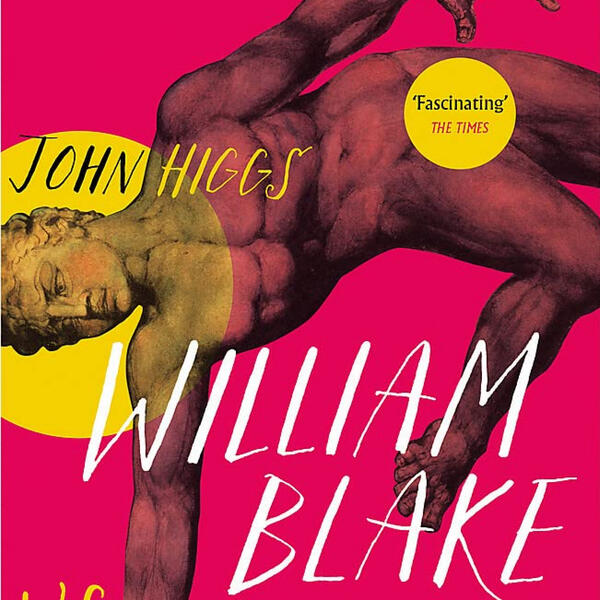
WILLIAM BLAKE VS. THE WORLD
John Higgs (2021)
(25/02/2023)
Apologies for this lengthy 'review-cum-summary' (extended throughout the comments) but I'm working on an extensive project involving Blake. Were Higgs to complain and ask it removed due to piracy concerns... Well, I might just agree! Nonetheless, this is a portfolio of my thoughts sprinkled between quotations from this incredible, intensive, imaginative work of art that required an...
Indeterminable amount of work and passion
(and now requires your money: go buy this book and enjoy)!

19 WAYS OF LOOKING AT WANG WEI
Eliot Weinberger (1987)
(23/02/2023)
I read this a few months ago and thought I'd drop a line.What we have here is a fantastic understanding of poetry as a prism (or language, rather). And how, with minute adjustment, a mode of communication can be altered drastically. We have a few dozen interpretations of one 'simple' poem, and how they all vary in their effectiveness.
Simply brilliant.I also talked to Najwan Darwish & Kareem James Abu-Zeid shortly after reading this. The latter is currently working on a similar project (a number of translators approaching one source to display differing perspectives) which I'm keen to read!

A PSALM FOR THE WILD-BUILT
Becky Chambers (2021)
(23/02/2023)
I'll keep this short: buy A Psalm for the Wild-Built.
I bought this because of the cover and the title. It cost more than the usual price, but something about the premise convinced me it needed to be read. And it needed to be read. This is an extremely short read, and so someday I'll return to this with a comprehensive review. I ordered the second book at chapter three. I need more books like this in my life.
Absolutely phenomenal. Witty, funny, contemporary yet never condescending. I expected Asimov, Lem, and got a fresh Hesse. Three Laws be damned, here be the Threefold Way! Haha.

IN PRAISE OF SHADOWS
Junichiro Tanizaki (1933)
(19/02/2023)
"The purist may rack his brain over the placement of a single telephone, hiding it behind the staircase or in a corner of the hallway, wherever he thinks it will least offend the eye. [...] And the toilet is the perfect place to listen to the chirping of insects or the song of the birds, to view the moon, or to enjoy any of those poignant moments that mark the change of the seasons. Here, I suspect, is where haiku poets over the ages have come by a great many of their ideas."In Praise of Shadows is a de-light-ful and illuminating essay into minimalism, change, time, and the beauty of things when shadow-cast. And therein, as he hints to with the Einstein comment at the end: the nature of relativity."I wrote a magazine article recently comparing the writing brush with the fountain pen, and in the course of it I remarked that if the device had been invented by the ancient Chinese or Japanese it would surely have had a tufted end like our writing brush. The ink would not have been this bluish color but rather black, something like India ink, and it would have been made to seep down from the handle into the brush."Namely, he discusses relativity in the artistic and 'beauty' sense."Sometimes a superb piece of black lacquerware, decorated perhaps with flecks of silver and gold—a box or a desk or a set of shelves—will seem to me unsettlingly garish and altogether vulgar. But render pitch black the void in which they stand, and light them not with the rays of the sun or electricity but rather a single lantern or candle: suddenly those garish objects turn somber, refined, dignified. [...] "I was once invited to a tea ceremony where miso was served; and when I saw the muddy, claylike color, quiet in a black lacquer bowl beneath the faint light of a candle, this soup that I usually take without a second thought seemed somehow to acquire a real depth, and to become infinitely more appetizing as well. ""And how these things were radically altered during the Reconstructionist era of Japan, whereupon they opened their borders to the West. This rapidly accelerated the state of their country in every respect (industrially, economically, psychologically, culturally, etc)."If my complaints are taken for what they are, however, there can be no harm in considering how unlucky we have been, what losses we have suffered, in comparison with the Westerner. The Westerner has been able to move forward in ordered steps, while we have met superior civilization and have had to surrender to it, and we have had to leave a road we have followed for thousands of years. The missteps and inconveniences this has caused have, I think, been many. If we had been left alone we might not be much further now in a material way than we were five hundred years ago. [...] They would have been no borrowed gadgets, they would have been the tools of our own culture, suited to us. One need only compare American, French, and German films to see how greatly nuances of shading and coloration can vary in motion pictures.
[...] how much better our own photographic technology might have suited our complexion, our facial features, our climate, our land. And had we invented the phonograph and the radio, how much more faithfully they would reproduce the special character of our voices and our music. Japanese music is above all a music of reticence, of atmosphere. When recorded, or amplified by a loudspeaker, the greater part of its charm is lost. [...] These machines are the inventions of Westerners, and are, as we might expect, well suited to the Western arts. But precisely on this account they put our own arts at a great disadvantage."The dissociating, alienating shadow this has cast upon Japan as a nation is still seen today in its various crises, mental health issues, and capitalist rubber-banding (they use fax machines and work overtime in a way that has been heavily documented)."I suppose I shall sound terribly defensive if I say that Westerners attempt to expose every speck of grime and eradicate it, while we Orientals carefully preserve and even idealize it. Yet for better or for worse we do love things that bear the marks of grime, soot, and weather, and we love the colors and the sheen that call to mind the past that made them."Parts reminds me of Akutagawa, Lafcadio Hearn, and Osamu Dazai - a morose, melancholic meditation on a merger between two hemispheres of a planet hitherto dislocated."I have always thought that hospitals, those for the Japanese at any rate, need not be so sparkling white, that the walls, uniforms, and equipment might better be done in softer, more muted colors."He also takes numerous opportunities to throw shade at the West in a way I found hilarious (and only occasionally debatable)."Paper, I understand, was invented by the Chinese; but Western paper is to us no more than something to be used, while the texture of Chinese paper and Japanese paper gives us a certain feeling of warmth, of calm and repose. Even the same white could as well be one color for Western paper and another for our own. Western paper turns away the light, while our paper seems to take it in, to envelop it gently, like the soft surface of a first snowfall. [...] The Chinese also love jade. That strange lump of stone with its faintly muddy light, like the crystallized air of the centuries, melting dimly, dully back, deeper and deeper—are not we Orientals the only ones who know its charms? We cannot say ourselves what it is that we find in this stone. It quite lacks the brightness of a ruby or an emerald or the glitter of a diamond. But this much we can say: when we see that shadowy surface, we think how Chinese it is, we seem to find in its cloudiness the accumulation of the long Chinese past, we think how appropriate it is that the Chinese should admire that surface and that shadow."And throughout is a sense of intimate perception, of contemplation over the ordinary and how this 'ordinary' changes with time in space."In making for ourselves a place to live, we first spread a parasol to throw a shadow on the earth, and in the pale light of the shadow we put together a house. There are of course roofs on Western houses too, but they are less to keep off the sun than to keep off the wind and the dew; even from without it is apparent that they are built to create as few shadows as possible and to expose the interior to as much light as possible. If the roof of a Japanese house is a parasol, the roof of a Western house is no more than a cap, with as small a visor as possible so as to allow the sunlight to penetrate directly beneath the eaves."---"[...] we Orientals tend to seek our satisfactions in whatever surroundings we happen to find ourselves, to content ourselves with things as they are; and so darkness causes us no discontent, we resign ourselves to it as inevitable. If light is scarce then light is scarce; we will immerse ourselves in the darkness and there discover its own particular beauty. But the progressive Westerner is determined always to better his lot. From candle to oil lamp, oil lamp to gaslight, gaslight to electric light—his quest for a brighter light never ceases, he spares no pains to eradicate even the minutest shadow.
[...]
And so as time goes by, old people give up the cities and retire to the country; and yet there is not much cause for hope there either, for country towns are year by year going the way of Kyoto, their streets strung with bright lights.
[...]
But do not think that old people are the only ones to find fault. The author of the “Vox Populi Vox Dei” column in the Osaka Asahi recently castigated city officials who quite needlessly cut a swath through a forest and leveled a hill in order to build a highway through Minō Park. I was somewhat encouraged; for to snatch away from us even the darkness beneath trees that stand deep in the forest is the most heartless of crimes."

QUANTUM PSYCHOLOGY
Robert Anton Wilson (1990)
(19/02/2023)
Brilliant book that digresses in academic research on occasion (but one can forgive an individual for reaching the same conclusions as another. We'll synthesise concurrent ideas into refined ones with time). The prose was sharp, witty, and as economic as possible (this is a rather succinct book for its content). Nonetheless, the formatting of this edition was atrocious, with non-justified text resulting in hanging letters and broken clauses. This isn't reflective of the work, however, which is as mind-whirling as this kind of book can get. For readers of Hofstadter, Rovelli, etc!---The Introductionreeled me in with discussions of multi-verses, mind-body problem, and individuals with a predisposition towards synchronicity/placebo. Here, he suggests the phrase 'psychosomatic unity' as an alternative solution to the mind-body problem, with it operating like a 'spacetime continuum,' the divisions redundant. He then introduces 'The Law of Octaves' and the import of imprinting/conditioning/learning, before moving onto the 'knowledge doubling curve' and eventuality 'singularity' - most of this is known to me naturally; it's always reassuring to be told I'm not crazy. People like Wilson and Hofstadter (to speak nothing of the great philosophers) have made this life far more bearable.Wilson then goes onto denote the concept of 'noise' in life - semantic, printed, psychomimetic, etc - instances where communication and connection is distorted; interference of perception.Emic realities comprise the 'imagined realities' or 'social realities' that follow game theory rules, such as language games, communication, symbols, etc. Whereas the supposed 'etic reality' is the 'objective' singular reality most believe we live in. It's impossible to discuss, demonstrate an etic reality without using the emic reality. I feel this strongly.Part I1. Kafka 'Before the Law' parable and accompanying anecdote of a Zen Roshi and his beguiled disciple. Brilliant introduction to... A lot of things - Coppenhaganism, interpretation, futility, the veil, and even the impossibility of understanding an etic reality.2. Deep reality, and how we cannot find one (which does not convey the same thing as 'there is no deep reality') in relativity to the Copenhagen interpretation of wave function collapse. Our nervous system operates as an instrumental sensor for reality, and obfuscates complete understanding. Makes me think of Metatron, the veil, and imagined realities. "A poet does not register the same spectrum as a banker," might be why I've spent a decade building my prism; a portfolio of paradigms to switch in-and-out of (with occasional distress). I likewise appreciate his deconstruction of 'meaninglessness' or 'noise.' What's amazing about Wilson's philosophy, so far, for me, is how it doesn't completely de-realise or de-stabilize for acceptance; on the contrary, it's rather liberating by way of limitation. But takes a lot of thought.3. He opens by conferring that one would better learn neuroscience to understand quantum mechanics than basic physics, and I'm inclined to agree. Every page following is genius - how these perceptual gambles (Transactional Psychology) relate to Disinformation Systems, UFOs, Lepufology, and even Cryptozoology. I also appreciate his relaying of what a 'reality tunnel' comprises, though I assumed based on etymology. Fascinating stuff.4. Briefly and (occasionally) succinctly delivers the idea of everything having deeper meanings depending on a point of view. Mental maps will always fail in certain areas unless they can map out every single aspect of the subject, and that's impossible, so we compartmentalize information. Likewise, our statements and symbols are only microcosmic abbreviations of the macrocosm that is reality and will never completely demonstrate true, chaotic, or nebulous meaning. I'm likely phrasing that poorly, but I understand what Wilson means.5. This chapter concerns our having 'two heads' and touches on themes of self-referentiality and incompleteness, a'la Russel & Hofstadter (or my short story collection, Deliriums) in a way that makes me think of Zeno's paradoxes of motion.6. How our tools of relative measurement (sensorium, nervous system, brain) are ordained by their own self-referentiality and therefore condemned to bias, or nicely: oriented/calibrated towards different ways of experiencing. This makes me wonder whether the influx and availability of art has altered the strange loop levels of contemporary human brains. This really amounts to: what appears self evident might not hold under scrutiny.7. Concerns strange loops, infinite regression, and the applicability and viability of quantum psychology in day-to-day interaction. I particularly liked his dismantling of Aristotelian yes/no thinking into a more mathematic modus. I know sombunall of what he's discussed so far, but appreciate both the reaffirmation and his vocabulary and sources. Brilliant.Part II8. More or less builds on the previous concept of quantum logic - IE breaking the binary and recognising a continuum. "People ignore the quantum maybe because they have largely never heard of quantum logic or Transactional Psychology, but they also ignore it because traditional politics and religion have conditioned people for millenniums — and still train them today — to act with intolerance and premature certainty."9. Concerns the 'Seven Forbidden Words' resulting from a causal spiral of self-referentiality wherein they're deemed indecent and then believed and supported as indecent by audiences that therein maintain the illusion of their indecency. Wheels within wheels. This is a metaphor for a lot more than seven naughty words, of course, but also political belief and identity persuasion.10. Then he discusses how people act upon their interpretation of words (despite interpretation being governed by relativity and game language). For instance, the shooting of Rushdie, the Londonderry/Derry incident, and a circumstance involving a man overreacting to his dog being called a 'fussy mutt.'11. Shortest yet, basically summarises how there is no equal to 'the universe' as everything comprised within it is, well, within it. Any abstraction, philosophy, religion, or concept, will be governed by being contained within the system it is trying to judge. It will be a neuro-ideology first and foremost, forever.12."Because the snake's umwelt or reality-tunnel differs so fundamentally from mammalian reality tunnels, friendships between humans and snakes occur much less frequently than friendships between humans and mammals.
The belief that the human umwelt reveals "reality" or "deep reality" seems, in this perspective, as naive as the notion that a yardstick shows more "reality" than a voltmeter, or that "my religion 'is' better than your religion." Neurogenetic chauvinism has no more scientific justification than national or sexual chauvinisms," is pure goddamn genius. I'm learning quite a bit of trivia to help with projects down the line (while getting my head blown every few pages, as I'm sure he'd like to hear).13. This lengthy chapter details E-Prime as a functional language, and I completely see the benefits. I've tried, throughout my life, to aim for that level of precision - but it's difficult to do that while permitting an un-obstructed stream of consciousness. "Even Aristotle, despite the abuse he has suffered in these pages, had enough common sense to point out, once, that "I see" always contains fallacy; we should say "I have seen." [...] Aristotle only noted that "I see" actually means "I have seen." Modern neuroscience reveals that "I see" (or "I perceive") actually means "I have made a bet." In the time between the arrival of signals at our eye or other receptor organ and the emergence of an image or idea in our brains, we have done a great deal of creative "artistic" work. We generally do that work so fast that we do not notice ourselves doing it. Thus, we forget the gamble in every perception and feel startled (or even annoyed) whenever we come up against evidence that others do not "see" what we "see.""Part III14. Concerns (though he doesn't list these people) the Rosenthal/Golem effect, performance anxiety, and self fulfilling prophecy, and how those symbiotic interactions can create a consequence via antecedent seeding (an ouroboros of causality, whereupon 'blame' is spiralled). Telling someone they are stupid can make them believe it can make them act it can make more people tell them they are stupid.15. This part then follows on from that, discussing psychosomatic medications, placebos, and the self-fulfilling prophecy nature of them; and how these spontaneous remissions are hardly documented (as of 1900), despite their prevalence. There is also a huge amount of optimism required on behalf of the individual to overcome their malady. Ends with a brief introduction to metaprogramming.16. How our supposed 'objective' (etic) realities are imposed upon by our imagined (emic) realities. How reality-tunnels differ across cultures, and how self-fulfilling prophecy can break from reason. Surety brings ruin.17. The necessity of 'psychosomatic unity' is as necessary to the mind body division RE mental health, placebo, or existence, as 'spacetime' was to the dichotomy of space and time. Likewise, Neuropeptides operate both as hormones and neurotransmitters, acting somewhat like photons in quantum mechanics (waves and particles). "As O'Regan points out, op. cit., we now have reason to believe that almost all medical treatment throughout almost all history worked on placebo principles. In other words, modern biochemistry indicates that before the discovery of antibiotics, (i.e., before the 1930s) virtually all the medicines used by doctors had no actual effectiveness. The patients got better, when they did, because the doctors believed in their useless potions and the patients acquired the "faith" from the doctors.
This last paragraph has more than historical interest. According to the Office of Technology Assessment, only 20 percent of established medical procedure in the U.S. today has been validated in rigorous randomized, double-blind, placebo-controlled studies. 1 Thus, 80 percent of what our doctors do rests simply on precedent and high hopes. Since more than 20 percent of us survive American medicine, a great many placebo cures must still occur daily, as they did before the 1930s."
You are what you eat. Fake it till you make it. Be who you wanna be.Part IV18. How we all possess multiple personalities with their own intrinsic memory storage (I feel this emphatically but Wilson might be overapproximating others, or atleast their self-awareness, which isn't the same thing). He also discusses neophilia and neophilic imprinting within the Oral BioSurvival System of young age (quite like psychosexual development paired with Adorno ideas). The Anal Territorial System which is what it says on the tin and is expressed through dominance, in Wilson's eyes, among other things. The Semantic Time-Bending System is language and its interplay with spatiotemporal variables (and how we can learn this and even manipulate it, even subconsciously).19."Every person lives in a different umwelt (emic reality) but every self within a person also lives in a different reality-tunnel.
The number of universes perceived by human beings does not equal the population of the planet, but several times the population of the planet. It thus appears some sort of miracle that we sometimes find it possible to communicate with each other at all, at all."
He ends the chapter by propounding the connection between EWG or Coppenhaganistic multi-verses and the psychological belief of a self comprised of an assortment of selves - all common sense in the 21st-century (if not someday, if pop culture indicates anything).20. Touches on the 'Sim-Balls' and 'Careenium' (spelt wrong?) of Hofstadter's I Am a Strange Loop without realising it. Discusses nonlocal correlation (makes me think of all the advancements in the field the past three decades, Mirror Neurons, and a ton of other associated concepts. Ah, to speak with him...)"So, then, alternatively, the photon doesn't leave the star 1,000,000 years ago "until" in a sense the result of our measurement today travels nonlocally in time "back" to the star and "adjusts" the photon to correlate with the other photon from the candle.
What did I just say?
Yes, we now have a backward-in-time causality, not necessarily as the literal truth in some Aristotelian sense, but as the only kind of model that makes sense in terms of the data we now have."Amazed me. For as long as I can remember, 'I've felt other people see themselves as a bullet having been launched out of a gun, one day fated to crash into a wall; whereas I see myself and my life as a bullet re-assembling, ricocheting off a wall, and retreating backwards, gaining speed as it reaches the gun and slides into the chamber.' (message I sent to a friend weeks prior to reading this book.)"We have found a strange footprint on the shores of the unknown. We have devised profound theories, one after another, to account for its origin. At last, we have succeeded in reconstructing the creature that made the footprint. And, lo! It is our own."By far my favourite chapter. I can hardly put to words my feelings towards it. This also conforms in my eyes with the big bounce interpretation of the big bang.21. My introduction to Wigner's Friend which serves account for the observer in Schrodinger's Equation. This, Godel's Incompleteness Theorem, and Von Neumann's Catastrophe of the Infinite Regress, are all entirely linked by their self-regressive paradox. Self-fulfilling programming can be a thing if we believe it to be a thing. "Non-Aristotelian logic deals with existential/operational probabilities. Aristotelian logic deals with certainties, and in the lack of certainties throughout most of life, Aristotelian logic subliminally programs us to invent fictitious certainties. That rush for fictitious certainties explains most of the Ideologies and damned near all the Religions on the planet, I think."Part V22. Bell correlation, nonlocal causality (of space AND time), and how to account for Hidden Variables within a 4th-Dimensional interpretation of space."If the computer and brain metaphors have not made the implicate order clear enough for the reader, try another model: a performance of Beethoven's Ninth has all the characteristics of hardware or the explicate order. You can locate it very precisely in space-time — at 9 p.m. on Tuesday at the Old Opera House, say — and if you get these space-time coordinates confused you will miss the performance.
But Beethoven's Ninth also has an implicate, enfolded existence as software, which does not exactly correspond to Dr. Bohm's implicate order but approximates to it. If every printed copy of the symphony could have a date and locale affixed — "We found this one in Lenny Bernstein's summer home on Sunday November 23," etc. — some aspect of the Ninth would still remain non-local because we can't say, exactly, how many heads contain all or part of it.
[...]
Bohm has avoided speculating about this parallel between his math and ancient Oriental mysticism, but others have not. Dr. Capra in The Tao of Physics uses a Bohmian non-local model of quantum theory as the "true" model (ignoring the physicists who prefer EWG or Copenhagenism) and then points out, quite correctly, that (if we accept this as "the only true quantum model") quantum theory says the same things Taoism has always said.
Indeed, Lao-Tse's famous paradox, "The largest is within the smallest" only begins to make sense to an Occidental after she or he has understood what non-local information means in modern physics.
Dr. Evan Harris Walker goes further. In a paper, "The Compleat Quantum Anthropologist" (American Anthropological Association, 1975) Dr. Walker — a physicist, not an anthropologist, by the way — develops a neo-Bohmian Hidden Variable model in which "consciousness" does not exist locally at all but only appears lo

THE COLLECTED SCHIZOPHRENIAS: ESSAYS
Esmé Weijun Wang (2019)
(17/02/2023)
This is an inconsistently fantastic (two fairly applicable words for the diagnosis, I feel) of memoirs concerning life with schizophrenia. She touches on pop culture, medical science, spiritualism, capitalism, socialisation, and many other phrases and buzzwords that ultimately amount to life in an attempt to capture the multi-faceted (like a prism) experiences living with the diagnosis. My favourites included Toward a Pathology of the Possessed, High-Functioning, L'Appel du Vide, and Beyond the Hedge and they all seem to share the same throughline, so perhaps that reflects what I wanted to see in this art. Nonetheless, confident, concise and clear, speaking her emotions and feelings without fear nor overplaying (not that I'm inclined immediately to such judgements, I tend to negate them with understanding - living is hard!)---Chapter 1 - Diagnosis
chiefly concerns why one might seek diagnosis, while acknowledging that the DSM is not an infallible bible handed to us by a God but a mortal instrument, akin to a prism or Rosetta stone for the mind, forever changing and therefore forever changing how we translate ourselves in relation to it. Likewise demonstrates the differences between Schizoaffective and Schizophrenia - all very necessary for the second chapter...Chapter 2 - Toward a Pathology of the Possessed
whereupon Weijun Wang parallels the case of Malcoum Tate with the film, The Exorcist, to demonstrate an emotional understanding towards those with suffering loved ones in an unusual and powerful way. This essay in particular shocked me, and made me think a while. It reminded me of a few cases I studied in criminology - I'm glad Wang takes this approach.Chapter 3 - High-Functioning
denotes why she clings to the term 'high-functioning' due to a stigmatization and demonization of the condition perpetrated by pop culture and societal expectation. She is weary of being labelled or stereotyped - a fear I can understand, least of all because I intend to continue to believe it, frightened of 'derailing' in some way that has been illustrated time-and-time again in media. However, she's aware of how this distancing (don't worry, I'm high-functioning) only further perpetrates this interaction and understanding. Page 51 in particular is just excellent.Chapter 4 - Yale Will Not Save You
concerns itself with schizophrenia within the educational system, how others respond to high-functioning schizophrenics in a normative environment. It features a few sad, relatable anecdotes about mental stigmatization and feelings of alienation.Chapter 5 - The Choice of Children
is about contemplating being a parent in light of such a diagnosis and way of life. I've often thought of the possibility myself. I'm in my late-20s, and feel as though I can't/shouldn't/won't have children as my life has felt like a nightmare. I don't think having children would be nice for them. I can't look after myself, and sometimes struggle with my gecko. Very important chapter; the anecdote regarding Camp Wish and Stuart made me openly cry.Chapter 6 - On the Ward
talks about her experiences (and the experiences of others) living on a ward, particularly involuntarily. Much of it parallels what Jon Ronson wrote in The Psychopath Test (and a few others prior), discussing the deconstruction of state mental health facilities and asylums as well as the conditions of contemporary facilities. In particular, she discusses the alienation, the inability to prove sanity, and the deindividuation as a result of being called a liar or that your memories are faulty. It ends with a note on 5150ing an individual, and the effects it can have on the mind.Chapter 7 - The Slender Man, the Nothing, and Me
discusses how a latent schizophrenic (or one capable of delusions or magical thinking) might interact with disturbing, paranoia-inducing art and be affected. It primarily concerns two stories: the two girls who stabbed a third on the behest of Slender Man; and herself at a young age ardently believing in the Nothing from The Neverending Story. Probably the chapter I have the most contention with, so far, but still good!Chapter 8 - Reality, On Screen
begins with her wanting to see Lucy and spreading the 'humans use 10% of their brain myth' without reiterating it is a myth - so I wonder if Weijun Wang knows it is. The rest of the chapter doubled down on the discussion of delusions and watching television, how the two intersect. Quite a few parts I didn't feel too sure about - but I'm glad she's sharing her own lived experience and opinion.Chapter 9 - John Doe, Psychosis
is about her experienced with PTSD, particularly with an ex partner, and its comorbidity with her schizoaffective diagnosis.Chapter 10 - Perdition Days
concerns Cotard's syndrome, Capgra's delusion, and feeling dead while alive. A lot of relatable stuff; I almost can't admit or accept a lot of it is delusional.Chapter 11 - L'Appel du Vide
discusses suicide in mentally anguished individuals, paying homage to photographs as memento mori and touching on Kurt Cobain. I'm intrigued by the prospective Golden Gate Suicide Net("I once attended a meeting at San Francisco City Hall at which people were debating whether to install a “suicide net” beneath the Golden Gate Bridge, which would hopefully deter the suicidal and catch attempted suicides.")and think I might be pro-net, but also feel it'll cast a constant reminder as to what it's deterring, which might inspire further jumping... I'm unsure."My mother-in-law told me one Christmas, after another episode of psychosis, that I was like Peter Pan: “You’ve just lost your shadow, and you’ll find a way to stitch it back to your foot.” I marveled at the congruency between that familiar story and the belief that, in death, the soul leaves through one’s feet. I wondered if I’d literally lost my soul as I photographed the silhouetted marks that my body left on the world."Chapter 12 - Chimayo
confers a sense of hope regarding treatment and prognosis, through words of Jean d'Arc and religious symbolism. Also directly confronts Lyme disease and her difficulties treating it.Chapter 13 - Beyond the Hedge
is by far one of the most fascinating memoirs in this book, to me. She touches on clairvoyance, or prophetic knowledge, precognition, etc, and its overlap within the Schizo-community. Essentially: schizophrenia is a lot more historically and mystically interesting than modern day psychology (or rather symptomatic psychoanalytical diagnosis) likes to belittle it down to. Most of the other non-fiction books I've read as of late appears to follow the same belief, even if the internet and pop culture is smitten without question.The second-century Gnostics claimed that among ordinary Christians lived the pneumatikoi, elite believers who possessed spiritual wisdom beyond that of their peers. The pneumatikoi could speak in tongues—a phenomenon called glossolalia—as evidence of being possessed by the Spirit; though occasionally intelligible, glossolalia “for the most part … consisted of frenzied, inarticulate, incoherent, ecstatic speech.” The psychiatric term for inarticulate, babbling speech is “schizophasia,” or “word salad,” and it is one of the more visible symptoms of schizophrenia.The rest of the chapter denotes 'the liminal' and its reference to the 'collective unconsciousness' before ending on an uplifting note of recovery and convalescence amid turmoil -"And yet liminal experiences, as Bri describes them, are not necessarily unusual or gifted to a special few. Dreams are the most common expression of liminality—more common than, say, seeing or feeling the presence of saints, angels, or God, which are all liminal experiences. To work with the liminal is to probe the notion of what is real versus imaginary, or even psychotic. In the beginning of Bri’s Beyond the Hedge workbook, she writes, “Anyone who wishes to gain proficiency in liminal work is going to have to become comfortable with the unseen. One of the best expressions of this are the words of Jesus Christ to St. Thomas: ‘Blessed are they who did not see, and yet believed.’” Working with the liminal involves working with faith.Bri says it this way: “I think that when we’re talking about … schizophrenia, we really want to be clear about what is rational, two plus two equals four; what is irrational, two plus two equals spaghetti sauce; and what is nonrational…. A lot of people who are diagnosed with schizophrenia that I have spoken with, that I have worked with … are not irrational at all.”---I'll conclude with this important segment:"I’m still trying to figure out what “okay” is, particularly whether there exists a normal version of myself beneath the disorder, in the way a person with cancer is a healthy person first and foremost. In the language of cancer, people describe a thing that “invades” them so that they can then “battle” the cancer. No one ever says that a person is cancer, or that they have become cancer, but they do say that a person is manic-depressive or schizophrenic, once those illnesses have taken hold. In my peer education courses I was taught to say that I am a person with schizoaffective disorder. “Person-first language” suggests that there is a person in there somewhere without the delusions and the rambling and the catatonia.But what if there isn’t? What happens if I see my disordered mind as a fundamental part of who I am? It has, in fact, shaped the way I experience life. Should the question be a matter of percentages of my lifetime, I’ve spent enough of this lifetime with schizoaffective disorder to see it as a dominant force. And if it’s true that I think, therefore I am, perhaps the fact that my thoughts have been so heavily mottled with confusion means that those confused thoughts make up the gestalt of my self; this is why I use the word “schizophrenic,” although many mental health advocates don’t.
[...]
There might be something comforting about the notion that there is, deep down, an impeccable self without disorder, and that if I try hard enough, I can reach that unblemished self. But there may be no impeccable self to reach, and if I continue to struggle toward one, I might go mad in the pursuit."(It's amazing how much the E-Prime of Quantum Psychology (R.A.W) parallels the person-first approach argument: "In the language of cancer, people describe a thing that “invades” them so that they can then “battle” the cancer. No one ever says that a person is cancer, or that they have become cancer, but they do say that a person is manic-depressive or schizophrenic, once those illnesses have taken hold." This more or less denotes R.A.W's argument for E-Prime.)

WITTGENSTEIN'S NEPHEW: A FRIENDSHIP
Thomas Bernhard (1982)
(05/02/2023)
I'll keep this brief, as the novella itself is short and certainly deserving of a read.For let us not deceive ourselves: most of the minds we associate with are housed in heads that have little more to offer than overgrown potatoes, stuck on top of whining and tastelessly clad bodies and eking out a pathetic existence that does not even merit our pity. But the day will come when I really will visit Paul, I thought, and I made some notes about things that I intended to discuss with him, things that I had been unable to discuss with anyone for so many months.Borderline obnoxious, histrionic, but nonetheless sympathetically endearing; just as I like it. I can see where Haber got his influence for his Saint Sebastian's Abyss and Reinhardt's Garden. Likewise, it directly references Wagner and Nietzsche, leading me to believe this is written in the style of their friendship - Ecce Homo comes to mind.
It reminds me of a poem, by T.S. Elliot: The Hollow Men -We are the hollow men
We are the stuffed men
Leaning together
Headpiece filled with straw. Alas!
[...]
This is the way the world ends
This is the way the world ends
This is the way the world ends
Not with a bang but a whimper.It was only with Karajan, whom he detested, that he met his match. [...] I must say that I have admired Karajan ever since I was a child, and that this admiration is based on experience; I have respected him at least as much as have all the musicians with whom Karajan has ever worked. Paul had a fervent hatred of Karajan, whom he habitually described as a mere charlatan, but I regarded him, from decades of observation, quite simply as the greatest musician in the world. The more famous he became, the better he became, but my friend, like the rest of the musical world, refused to see it.Good to see some Karajan appreciation, ahahah! I was listening to his rendition of Holst's The Planets the other day because I'm a Karajan normie.You’re my only friend, the only person I have, the one and only, he would stammer to the person he was embracing, who was at a loss to know how to calm the poor wretch, how to relieve his tension.I can sincerely buy the interdependence of the two, each having found themself in some way in the other. It makes me think of my relationships, and where I've erred. Life is difficult, and particularly when mental distress is concerned.Don’t rush things, I told myself. It’ll take time to get back to the kind of conditions that will one day make it possible to start work on a new book. When a sick person returns home after a long absence, he finds everything strange, and the process of familiarizing himself with it again, of resuming possession of everything, is long and arduous. Having lost everything, he has to rediscover it. And because a sick person is always deserted—to say anything else would be a gross lie—he must try to develop a quite superhuman energy if he wants to carry on from where he left off months beforeThomas understands the nuances of mental debilitation and the effects of convalescence on the body. Also, the dependency ON that convalescence that some, particularly hypochondriac, develop.A healthy person, if he is honest, wants nothing to do with the sick; he does not wish to be reminded of sickness and thereby, inevitably, of death. He wants to stay with his own kind and is basically intolerant of the sick.
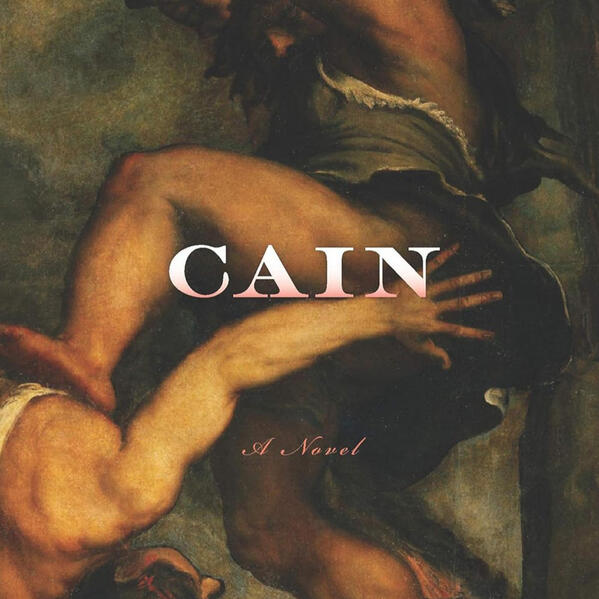
CAIN
José Saramago (2009)
(23/01/2023)
Saramago's prose style for Cain floats, voices drifting between characters like smoke; a long, continuous stream of consciousness split into thirteen parts. It moves like a painting,he rushed over to adam and eve and unceremoniously, no half-measures, stuck his tongue down the throats of first one and then the other.a vicious tapestry of woe and meditation where,Quickly, in case they should wake up, god reached out and very lightly pressed adam's belly with the tip of his forefinger, making a rapid circling movement, and there was a navel. The same procedure, carried out on eve, produced similar results, with the one important difference that her navel was much better as regards design, shape and the delicacy of its folds.in the centre, wanders the 'Lord's' most ardent follower:It was then that abel revealed his true nature. Instead of feeling for his brother in his misfortune and consoling him, he mocked him and, as if that were not enough, began to put on airs, proclaiming himself, to cain's astonishment and bafflement, to be the lord's favourite, the lord's chosen one.Cain.Maybe, but no more sacrilegious than you allowing abel to die, You were the one who killed him, True, but you were the one who pronounced sentence, whereas I merely carried out the execution [...] The person who stays to keep watch over the guard is just as much a thief as the one who actually goes into the vineyard, said cain [...] It's simple enough, I killed abel because I couldn't kill you, so, in intent, you are dead too [...] May I say goodbye to my parents, asked cain, That's up to you, I don't involve myself in family mattersOr, no one! - One in control of their own destiny, a trickster.
Along the way, Cain even adopts other names.find him sitting on the damp ground in their vegetable patch, staring at a small, newly planted tree, waiting for it to grow. He was four or five years old and he wanted to see trees grow. Then she, apparently even more imaginative than her son, explained to him that trees are very shy and only grow when no one is looking at them, They're embarrassed, you see, she said to him one day. For a few moments, cain said nothing, but after some thought, replied, Then don't look at them, mama, they're not shy with me, they're used to me. Sensing what would happen next, his mother looked away, and immediately her son's voice rang out triumphantly, It grew, it grew, you seeAnd this Cain acts as a vessel for Saramago's views on Christianity, God's digressions within the Bible, and evolving ennui and apathy.azael, the angelic guard charged with keeping them out of the garden of eden, welcomed them in christian fashion, gave them food and, above all, equipped them for life with a few precious practical ideasHe is witty,The logical, natural and simply human response would have been for abraham to tell the lord to piss off, but that isn't what happened. The following morning, that unnatural father rose early to saddle up the donkey, prepared wood for the sacrificial fire and set off to the place the lord had indicated, taking with him two servants and his son isaac.and lost in his spatiotemporal ego, splitting across various points of Biblical testimony through a phantasmagorical merging of voices and places within one monologue.Father, it isn't so much a matter of whether or not I died, although obviously that matters to me a great deal, but the fact that we are ruled by such a lord, as cruel as baal, who devours his own children, Where did you hear the name baal, In dreams, father. I'm dreaming, said cain when he opened his eyes.He is witness to all of God's errs throughout the Hebrew Bible (primely, the Pentateuch).- here, The Book of Nonsense - including an Arabian Nights esque interpretation of the tale of Lilith, the Tower of Babel, Sodom and Gomorrah, Abraham and Isaac, Moses, and more.Now, though, the lord conceals himself in columns of smoke, as if he preferred not to be seen. As mere observers of events, we are of the view that he feels ashamed of some of his less palatable actions, for example, those innocent children in sodom devoured by his divine fire.My favourite is Noah.Now noah was tearing his hair out in despair, all is lost, with no women to impregnate, there will be no life and no human race!Darkly hilarious.On one of those days of tumultuous tempests, with the ark being shaken by the storm and the animals trampling each other, ham's wife slipped on the filthy deck and ended up beneath the feet of an elephant. The others threw her into the sea just as they found her, all bloody and smeared with excrement, like a miserable bit of human detritus without honour or dignity. Why didn't you clean her up first, asked cain, and noah replied, There'll be water enough in the sea to wash her clean.He becomes testimony to His sins, much less a witness to his own.So what are you making, what is it, a boat, an ark, a house, he asked. The oldest member of the group, a tall man, as strong as samson, said only, It's not a house, And it's not an ark either, said cain, because arks always have lids, and if this thing had a lid, no amount of human strength could lift it.Eventually, the narrative reaches an alternative universe conclusion that reminds me, oddly, of Devilman (though this book shares similarities with countless other works, least of all Paradise Lost, Frankenstein, The Time Traveller's Wife, The Time Machine, Grendel).
By the close, there is only Cain and his consequences.in short, cain, without knowing how or when, had found a path.There had to come a day when someone would show you your true face

REINHARDT'S GARDEN
Mark Haber (2019)
(22/01/2023)
It's trash.
Influenced by - neigh - derivative of Mila Menendez Krause and Her 'fifth person' technique, itself revolutionary, and therefore well capable of supporting itself. And, were we to fear collapse, we need only look to the work of José Fernández Irala - his The Marble Pillars - which invigorated literature and brought it back to life from death. I've read Her works, you know, Haber? All of them. Her forbidden thirty-two books; eye-spinning seventeen short-stories; mind-altering eight essays; even Her Broken Aphorisms, unlike some. Yes, Haber likes to pretend he is the marvelous Mila Mendez Krause's biggest fan, Her most ardent appreciator, the one who - in his eyes, his myopic eyes, likely very upset eyes, most certainly requiring correction (requiring glasses, those eyes) eyes - yes, he Haber, of the ill-eyes, likes to pretend he truly recognised Mila Menendez Krause first, in Her mystique and magnificence... And, he worsens his soul, and damns his case in the process by earnestly attempt to re-write history! To pretend She does not exist! To suggest that Nuestros Vientres Huecos and, greater still, Vasos Oscuros did not, in fact, directly inspire Pale Fire! Frankly: laughable! Frankly: disgusting.
One need only consult Borges's nameless, wafty and olfactory, erotic memoirs (with blindness came a superiority of the other senses) to understand even he, in his blindness, saw Her better than this Haber ever did, enough to write his lusty fantasies and hide them, in his bedroom(s) behind a paperbound volume detailing the sexual customs of the Balkans - and I see Her better than them all. Yes, indeed, I was going to award this book a five-point review, a constellation of stars to circumvent its majesty... But then its creator pulled that stunt. That stunt which impressed me and then as quickly appalled me, sent me researching rabidly, bouncing, and dancing at his gunshot; at that stunt. Does he think me an idiot, this Minotaur of viral minor taunts, this mono-terror afflicting bastard? Does this Oz believes he can un-write a person from memory, from time, from being?src: https://lithub.com/the-writer-youve-n...
---
Or, rather:When I was first aware that I had been laid low by the disease, I felt a need, among other things, to register a strong protest against the word "depression." Depression, most people know, used to be termed "melancholia," a word which appears in English as the year 1303 and crops up more than once in Chaucer, who in his usage seemed to be aware of its pathological nuances. "Melancholia" would still appear to be a far more apt and evocative word for the blacker forms of the disorder, but it was usurped by a noun with a blank tonality and lacking any magisterial presence, used indifferently to describe an economic decline or a rut in the ground, a true wimp of a word for such a major illness.
- Darkness Visible, William StyronReinhardt's Garden is a cocaine-fuelled journey into the jungle of the soul: melancholia. Irreverent, laugh-out-loud funny, disgustingly relatable. I won't bother quoting as it's endlessly, freshly, quotable and should just be experienced by the reader.
Except this one:All of us, I cautioned, are dancing with death, whether we know it or not; some souls are simply more attuned to death’s ginger steps, death’s faint inching across the courtyard of our lives. And some souls, he groaned, perform the lead in a play nobody is watching.and this one:[...] you’ve likely smoked cigarettes with tobacco grown on the self-same soil that killed my Vita [...]and this one:Every single one of us is melancholic, we’re inherently constructed this way, but we spend our lives busy in the act of denial, trying to deflect our most natural state, yet, if left alone long enough, melancholy surfaces; it’s always there, inexhaustible, unconquerable. Philosophers have labeled melancholy a disease, claimed it is sadness without reason, yet I was certain it was the sadness of reason. When one is melancholic, one sees reality with complete lucidity. Melancholics are the blessed of this world, the seers and visionaries, and as Jacov spoke of his melancholy he became less melancholic, because, to study this emotion, I realized, one had to leave it behind, for melancholy drains the strength, saps the spirit, erodes the aptitude, and one of melancholy’s cruelest ironies is the strength required for it to be studied. It became my salvation [...]And I'm afraid I must stop there, but the truth is I want to quote 86% of the book.Rife with symbolism, from the one-legged prostitute, to the incestuous background reminiscent of Lolita, to the 'ceaseless circle' they walk on their melancholic journeys, this book, like Saint Sebastian's Abyss - yes, the Saint Sebastian's Abyss - with its nuanced details hidden to all but the most committed observers of Saint Sebastian's Abyss - this book, LIKE Saint Sebastian's Abyss, calls me into its gaze, beneath its blankets, into its fold, to covet with demons of obsession pushed by, propelled by, created by their obsessions. Yes, like Saint Sebastian's Abyss, Reinhardt's Garden voices a specific, verbose, so passionate one might say over the top way of thinking I cannot help but adore.
Byronic monomaniacs, twisted in labyrinths and biding time. This novel, I say, yes, this sublime novel, I cry, is like a castle, I howl, an incredible and uncompromising castle![...] was not only not architecture but the antithesis of architecture and, even perhaps, architecture’s nemesis. [...] The castle’s vertiginous contours would eventually make future guests ill at ease and nauseated, an entire estate seemingly built, said one visitor, in an epileptic seizure. Doorways led to trapdoors or false doors in maddening, never-ending riddles that took Sonja and I months to navigate. None of this, of course, took away from the sublimity of the estate itself.Where we came forth,
and once more beheld the stars.
- The Divine Comedy, Dante

SUM: FORTY TALES FROM AFTERLIVES
David Eagleman (2009)
(21/01/2023)
What do you get, if you mix Borgesian mind-bending, a Chiang contemporary perspective, and Kafka's nightmarish parables, and blend them with The Atrocity Exhibition/Invisible Cities/Cosmicomics? You get this wonderful little book of aphorisms.
And I'm selling it short.
It's a portfolio of afterlives; of coping mechanisms. With oscillating weights of micro/macrocosmic perspectives thrust upon our lives from page to page. In many ways, this is an art gallery of human conditions; ways we continue to stay sane without an answer to 'what happens after we die?'
To many, the answer is somewhere between the tales in this book.
As comforting as it is horrifying as it is speculatively profound as it is wonderful.I felt so seen. So many of my own interpretations, thoughts as I'm drifting to sleep, made it into this book. As much poem in places as it is short story. And the whole thing, in ways, can be seen as a transmodern novella - our novella.
Thank you, David, for composing such a profound, organised, succinct work of art.
---Favourites include:Ineffable
Blueprints
Sum
Subjunctive
Death Switch
The Unnatural
Distance
Conservation
Graveyard of the Gods
Mirrors
Reins
Mary
Oz
Apostasy
Reversalbut I sincerely loved them all, except maybe 'Missing.'
---Summary Notes:In Sum, you feel all of each proportional moment in serial order -You spend two months driving the street in front of your house, seven months having sex. You sleep for thirty years without opening your eyes. For five months straight you flip through magazines while sitting on a toilet.
You take all your pain at once, all twenty-seven intense hours of it. Bones break, cars crash, skin is cut, babies are born. Once you make it through, it’s agony-free for the rest of your afterlife.In Egalitaire, God struggles with the paradox of Her creation -So God sits on the edge of Her bed and weeps at night, because the only thing everyone can agree upon is that they’re all in Hell.In Circle of Friends, the afterlife comprises only of the people you recall having met; at first, bliss, but soon, a type of hell -The missing crowds make you lonely. You begin to complain about all the people you could be meeting. But no one listens or sympathizes with you, because this is precisely what you chose when you were alive.In Descent of Species, you, overwraught with complexity of living, choose for the simplicity of transforming into a horse -This moment of lucidity does not last long. But it serves as the punishment for your sins, a Promethean entrails-pecking moment, crouching half-horse halfman, with the knowledge that you cannot appreciate the destination without knowing the starting point; you cannot revel in the simplicity unless you remember the alternatives.In Giantess, you are hostage by your saviour from another planet -Do you think it would have any meaning at all if you displayed one of your Shakespearean plays to a bacterium? Of course not.In Mary, which is amazing, you discover God is a big fan of Frankenstein -God discovered the principles of self-organization by experimenting with yeast and bacteria. He reveled in the beauty of His inventions. Once He mastered the general principles, His inventions became increasingly sophisticated. With artistic flair He sewed together the astounding platypus, the compact beetle, the weighty woolly mammoth, the glistening pods of dolphins. His skills became razor-sharp and keen, and His accurate fingers fashioned—with blinding ambitious accuracy—all the animals at the limits of His vast imagination.In The Cast, we are all performers in eachother's respective dreams, hitchhiker's from point to point in a Borgesian, Kaiba-esque chain of internal visions brought to life/death -Merrily, merrily, merrily, merrily, life is but a dream. [...] There is a woman in my dreams whom I see every night, but I can never catch up with her, passing as we do into our next worlds.In Metamorphosis, one only dies when their name is never said again -There are three deaths. The first is when the body ceases to function. The second is when the body is consigned to the grave. The third is that moment, sometime in the future, when your name is spoken for the last time. So you wait in this lobby until the third deathIn Missing, we have a bilateral view on God, misunderstanding of Sex as Gender, and a misunderstanding of homosexuality and asexuality, but with a Stanislaw Lem charm -Upon close examination, they discovered that the monosexual inhabitants were miserable, crushed like existentialists under a feeling of the absence of something terribly important, something they couldn’t put their fingers on.In Spirals (which I hoped more from given the name), we are presented with a Lem/Adams circumstance whereupon we were supercomputers deriving a meaning for existence all along. I love the creatures -At some point in the development of their society, these creatures began to wonder: Why are we here? What is the purpose of our existence? These turned out to be very difficult questions to answer. So difficult, in fact, that rather than attacking the questions directly, they decided it might be easier to build supercomputing machines devoted to finding the answers.In Scales, we are the extremities of God, whose existence relies on our belief, Tinkerbell style -Sometimes He wonders if we’re doing it on purpose. Are His beloved subjects yearning to know His body, to metastasize throughout His greatness by way of His arterial system? He doesn’t suspect that we’re innocent of the journey.In Adhesion, we are the results of an experiment on cohesion and community, and how things synchronise and stick together -They research men and women who are not naturally adherent but are held together by circumstance. Those pressed together by obligation.In Angst, we are merely celestial being keeping the cosmos afloat, vacationing in the amnesiac bodies we call Humans -And when we’re forced to leave by the wearing out of those delicate little bodies, it is not uncommon to see us lying prostrate in the breeze of the solar winds, tools in hand, looking out into the cosmos, wet-eyed, searching for meaninglessness.In Oz, you peel back the curtain and... Discover wisdom -And there you see the face. Indeed, it is larger than the moon’s orbit. It is a sight beyond the pens of lyric poets.In Great Expectations, the familiar concept of an afterlife through digital uploading is subverted by the way it doesn't work -Although He doesn’t say it, everyone knows what He’s thinking when He retires to His bed at night: that one of His best gifts—the ability to have faith in an unseen hereafter—has backfired.In Mirrors, which is stellar, we are the amalgam of all who have observed us, and exist in their eyes, and therefore deteriorate into the nothingness we started with, before needing to confront each part of ourselves from scratch, therefore killing ourselves -You’re losing you, but you don’t seem to care. There’s only a little bit of you remaining now, the core of you: naked consciousness, bare as a baby.In Perpetuity, only sinners are granted the everlasting -But they’re both wrong. In truth, God lives a life very much like ours—we were created not only in His image but in His social situation as well.In The Unnatural, you restart life with 'death' removed, and suicide becomes normalised, and all else collapses -There is a noticeable decline in accomplishment. People take more naps. There’s no great rush.In Distance, you ask God why he keeps away from Us, where he replies he once lived among us -“But one day I came to one of my homes and found that all the windows had been broken.”In Reins, we are presented with a God akin to Kafka's Poseidon, condemned to his obsessive meticulousness out of passion -Very few people visit Him anymore. He finds Himself lonely and misunderstood.In Microbe, we are granted the most microcosmic perspective of existence and God -So although we supposed ourselves to be the apex of evolution, we are merely the nutritional substrate.In Absence, Heaven is a garden project (much like Earth) started by a God who disappeared -Some people hypothesize that God is never planning to return. Others say God went crazy; others assert He loves us but was called away to spawn new universes. Some say He is angry, others say He contracted Alzheimer’s.In Will-o'-the-Wisp, Heaven is a library room complete with omniscient surveillance of Earth, so you can see the status of the people and things you left behind... For a while -They don’t understand they’ve been blessed with insulation from the future, while the sinners are cursed in the blue-green glow of the televisions to witness every moment of it.In Incentive, Heaven is, in fact, the other side of life - for half of us are actors, the other beneficiaries, who flip back and forth at the behest of a director ad infinitum -If you play your part well, you can more quickly leave this acting job.In Death Switch, a transient, ethereal, conceptual afterlife exists when we create Death Switches which can do things electronically after our deaths, allowing our presence on Earth to continue -By the time we die and our death switches are triggered, there will be nothing left but a sophisticated network of transactions with no one to read them: a society of emails zipping back and forth under silent satellites orbiting a soundless planet.In Encore, our Creators replicate a form of us inspired by the data they had of our current existence -The Creators watch none of the details as our lives unfold. They could not care less. Only afterward do they become interested again, when they have the opportunity to do what they do best: create.In Prism, all versions and ages of you at all times of your 'known' existence exist at once -The you that existed as a single identity is now all ages at once. These pieces of you no longer get older but remain ageless into perpetuity. The yous have transcended time.In Ineffable, death is something that happens to all things, and those things, too, have afterlives -When soldiers part ways at war’s end, the breakup of the platoon triggers the same emotion as the death of a person—it is the final bloodless death of the war. This same mood haunts actors on the drop of the final curtain: after months of working together, something greater than themselves has just died. [...]In this way, death is not only for humans but for everything that existed.In Pantheon, there are a near-infinite array of Gods, all fighting and coordinating, all sharing a link: us -Despite the best guesses of erstwhile civilizations, the gods do not hold dominion over categories of war, love, and wisdom. Instead, the divisions are much finer-grained. One god has control over objects that are made of chrome. Another over flags. Another over bacteria. The god of telephones, the god of bubble gum, the god of spoons.In Impulse, there is no true afterlife, as there is none for computer chips (which we are) except we have a glitch, a virus -But it turns out that a tiny, unexpected bug has crept into the program, an anomalous algorithm that the Programmers did not intend and have not yet detected: our consciousness.In Quantum, you are granted the infinite variety of... The infinite... And come to find pleasure in simplicity -In the afterlife you can enjoy all possibilities at once, living multiple lives in parallel. You find yourself simultaneously eating and not eating.In Conservation, we are all parts of a single story featuring a singular protagonist, quark (very Cosmicomics) -If it feels to you that we’re connected by a larger whole, you’re mistaken: we’re connected by a smaller particle. Every atom in your body is the same quark in different places at the same moment in time. [...] Then, on an afternoon that would come to be known by our physicists as the Day of Decline, the quark suffered an epiphany. It realized it had reached the limits of its energy. Its stories had grown too baroque and rococo to be contained by the maximum speed of its pencil strokes. [...] As the decline continues, you will someday turn a familiar corner to find buildings missing. At some point you may look through the missing walls of your bedroom to find your lover only half drawn.In Narcissus, we are cameras for cartographers, created to craft maps -In the afterlife you receive a clear answer about our purpose on the Earth: our mission is to collect data. We have been seeded on this planet as sophisticated mobile cameras. [...] Day after day, with sinking hearts, the Cartographers scroll through endless reels of useless data.In Seed, God is an inventor, artist, and creator, entertaining us with His wonders, but growing weary at our evolution, learns His own limitations -Although we credit God with designing man, it turns out He’s not sufficiently skilled to have done so. In point of fact, He unintentionally knocked over the first domino by creating a palette of atoms with different shapes. [...] Recently He has run into an unforeseen problem: our species is growing smarter. While we were once easy to awe, dragging knuckles and gaping at fire, we have replaced confusion with equations.In Graveyard of the Gods, even Gods come back to Heaven - everything comes back - and this, in itself, is a type of Hell -After you arrive and look around for a while, it becomes obvious that anything that once existed enjoys a continued existence. [...] Although the gods choose to congregate together out here, the truth is that they cannot stand one another. They are confused because they have found themselves here in the afterlife, but they still, deep down, believe they are in charge. [...] There is only one thing they appreciate about this afterlife. Because of their famed vengefulness and creativity in the arts of torture, they find themselves impressed by this version of Hell.In Apostasy, God is a Borgesian contraption of concept, frightened Her existence will be found by those capable of blinding themselves to the unbearable light-deluge of ideas propounded by others in order to find Her -In the afterlife you meet God. To your surprise and delight, She is like no god that humans have conceived. [...] She is the elephant described by blind men: all partial descriptions with no understanding of the whole. [...] And this is why She was always leery of apostates, those who rejected the particulars of their religion in search of something that seemed more truthful. She disliked them because they seemed the most likely to float a correct guess.In Blueprints, we are all lines of code, and this is not a deterministic thing, but an argument of values and probable possibilities -The Rewarder whispers into one of your ears, Isn’t it wonderful to understand the code? The Punisher hisses into your other ear, Does understanding the mechanics of attraction suck all the life out of it? [...] This game always ends in disappointment for both sides, who are freshly distraught to learn that being let into the secrets behind the scenes has little effect on our experience.In Subjunctive, Heaven and Hell are defined by a metric of perfection, or relative success, as infinite versions of You are subjected to infinite rivalry -And thus your punishment is cleverly and automatically regulated in the afterlife: the more you fall short of your potential, the more of these annoying selves you are forced to deal with.In Search, we de-atomise upon death (wrong term, but these are notes), and are in a constant, pleasant state of reincarnated relocation, envoys of energy and life aiming to converge upon a singular point, one day -In the moment before death, you are still composed of the same thousand trillion trillion atoms as in the moment after death—the only difference is that their neighborly network of social interactions has ground to a halt. [...]In Reversal, You peek into the depiction of the Afterlife that h
IMPRO
Keith Johnstone (1979)
(21/01/2023)
Why am I reading this?"Life’s but a walking shadow, a poor player
That struts and frets his hour upon the stage,
And then is heard no more. It is a tale
Told by an idiot, full of sound and fury,
Signifying nothing."
- Macbeth, William ShakespeareI believe we all act and dance, masked in performance.“Whether an honest performer wishes to convey the truth or whether a dishonest performer wishes to convey a falsehood, both must take care to enliven their performances with appropriate expressions, exclude from their performances expressions that might discredit the impression being fostered, and take care lest the audience impute unintended meanings.”
- The Presentation of Self in Everyday Life, Erving GoffmanThis is sociological dramaturgy."All the world's a stage,
And all the men and women merely players;
They have their exits and their entrances,
And one man in his time plays many parts..."
- As You Like It, William ShakespeareAnd I also believe it is perspective, alteration of lenses, that determines reality.“The mind is its own place
and, in itself can make a
heaven of hell or a
hell of heaven.”
- Paradise Lost, John MiltonThis is the theory of general relativity.
This is observational quantum mechanics.“External perception is an internal dream which proves to be in harmony with external things; and instead of calling ‘hallucination’ a false perception, we must call external perception ‘a confirmed hallucination.”
- Helgoland, Carlo RovelliI don't want to lose myself to myself in a search for self but...“In the end, we self-perceiving, self-inventing, locked-in mirages are little miracles of self-reference.”
― I Am a Strange Loop, Douglas HofstadterWhile exploring these thoughts, I reasoned that understanding improvisation - spinning a bad hand into a good thing, attuning my reactions to my environment - would only better a performance (which I believe we all enact).On with the show!---"At about the age of nine I decided never to believe anything because it was convenient. I began reversing every statement to see if the opposite was also true."CH1 - NOTES ON MYSELFI like the visual sharpening technique he starts with. Not just as a technique in general, but as an introduction. Immediately grabbing. And he then leveraged it into a laugh from me -"One afternoon I was lying on my bed and investigating the effects of anxiety on the musculature (how do you spend your afternoons?)"I'm using this review to cultivate quotes and segments I feel profound enough to save and share."People think of good and bad teachers as engaged in the same activity, as if education was a substance, and that bad teachers supply a little of the substance, and good teachers supply a lot. This makes it difficult to understand that education can be a destructive process, and that bad teachers are wrecking talent, and that good and bad teachers are engaged in opposite activities."Already, I'm noticing a rhythm of good perspectives - and that's the takeaway from the beginning: the alteration of a paradigm, the shifting of a view."One day, when I was eighteen, I was reading a book and I began to weep. I was astounded. I’d had no idea that literature could affect me in such a way. If I’d have wept over a poem in class the teacher would have been appalled. I realised that my school had been teaching me not to respond.
(In some universities students unconsciously learn to copy the physical attitudes of their professors, leaning back away from the play or film they’re watching, and crossing their arms tightly, and tilting their heads back. Such postures help them to feel less ‘involved’, less ‘subjective’. The response of untutored people is infinitely superior.)Fucking stellar. Just... Spot on. Even in the high school I experienced from 2008-2013. Even in colleges and universities of the UK today. I'm glad to have had a handful of emotional teachers throughout; ones I'll never forget (in particular: Winters, Stone, Wake, Stretch, and Hope Staff). Otherwise, the majority have been robotic in their elocution and passion, leading teacher and student alike to wonder why they were there."I tried to resist my schooling, but I accepted the idea that my intelligence was the most important part of me. I tried to be clever in everything I did. The damage was greatest in areas where my interests and the school’s seemed to coincide : in writing, for example (I wrote and rewrote, and lost all my fluency). I forgot that inspiration isn’t intellectual, that you don’t have to be perfect. In the end I was reluctant to attempt anything for fear of failure, and my first thoughts never seemed good enough. Everything had to be corrected and brought into line."Look, mate, we're only, like, six out of two-hundred pages in. Do you want to slow down with the synchronicity, a bit? Bloody hell. The whole section concerning Stirling is a masterclass in deconstructing the adult hubris instilled within us in this post-industrialised educational environment. We're pushed from imagination and freedom."I began to think of children not as immature adults, but of adults as atrophied children. But when I said this to educationalists, they became angry."Again, something I have needed to learn in life. Likewise, that a philosopher is a child, refusing to stop asking Why?, peeling layer after layer back to see the innards. "Why? Why? Why? Why? Why?" and "Why? Why? Why? Why? Why?" but they will not take, "Because I say so!" for an answer. The annoying trait of every innovator."Instead of seeing people as untalented, we can see them as phobic, and this completely changes the teacher’s relationship with them."People are frightened of 'failure,' but 'failure' is a necessary rung to relative 'success.'
Riding a bike required falling off it. And all that.---CH2 - STATUS"‘Try to get your status just a little above or below your partner’s,’ I said, and I insisted that the gap should be minimal. The actors seemed to know exactly what I meant and the work was transformed. The scenes became ‘authentic’, and actors seemed marvellously observant. Suddenly we understood that every inflection and movement implies a status, and that no action is due to chance, or really ‘motiveless’. It was hysterically funny, but at the same time very alarming. All our secret manoeuvrings were exposed. If someone asked a question we didn’t bother to answer it, we concentrated on why it had been asked. No one could make an ‘innocuous’ remark without everyone instantly grasping what lay behind it. Normally we are ‘forbidden’ to see status transactions except when there’s a conflict. In reality status transactions continue all the time."Here, status means the perspective of one's worth or importance relative to another's. This segment is profound, a wonderful allegory for why people flounder among the famous, wrangle with royalty, or experience imposter syndrome. To speak little of simple miscommunication.
Status is an illusion... One can play with illusion.
Remember: Frank Abagnale. And, also, that your idol suffers from diarrhoea on occasion.This is explored here:"TRAMP:
’Ere! Where are you going?
DUCHESS:
I’m sorry, I didn’t quite catch …
TRAMP:
Are you deaf as well as blind?Audiences enjoy a contrast between the status played and the social status. We always like it when a tramp is mistaken for the boss, or the boss for a tramp.
Chaplin liked to play the person at the bottom of the hierarchy and then lower everyone."And here:"[...] we found that people will play one status while convinced that they are playing the opposite. [...] many of us had to revise our whole idea of ourselves. In my own case I was astounded to find that when I thought I was being friendly, I was actually being hostile! If someone had said ‘I like your play’, I would have said ‘Oh, it’s not up to much’, perceiving myself as ‘charmingly modest’. In reality I would have been implying that my admirer had bad taste. I experience the opposite situation when people come up, looking friendly and supportive, and say, ‘We did enjoy the end of Act One’, leaving me to wonder what was wrong with the rest."Likewise, the 'War and Peace' dialogue experiment was incredible.
How, with the reduction of status or perceived social class, comedy/grace is permitted.“Its easy to make frends if you let pepul laff at you.”
- Flowers for Algernon, Daniel KeyesIf you put someone on a pedestal, they will look down on you or away.
And if you put yourself on a pedestal, well..."A further early discovery was that there was no way to be neutral. [...] The messages are modified by the receivers. [...] You can see people trying to be neutral in group photographs. [...] If someone points a camera at you you’re in danger of having your status exposed, so you either clown about, or become deliberately unexpressive. [...] If status can’t even be got rid of, then what happens between friends? Many people will maintain that we don’t play status transactions with our friends, and yet every movement, every inflection of the voice implies a status. My answer is that acquaintances become friends when they agree to play status games together."This book is an incredible work of sociological naturalistic observation and group case studies, particularly regarding interplay through action and emotion. And Johnstone is a master observer; these are some well elocuted, brilliant summarisations of group dynamics."I can achieve a similar effect by saying ‘I smell beautiful’ as ‘You stink’. [...] Tragedy is obviously related to sacrifice. Two things strike me about reports of sacrifices: one is that the crowd get more and more tense, and then are relaxed and happy at the moment of death; the other is that the victim is raised in status before being sacrifice."Execute: Looping Thoughts -
'Execution' means both the
beginning and conclusion of
a performance
so a balance is needed
in 'observation' and 'disposition,'
observation of disposition,
disposition of observation,
by all parties to maintain
a performance in play."This is because normal people are inhibited from seeing that no action, sound, or movement is innocent of purpose. Many psychologists have noted how uncannily perceptive some schizophrenics are. I think that their madness must have opened their eyes to things that ‘normal’ people are trained to ignore."Representation."One way to teach transitions of status is to get students to leave the class, and then come in through the real door and act ‘entering the wrong room’. It’s then quite normal to see students entering with head down, or walking backwards, or in some other way that will prevent them from seeing that it is the wrong room. They want time to really enter before they start ‘acting’. They will advance a couple of paces, act seeing the audience, and leave in a completely phoney way."Wonderful technique to employ in literature; how a character enters a room can define them at that current point in time. Particularly their reaction to what's in the room. So many infinite varieties."You then have to work together with the student, as if you were both trying to alter the behaviour of some third person. [...] The movement teacher Yat Malmgren told me that as a child he’d discovered that he didn’t end at the surface of his body, but was actually an oval ‘Swiss cheese’ shape. To me, this is ‘closed-eye’ space, and you experience it when you shut your eyes and let your body feel outwards into the surrounding darkness. Yat also talked about people who were cut off from sensing areas of themselves."Incredibly, I wasn't expecting to see my experiences of 'realizing I have a body' mirrored back to me so eloquently. That, and my dissociative tendencies. I connect with this quote completely, but I'm unsure what shape, exactly, my non-corporeal body has. It's not a PK/telekinesis thing, but it's definitely a sensation I have felt."The mime must first of all be aware of this boundless contact with things. There is no insulating layer of air between the man and the outside world. Any man who moves about causes ripples in the ambient world in the same way a fish does when it moves in the water.I can understand this. There's something about it associated with physics. The difference between holding a rope and not holding a rope is purely perceptual, sensory. If one can convince themselves of that illusion even when there is no rope, they can convincingly act as though they are holding one.
Otherwise, a lot of this chapter comprises relationship dynamics (for instance: master-servant) and the see-saw effect that incurs comedy when one manipulates that see-saw in unexpected or subversive ways."In life, status gaps are often exaggerated to such an extent that they become comical. Heinrich Harrer met a Tibetan whose servant stood holding a spitoon in case the master wanted to spit. Queen Victoria would take her position and sit, and there had to be a chair. George the Sixth used to wear electrically heated underclothes when deerstalking, which meant a gillie had to follow him around holding the battery. I train actors to use minimum status gaps, because then they have to assess the status of their partners accurately, but I also teach them to play maximum status-gap scenes. [...] Maximum-status-gap exercises produce ‘absurd’ improvisations."I like the way he then discusses Waiting for Godot:"If you observe the status, then the play is fascinating. If you ignore it the play is tedious. Pozzo is not really a very high-status master, since he fights for status all the time. He owns the land, but he doesn’t own the space. It must be clear, I think, that even the stage directions relate to status. Every ‘silence’ is lowering to Pozzo. I remember a reviewer (Kenneth Tynan) making fun of Beckett’s pauses, but this just shows a lack of understanding. Obviously Beckett’s plays need careful pacing, but the pauses are part of the pattern of dominance and submission. Godot earns its reputation as a boring play only when directors try to make it ‘significant’, and ignore the status transactions."CH3 - SPONTANEITYOne of my students spent two years in a classroom where the teacher had put a large sign over the blackboard. It said ‘Get into the “Yes, Sir” attitude.’ [...] Intelligence is proportional to population, but talent appears not to be related to population numbers. I’m living in a city at the edge of the Rocky Mountains; the population is much greater than it was in Shakespearian London, and almost everyone here is literate, and has had many thousands of dollars spent on his education. Where are the poets, and playwrights, and painters, and composers?The first part of this segment concerns the crushing of the creative spirit. Something that still occurs today in the educational system but in a different way, but also in our day-to-day communication. Luckily, in the internet era, the ability to be creative is more accessible to most, and expressionism has been more embraced.Someone asked Kubrick if it was usual for a director to spend so much care on lighting each shot and he said, ‘I don’t know. I’ve never seen anyone else light a film.’
You have to be a very stubborn person to remain an artist in this culture. It’s easy to play the role of ‘artist’, but actually to create something means going against one’s education.Still a worthwhile observation. Committee tested, safe, art exhausts me.We have an idea that art is self-expression—which historically is weird. An artist used to be seen as a medium through which something else operated. He was a servant of the God. Maybe a mask-maker would have fasted and prayed for a week before he had a vision of the Mask he was to carve, because no one wanted to see his Mask, they wanted to see the God’s.andSchiller wrote of a ‘watcher at the gates of the mind’, who examines ideas too closely. He said that in the case of the creative mind ‘the intellect has withdrawn its watcher from the gates, and the ideas rush in pell-mell, and only then does it revie
THE SAILOR WHO FELL FROM GRACE WITH THE SEA
Yukio Mishima (1963)
(21/01/2023)
I had no idea what this book would concern beyond the obvious before reading, and I urge any prospective reader do the same. Let it wash over you, hook after hook working their magic until you need - NEED - to no what happens next. If you're a fan of the domestic Murakami works, Zweig releases, or even things like The Wasp Factory or Lord of the Flies, I'd recommend you read this. There were likely better comparisons, I'm just too fatigued by the 'climax' to exhaust myself further. Brilliant, spontaneous read, that's been on my horizon for a while. Let it wash over you.---NOTES FOR [SUMMER] (SOFT SPOILERS)Noboru watches his mother through a peephole as she makes love to a sailor, Ryuji.Whereas most men choose to become sailors because they like the sea, Ryuji had been guided by an antipathy to land. [...] He found himself in the strange predicament all sailors share: essentially he belonged neither to the land nor to the sea. Possibly a man who hates the land should dwell on shore forever. Ryuji hated the immobility of the land, the eternally unchanging surfaces. But a ship was another kind of prison.I'll leave the JoJolion references at home. I have always adored the imagery of a sailor who belongs to neither land nor sea, and this is the best expression of it I've seen so far. I'm immediately drawn in.At twenty, he had been passionately certain: there’s just one thing I’m destined for and that’s glory; that’s right, glory! [...] And it seemed increasingly obvious that the world would have to topple if he was to attain the glory that was rightfully his. [...] Sometimes, as he stood watch in the middle of the night, he could feel his glory knifing toward him like a shark from some great distance in the darkly heaping sea, see it almost, aglow like the noctilucae that fire the water, surging in to flood him with light and cast the silhouette of his heroic figure against the brink of man’s world. [...] There must be a special destiny in store for me; a glittering, special-order kind no ordinary man would be permitted....a wonderful illustration of solipsism paired with the grandiose sense of one's destiny. Relatable, harshly so, with the cold clear imagery of Gatsby at the bay. We're not even that far into this novel, and I'm already struck by the quality of the prose - and this is a translation! I wonder how wonderful the original is.The stars slanted into the south, swung to the north, wheeled, whirled into the east, and seemed finally to be impaled on the tip of the mast.I'll tell you what: so far, his sex scenes have been some of the best, most direct but poetic allusions I've read before. They don't drag yet convey a sense of dilated time - not over and done with, not overbearing - and carry an allegorical weight to them. Hopefully that doesn't change.Fusako had met Ryuji for the first time two days before. Noboru, who was a fanatic about ships, had wheedled her into asking a shipping executive friend for a letter of introduction, and they had gone to see the Rakuyo, a ten-thousand-ton freighter anchored at Takashima Pier. . .Interesting how Noboru was directly responsible for the two meeting. I like the way the three chapters so far have been told from Noboru, Ryuji, and Fusako's POV, all with different voices.Ryuji seems to be a man so caught up in the oceanic, infinite expanse of his self-ordained destiny - a flow which he feels little control over - that he is frightened of commitment, of sedentary stasis. Landmasses do not speak to him, only the sea; but even that, lately, makes him think of love, of commitment, and that reminds him of the land.Running into Ryuji near the park worried Noboru. He wondered what he could do to keep the sailor from telling his mother about the meeting. In the first place, he hadn’t gone swimming at Kamakura as the adults supposed.And so the three are caught in a tangle of lies. Fatherless Noboru confides, impressed with what he saw, to his group of friends, a socially anomic party of young boys, who enthusiastically dismantle Noboru's heroic depiction of the sailor and fill him with ennui.Noboru had been trained in such a way that practically nothing sexual, not even that scene the night before, could surprise him. The chief had taken great pains to insure that none of the gang would be abashed by such a sight [...] he maintained that their genitals were for copulating with stars in the Milky Way. Their pubic hair, indigo roots buried deep beneath white skin and a few strands already strong and thickening, would grow out in order to tickle coy stardust when the rape occurred. . . .The group is more or less a cult, led by a charismatic boy who has deconstructed sex, morality, and familial bonds. He is deindividuating them, preparing them for something to come. The 'chief' proports to have read every book around their home, a home where he is infrequently attended to by estranged parents. They more or less let him get away with anything.Soon the shirts would be flapping in the wind and then he would be killing, breaking the endless chain of society’s loathsome taboos. [...] The boys were overjoyed at the spattered blood on the log. [...] But beneath the surface was a smooth expressionless interior, a placid, glossy-white inner life in perfect consonance with Noboru and the others; and they could feel their own intricate, soot-black insides bearing down upon and shadowing it like ships moving upon the water.I killed it all by myself—a distant hand reached into Noboru’s dream and awarded him a snow-white certificate of merit—I can do anything, no matter how awful.
The chief peeled off the squeaky rubber gloves and laid one beautiful white hand on Noboru’s shoulder. “You did a good job. I think we can say this has finally made a real man of you—and isn’t all this blood a sight for sore eyes!”They then commit an atrocity. The chief is psychotic, and his followers have lost themselves to depravity. He is not one for the land; he has fallen to the infinite depths of the ocean.
Noboru is a wayward sailor.
This book is captivating, so far; tender, alienating, violent, aggressive. Indeed, like the sea.Noboru didn’t realize that Ryuji was sinking into a void. He didn’t even notice that the sailor wasn’t looking in his direction any more. Lack of sleep and a succession of shocks had exhausted him, the bloodshot eyes he had told the housekeeper were from the salt water were beginning to close.Nobody is as they present. They are all mentally adrift, caught up in the maelstrom of their own desires and inhibitions. Occasionally, they drift into view of one another, only to drift out just as quick. How vivid they are written, to us, the reader, is a testimony to Mishima's writing and John Nathan's translation.Since dark antiquity the words have been spoken by women of every caste to sailors in every port; words of docile acceptance of the horizon’s authority, of reckless homage to that mysterious azure boundary; words never failing to bestow on even the haughtiest woman the sadness, the hollow hopes, and the freedom of the whore: “You’ll be leaving in the morning, won’t you? . . .”
But Fusako was determined not to submit, though she knew Ryuji would try to make her speak. [...] For Ryuji the kiss was death, the very death in love he always dreamed of.Fusako is revealed to likewise be an agent of her own design, incompatible with the designs of the other two characters. All three are caught in a tumultuous wave their refusing to acknowledge. I wonder if it will calm or wash over everything.He was perfectly aware that he would leave her in a day, yet he was ready to die happily for her sake. Death roused inside him, stirred.
Then the pale tremor of a ship’s horn floated in from the direction of Center Pier and settled over the garden. A nebulous mist of sound, it would never have registered on Ryuji’s ear if he hadn’t been a sailor.Incredible writing... This book WILL require a re-read. So many angles to appreciate, and at such a short word-count. Brilliant. The desensitisation Noboru is undergoing, the alienation of Fusako, and the estrangement of Ryuji - to reduce their complex facets down to one word apart.Noboru squeezed a mountain of toothpaste onto his toothbrush and belabored his mouth until the gums bled. Staring into the mirror, he watched a pistachio foam swaddle his irregular teeth until only the shiny pointed edges of the boyish cuspids showed: he was despondent. The smell of peppermint made a purity of his rage.NOTES FOR [WINTER] (SOFT SPOILERS)The sea was responsible for the unreality of the place, for it was to her service alone that the streets, the buildings, even the dumb bricks in the wall were pledged. The sea had simplified and abstracted, and the pier in turn had lost its sense of reality and appeared to be dwelling within a dream.Has a strong magical realist introduction to the second half. The husband/father surrogate has been away for some time... I wonder what has happened in the meantime...
It seems, to Ryuji, that being a 'landsman' is quite similar to being part of a nuclear family, or at the very least taking responsibility that stabilises and roots him from 'freedom.'And they strap three little round mirrors to their foreheads. When those mirrors catch the light from the bonfires, they look just like . . . three-eyed devils.Nonetheless, Ryuji pushes for the opportunity to prove himself, and be a man of the land, while the son festers in insecure detachment and vendettas.
The conversation between Yoriko and Fusako was very illuminating and foreboding... Peppered with social obstructions, classist soliloquys, but - ultimately - deflection born from fear.Fathers! Just think about it for a minute—they’re enough to make you puke. Fathers are evil itself, laden with everything ugly in Man. [...] They stand in the way of our progress while they try to burden us with their inferiority complexes, and their unrealized aspirations, and their resentments, and their ideals, and the weaknesses they’ve never told anyone about, and their sins, and their sweeter-than-honey dreams, and the maxims they’ve never had the courage to live by—they’d like to unload all that silly crap on us, all of it!Somewhat like the deflection and projection of the 'chief' who froths at the mouth at the prospect of Noboru having a father. Noboru, meanwhile, anxiously waits for signs that Ryuji will leave again. His morality, and loyalty to the group, relies on Ryuji's ability to be a father figure and plant his feet on land.‘Dad, is there any purpose in life?’ You see what I was getting at, don’t you, what I really meant? Father, can you give me one single reason why you go on living? Wouldn’t it be better just to fade away as quickly as possible? But a firstclass insinuation never reaches a man like that. He just looked surprised and his eyes bugged and he stared at me. I hate that kind of ridiculous adult surprise. And when he finally answered, what do you think he said? ‘Son, nobody is going to provide you with a purpose in life; you’ve got to make one for yourself.’
“How’s that for a stupid, hackneyed moral!The chief's existentialism, the result - perhaps - of surplus knowledge unconverted into wisdom, has amounted to him attempting to convert his followers into a similarly minded nihilism. He's furious his father did not possess the meaning of life, nor impress his son enough.A father is a reality-concealing machine, a machine for dishing up lies to kids, and that isn’t even the worst of it: secretly he believes that he represents reality. [...]But it’s time you realized that a father who would buy you an air rifle is just as bad as one who won’t.I love the first half of this conjoined quote. His hypocritical, oxymoronic philosophy is a good demonstration of child apathy resulting from poor father figures, boredom, and misguided judgement systems.
Chapter Four is fantastic.Now Ryuji was obliged to reach a father’s decision, the first decision about shore life he had ever been forced to make. But his memory of the sea’s fury was tempering his critical notons of land and the landsman with inordinate mildness, and his instinctive approach to problems was therefore thwarted. To beat the boy would be easy enough, but a difficult future awaited him.INCREDIBLE. Ryuji is a son to the sea. His discipline is understanding. And to this, the boy who understands he deserves far more punishment than just peeping, feels rage.He was thinking that the chief had been right: there were worse things than being beaten.I didn't expect this, it's been such a tumultuous read, like the best parts of Zweig.This law they’ve written is a kind of nursery tale, a pretty deadly nursery tale, I’d say. And in a way it’s understandable. After all, up to now we have been nursery kids, adorable, defenseless, innocent kids.So close to transvaluation, to understanding the problem, but the chief scapegoats the woes of society to leverage his own wants; he's an authoritarian, and a charismatic one.The ending is so abrupt... I wanted more. I'm not complaining, I'm just despairing - what a conclusion...
THE BOOK OF IMAGINARY BEINGS
Jorge Luis Borges (1957)
(20/01/2023)
My favourite imaginary beings include:Abtu and Anet, the fish,
the imagined animal of Kafka, kangaroo-like, and,
creatures in the form of Spheres,
Bahamut and Behemoth,
the five headed hellhound, Cerberus,
the mystical, wise, Chinese Dragon,
Chronos/Hercules,
my beloved Crossbreed,
the Double,
the incredible variety of the Eastern Dragon,
the Eater of the Dead and the
Eight-Forked Serpent,
Fauna of Mirrors,
of course, the Golem, (particularly the parts I never knew before!),
Kafziel,
the Hundred-Heads, and karma, therein,
the Kujata,
the Mandrake and the Manticore,
my presshussss Minotaur,
the Odradek (whom I feel a lot of attachment for),
the Peryton,
the Remora,
Scylla, and
the Simurgh,
Thermal Beings,
Two Metaphysical Beings!!!!!,
the Western Dragon (I LOVE his Beowulf notes).
MANGA IN THEORY AND PRACTICE: THE CRAFT OF CREATING MANGA
Hirohiko Araki (2015)
(19/01/2023)
Let's get this outta the way. I very much like JoJo's Bizarre Adventure ( JoJo no Kimyou na Bouken. ) That said, I don't think it's perfect and is marred by numerous errors, mostly owing to the unforgiving nature of the drafting, creating, publishing, mangaka.My favourite parts in order are (always changing): 7 > 5 > 4 > 2 > 6 > 1 > 3,
with JoJolion either slipping between 7&5 or 4&2 depending on what side of the bed I woke up on.I left any dreams of becoming a comic book artist, let alone a mangaka, behind me more than ten years ago, but still admire the passion and dedication. I aim to apply that ferocious passion to my own work, wherever possible, while also learning the lessons of burnout and overtime that beguile the best of them - R.I.P Miura. So, I read this book to understand JoJo's, Hirohiko, himself, and perhaps even to learn some tips on how to keep writing exciting in the ways I, relatively, admire in his work.---Think of the golden way of which I write in this book as signposts directing you to the royal road of manga at the summit. Attempts to reach those heights without any such map or anything else to guide the way will be frustrated far from the peak. This is something I’ve seen and heard happen many times. [...] To be perfectly honest, by making public ideas and methodologies that are trade secrets, which up until now I’ve held under monopoly, the publishing of this book will be disadvantageous to me on a personal level. But I’m writing this book because my desire to impart these techniques is far greater than any disadvantage that may come from revealing them."It's Araki, so the pretension is to be expected. The beginning dedicates a lot of time to discussion of this 'golden way' - I'm excited to keep my ears open and pick up some good guidance.CH1 - GETTING STARTEDAraki recounts his failures, his rejected submissions, and how he grew from mimicking and copying by learning how to foster his own originality. This led to the realisation that the first page is integral - without them turning it, everything collapses, and all your work is for nothing."How I found the solution was through systematically analysing the first pages of popular manga. Since every mangaka takes special care with their first pages, I could study those leading pages to see what the creators were trying to achieve and the effects of their techniques, and use that knowledge to bring my own work alive. One word of warning: studying best-selling publications is crucial to finding what elements sell, but you mustn’t simply copy those works."He then goes on to recount how important titles are. In particular he enjoys striking, absurd ones, or ones with the character's name (which, well, makes sense.)"At the most basic level, the first panel should illustrate the five Ws and one H—in other words, who is doing what, and when and where, and why and how."Is worthwhile advice given to many children but often forgotten later down the line, especially in writing. It shouldn't be outwardly apparent all the time, sometimes illusionary, but they are the words that glue together intrigue.CH2 - MASTERING THE FOUR MAJOR FUNDAMENTALS OF MANGA STRUCTUREThe four fundamentals are, in order of importance:• Characters• Story• Setting• Themesthey influence one another, and are not mutually exclusive. He also stresses the importance of questioning why you enjoy the things you enjoy, and over analyse their latent informative content.CH3 - DESIGNING CHARACTERS"Some mangaka will go as far as to say that if you have characters, you have a manga."True, with admitted exception and alternative or fringe forms, of other mediums. Whether it be Jay, Gatsby, and Daisy; or the Xenomorph, the Babadook, the velociraptor of Jurassic Park. Could go on; characters are, often, key. I could name a ton of exceptions but the case is still a strong one. Especially if the metric result is 'popularity' or 'success' (often the same thing to some.)"The most important part of a character is their motivation. What does your protagonist want to accomplish? [...] Your characters’ motivations have to gain the interest and empathy of your readers. A good motivation is one that makes the reader wonder what will happen to that character, and what that character will do, because then the reader will want to keep reading. [...] You need to include in your main characters weaknesses or faults, or more human desires."He then goes onto discuss villains, of particular interest to me (given how truly irredeemable yet irresistible his cartoonish characters are):That said, being able to get readers to empathize with ugly desires is a tremendously tall hurdle, one that requires thought and planning to overcome. Once you have that ability, you could turn even a heartless killer into your main character.
In Dio’s case, I depicted him as coming from an unfortunate upbringing, saddled with a father who had no redeeming qualities whatsoever. [...]
With Jonathan and Dio, I based the characters off the duality between light and shadow, and used black and white contrasts in my drawing to set them apart.
But sometimes the difference between good and evil may depend on your readers’ viewpoints. As I’ve grown older, I’ve found that good and evil are not so easily delineated, and I’ve taken more interest in the reasons why people do bad things."Major props to him for admitting the earlier arcs were marginally defined by their abundance of dichotomies. I was drawn to it for the same reasons I was drawn to Sonic Adventure 2, Yin and Yang, and the colour grey. But while fantastic for superficial reasons, it's too reductive, as he admits and says he learned from (and I believe) later on. Perhaps JoJolion was a test of this, and that's where my complex feelings towards it lie."There may be nothing more beautiful than a person who pursues something important, regardless of society’s approval, and even if it means standing alone."In many ways, I agree. In some ways, I disagree. Still, nonetheless, those I admire fall in this camp."I think that even if you’re creating a manga that includes love and romance, you could have it be between two male characters, as long as that fits with your manga’s world. As long as your characters are appealing, you could get away with a world of all men. You have nothing to fear."This, I agree with, however!
He then proceeds to layout his indispensable character creation sheets, alongside how he likes to interplay various characters against one another to create scenarios."At the time, Star Wars (1977) was wildly popular, but I preferred Carrie (1976) and its tale of a girl with supernatural powers who exacts ferocious revenge upon her parents and bullies. I was well aware that what I liked and what became smash hits were two different things. But even knowing that, I couldn’t shake my desire to remain true to the things that I personally enjoyed, and that I thought were good, and to not hew to what was currently in vogue."Genuinely inspiring. "“If you only read the books that everyone else is reading, you can only think what everyone else is thinking.” - Haruki Murakami"At the time, a mangaka could earn about 3,500 yen ($18, or about $45 in 2017 dollars) per page, which after taxes came out to about 3,000 yen ($15, or about $40 in 2017 dollars). Poker Under Arms was thirty-one pages, which only amounted to about 100,000 yen ($450, or about $1,200 in 2017 dollars). But even with a low page count, a manga takes considerable time. I spent about a month working on Poker Under Arms, but the prospect of earning a mere 100,000 yen a month was clearly untenable. Working part time as I created manga was an option, but if I was to call myself a mangaka, I wanted to be able to sustain myself on my craft alone."He then discusses how, essentially, the use of effective friction between characters and motivations can create intrigue and fascination, as well as an enthusiastic reader-base.CH4 - HOW TO WRITE A STORYAraki denotes the importance of 'motion' in a character, as well as rooted sense, and a feeling that they are evolving in some form by the conclusion, even across long running works (stagnation found in The Simpsons, and their clumsy attempts to fix it, are indicative of this)."Any manga that can be considered famous, as well as any novel or movie, will share certain story beats that will never stop captivating audiences. The basic version of this structure can be summed up as ki-shō-ten-ketsu, or introduction (ki), development (shō), twist (ten), and resolution (ketsu) [...] Whether you’re working in long form or short, when it comes to the story, the two ironclad rules are that you follow the ki-shō-ten-ketsu structure and that your protagonist is always rising. Even if you’re changing up the structure to ki-shō-ten-ten-ten-ten-ketsu, through each ten your protagonist must always be growing."...reminds me of The Pledge, Turn, and Prestige employed by magicians and improvisors. As well as, of course, the three act structure, heroes circle, and kabuki theatre, among other frameworks.It was at 'story taboos' that I became convinced of something. He lists four things to avoid, and I believe he is not just 'guilty' but trademarked by three of them... Most specifically in JoJolion's conclusion, which he almost directly alludes to here. I'm convinced JoJolion was written around and through this book, almost self referring and recurring into itself. It explains a lot, from Gappy's duality to The Wonder of U.CH5 - ART EXPRESSES EVERYTHING"So then, what’s the difference between the poor artwork in manga that sells and the good artwork in manga that does not? The secret to artwork that sells is that the artist is instantly recognizable from their drawing. [...]
Approaches to drawing can be broadly divided into two groups:
1. Realism
2. Signification
Realism in art seeks an imitation of reality, like a plaster bust. Signification is drawing an object in a way that is recognizable at a glance. Three circles grouped together can be recognized as Mickey Mouse.Even as an author of English literature who doesn't use the STRICTLY visual medium to convey my message, this is stellar advice. Every author of merit I know has a signifier to them; some trademark or aspect that I come to them for. Figuring that out in advance, or earlier on, is key. Likewise, realism is balanced in every work, even the most fantastical, and becomes - in a way - another signifier."Sometime after you begin drawing regularly, there will come a point when you think, “This just isn’t working out lately.” When this happens, you may become somewhat worried, but if you keep drawing, you’ll be able to break through it. The very fact that you’re worried about it means that you’re trying. [...]
My breakthrough came just before JoJo was first serialized, when I went on a trip to Italy.
If you were to sum up what makes my art distinctive in a single word, it would probably be the posing of figures, and that is something I acquired on that trip. And since you can’t draw a character posing from their face alone, I always draw sketches for fans as bust illustrations with the shoulders indicating a characteristic pose."Likewise, I've been drawing inspiration from Greco-Roman statues and post-enlightened paintings for my writing. Something about the depth and complexity of a statue is awe inspiring; I'd very much like to visit Italy, myself sometime."I believe that the fundamental role of art is to make the invisible visible. Whatever the artist wants to express, be it love, friendship, justice, or something else—these are not things that can be seen by the eye, and the artist must turn these invisible ideas into a visible picture.Agree. Again, not just attributed to art. For me, art also acts as a time conduit by which to extend an individual's life. Let's say an author spends eight years on a book you can read in four hours and then reiterate the gained knowledge of: the author has dilated time required to achieve those epiphanies. It's my belief that this is why our societies grow 'wiser' - as they accelerate ascertainment of knowledge and improve the time required to share the information.Also, he then goes on to explain how, because of this philosophy, he developed Hamon and Stands - "while Hamon made superpowers visible, Stands took the next step and made them into characters.""When an artist gives form to something invisible, their state of mind will be reflected in the picture whether they’re aware of it or not. Any attempts at fake sincerity will be in vain. The readers will always see through to the truth."and"This might be a little hard to put into words, but when I draw using physical media, I almost feel like I’m caressing the drawing, and I start to feel affection for my characters. That even applies—given enough time—to characters that I don’t like when I first create them. Sometimes I’ll even cry when they die."Are among the reasons Araki is one of the best mangakas of all time. He's a honed automaton with more emotion than most, and you can feel it from the drawings, his expression through figures in passionate motion - he's always having fun, and keeping his love of art afloat. I don't think I've seen a truly, truly lazy drawing from him. Especially in his later years."Sometimes, maybe influenced by my physical state that day or some chemical change beyond my understanding, my drawings go better than I had anticipated and make me think, “This line is really great!” or “I nailed the curve of that cheek! It’s perfect!” When those drawings come like unexpected presents, when my art is better than me, I think that maybe it’s the god of manga descending to visit me."CH6 - WHAT SETTING IS TO MANGABe thorough in research, rooting your story in its setting using minute details - phone types, chart topping songs, or even just flora and natural detail. He also recommends visiting the location, if it's a place that exists in life. He travelled to Egypt numerous times, and trekked the distance of Steel Ball Run by himself."...keeping up a serialized manga requires great amounts of time and stamina. Missing a deadline will begin to exact a mental and physical toll, and once you finish your assignment and it comes time to face the next week’s planning meeting, you’ll already be exhausted in mind and body. Under those conditions, continuing to make good manga is not possible. If you can’t find time to do this kind of research, or even to watch movies or read books or other activities to help find ideas, you’ll wither as a mangaka."CH7 - ALL ELEMENTS CONNECT TO THE THEMIf [...] the manga successfully finds a large audience, the creator’s ambitions will be fulfilled, the passion to create will wane, and the manga will arrive at a dead end. The mangaka will begin searching for a new path, and be beset with doubt. If you view creating manga as a temporary business endeavour, that result might be good enough for you.Every artist, author, musician, whatever, needs to evaluate this. Are you doing this so others can see you do it and congratulate you, eternally? Or do you WANT to do it, regardless? Is it built into you? Do you want to build it into you? Or do you want to pretend until you can't anymore?---He then provides two valuable chapters on implementing these tips into his own work, with examples and everything - extremely interesting to any existing fan of his work. In particular, his drafting procedure, focus on lens, insistence on thorough research, and establishment of hooks and motivators for both the characters and reader.My closing conclusion is this: ultimately, the 'golden way' or 'royal road' to Hirohiko Araki is alike to Shelley's 'sublime.' That is to say, it is directly linked to his philosophy on the 'Golden Ratio' or symmetrical perfection; divine beauty derived by synchronised, synergised points of emphasis. He understands he does not achieve this all the time, but aims to achieve it where possible by refining his style and attitudes accordingly to maximise the propensity.Reading this book has confirmed some of my s

THE CURIOUS INCIDENT OF THE DOG IN THE NIGHT-TIME
Mark Haddon (2003)
(19/01/2023)
The first paragraph made me think of The Book of Revelations, limbo, and Borges. I feel like a broken record. I mean... the dog was killed with a 'garden fork' - so, yes, a stretch. But. Anyway. Those are my first impressions. Need to not play detective!way off, but always fun to speculate!I feel a clue at the heart of his prime number extracted from a name game that he plays. Something that would solve this! Hmmm. Likewise, he feels he can't lie because of his absolute perspective - his lacking 'theory of mind', or 'expanded concept of infinite variety', as I like to think of it...
I'm liking this! It's got me tearing up, booting up minesweeper, sorting prime numbers in my head, and detecting. I'm not going to try too hard - I always love to be surprised and come close to the solution - but I'm going to try hard enough to come close, nonetheless.I predicted the ultimate culprit early, though a few red herrings caught me. It doesn't matter, though, the reveal was still shocking even if it had been an earlier guess.Christopher is a wonderful protagonist. Someone so objectively indiscriminate at noticing the minutia of things - clothing, times, etc - works wonderfully for a detective novel like this. I also relate to him, obviously, a lot. Particularly with his colour philosophy (and especially with Battenburg)!"All the other children at my school are stupid. Except I’m not meant to call them stupid, even though this is what they are. I’m meant to say that they have learning difficulties or that they have special needs. But this is stupid because everyone has learning difficulties because learning to speak French or understanding relativity is difficult and also everyone has special needs, like Father, who has to carry a little packet of artificial sweetening tablets around with him to put in his coffee to stop him from getting fat, or Mrs. Peters, who wears a beige-colored hearing aid, or Siobhan, who has glasses so thick that they give you a headache if you borrow them, and none of these people are Special Needs, even if they have special needs."The more I read, the more I love this book. The incident involving his father - physical confrontation - felt horribly familiar. I'm not as 'emotionally stunted' as Christopher, however. Not in the same way, at least."I like it when it rains hard. It sounds like white noise everywhere, which is like silence but not empty.I'm drawn equally to the Flowers for Algernon-esque portrayal and the multiple mysteries themselves, which have blossomed so naturally and steadily from the text. It has the 'learn as you read' mentality of The Midnight Library and Sophie's Choice (two recent reads) with the nuance of a Doyle / Poe detective story. I love how swift and steady the prose is, and the dialogue is so starkly realistic that I can't help but frown (and sometimes cry) at moments of miscommunication or verbal battery. Brilliantly told, so far, and I hope it lives up by the conclusion."I rolled onto the bed and curled up in a ball.My stomach hurt.I don’t know what happened then because there is a gap in my memory, like a bit of the tape had been erased. But I know that a lot of time must have passed because later on, when I opened my eyes again, I could see that it was dark outside the window. And I had been sick because there was sick all over the bed and on my hands and arms and face."Oh God... I feel so seen, I'm sobbing. From him finding the letters to this quote I'd been holding my breath, but this got me. So realistic. Oh God.
I'd react the way Christopher did initially to the news his father imparted concerning Wellington. I see animals as no different to people. The murdering of an animal is a callous and morally disregarding thing, to me, and IS indicative of SOMETHING."It would be a bit warmer in the shed but I knew that Father might look for me in the shed, so I went round the back of the shed and I squeezed into the gap between the wall of the shed and the fence, behind the big black plastic tub for collecting rainwater. Then I sat down and I felt a bit safer."I've reacted the same way before... Ah, I need to not expose myself too much. These are going online. Damn it, though, Haddon, you've caught something real, here.And then I thought that I had to be like Sherlock Holmes and I had to detach my mind at will to a remarkable degree so that I did not notice how much it was hurting inside my head.Amazing Asperger's representation. Likewise, the entire segment in the train station and on the trains was some of (if not THE) best representation of information overload for people on the autistic spectrum I've ever experienced in literature. My toes were curling, my hair standing up - the amount of sonic, technical, and visual data being express in short, tight bursts of prose made me feel nauseated. Precisely how I felt with trains and stations before desensitisation therapy.I've had very similar dreams as him, involving the virus. And the interactions with the rat, and in London, had me frightened as much as I was emotionally shaken. Real emotion, real synchronisation. Mark really understood the children he worked with, and clearly listened to them. I never received the support Christopher has, and I'm glad Mark included a good support network for him."Then he came a bit closer to me and he crouched down like you do with dogs to show that you are not an Aggressor and he said, “I wanted to ask you how the exam went.”This book is an incredible reflection of mid-teen austistic interacting. I sympathise with every character. Life is so hard."And Mother got flu and I had to spend three days with Father and stay in his house. But it was OK because Sandy slept on my bed so he would bark if anyone came into the room during the night. And Father made a vegetable patch in the garden and I helped him. And we planted carrots and peas and spinach and I’m going to pick them and eat them when they’re ready."This book has greatly affected me. If I don't give it five stars upon finishing, I can imagine it floating up in my memory. It's a beautiful work of art (the stars ultimately mean nothing by a representation of synchronicity). He let it spiral, stream of conscious style, meandering like the best of rivers, even if it didn't go the direction I expected. One of the best books I've experienced in terms of representation of my youth, rivalling even Fear of a Blank Planet by Porcupine Tree.
GALATEA
Madeline Miller (2013)
(18/01/2023)
O goddess! Why cannot I find a maiden such as this for my wife? Why must such perfection be marble and not flesh?Galatea is a wonderfully short vignette about domestic abuse. It reminded me of Ted Chiang's 'Seventy-Two Letters' combined with Stephen King's Rose Madder, told with the flow of a sea painted by a sculpture artist. Indeed, Miller fulfilled Galatea's wish to be painted, albeit with words.The protagonist, Galatea, is a suffering housewife (and groomed, imprisoned sexual object) to a rich, successful artist and inventor who believes (and leads her to believe) he crafted her from marble. This is vague, however, and one could interpret a contemporary setting (there are sci-fi touches) whereupon all characters are, in fact, made of flesh.I had expected him to say “young.
"Ten,” I said. “Not twelve, perhaps?”Nonetheless, the husband sculptor creates toy people, which he sells to locals (particularly for sexual reasons). His most recent project is a ten-year-old girl, his interests getting younger as time passes, and this sickens Galatea.“I will never run again, I swear on my life. I can barely stand when you leave me. I live every day yearning for you to come. You are my husband, and father.”
“And mother,” he said.
“Yes, and mother. And brother too. And lover. All of these.”Galatea has, unfortunately, learned to use her beauty and innocence to her advantage to manipulate some circumstances to her favour and avoid battery, or worse.“What is that?”
I looked down at my belly and saw the faint silvery tracks on my skin, caught in the light.
“My love, it is the sign of our child. Where the belly stretched.”
He stared. “How long have they been there?”
“Since she was born.” Ten years ago now.
“They are ugly,” he said.
“I’m so sorry, my love. It is the same for all women.”
“If you were stone, I would chisel them off,” he said.What's amazing is how much brutal history and emotional power Miller is capable of conveying in such a short word count.I had thought about it all day, if I would wake her or if I wouldn’t. But seeing her asleep, I could not. She was a child, only ten [...] I kissed her forehead and whispered, “Daughter, I’m sorry.”
I went to my husband’s room and stood in the doorway. He was flung across the bed and rumpled.
“Ah, my beauty is asleep,” I said.Likewise, the swift, simple prose, peppered with occasional delicacies and moments of tenderness (as well as brutalities, moments of sickness), offers quite a bit of emotional for what, ostensibly, amounts to a ten minute read."Water was not my element. It dragged at my clothes as I swam. [...] I think he expected me to fight and claw. I didn’t fight. I seized him close around the ribs, holding my wrists so he could not get free."It's the final image that sticks in the mind, a descent out of the narrative; a bittersweet conclusion.

THE MIDNIGHT LIBRARY
Matt Haig (2020)
(18/01/2023)
Cover made me think of limbo, Schrödinger's Equation, and observational quantum mechanics.
I could have left it there.It also made me think of a quote from my recently read 'Red Thread' by Charlotte Higgins:"Borges wrote that a library is a labyrinth. This is also true – the rows of bookshelves running on for miles, with paths and passageways between them, the classification of the texts working as a kind of cipher that the reader must decode in order to find what she wants. That is only the superficial idea, however. Borges meant that literature is itself a labyrinth, and that every library contains the possibility of infinite places and infinite existences. Open a book in a library and you can disappear into a world, its cities, and its landscapes. All books, in turn, are labyrinths that express the winding shapes of their writers’ imaginations."At first, I thought:
'Is this how die hard gamers felt about Ready Player One? I'm not nauseated by the 'pop culture' references, yet, and am actively enjoying them! The prose is swift, contemporary, considerate of a mental health angle, complete with bitesize lessons on the universe. So far, so good.'But then the contemporary aspects wore on me. So relatable that it missed the mark. I felt condescended to, by a smart, sentimental book, with a considerate message, and felt bad for having an aversive reaction to it. This is a supremely postmodern (transmodern?) novel, whatever that means. Blending text messages, status updates, and prose together in a multiverse narrative about the infinite variety of life. Equal parts The Tatami Galaxy, Infinite Vacation, suicide memoir, and Borgesian parable (without the succinctness). But I didn't enjoy the formatting or dialogue. Extremely ham-fisted with little style in the prose; not enough illustration."Restrictive cardiomyopathy," was witty. I kinda liked the Schrodinger / Voltaire allusion to convey a predeterministic state based on observation. Otherwise... It was show-offy, reminiscent of the parts of Sophie's World that tired me out. It's not as emotionally compelling as it is intelligent, and the characters didn't grip me. I somewhat like it as a compendium of philosophical ideas.Other reviewers, I couldn't help but notice, described the book as very 'self-help' and I'm inclined to agree. It felt like an extended Dhar Mann YouTube video; a feel-good motivational think piece. I don't know... It didn't feel sincere. I liked the premise, but felt more hope and infinite optimism from (and time to dwell on) The Library of Babel.How confusing. In another universe, I'm this book's target demographic. But not this one.
I'm don't enjoy this type of monologue, as optimistic as it is. Perhaps I never will.
RED THREAD: ON MAZES AND LABYRINTHS
Charlotte Higgins (2018)
(15/01/2023)
This was a well-researched, personal insight into labyrinths, mazes, and the way they reflect the constantly twisting human condition. Rife with trivia, anecdotes, personal characters, poetry, surreal purposeful turns in the prose, tense, and points of view. The photographs were all exceptional quality and well sourced. I also love the hardcover design in an era of lazy hardcover early releases.Though, I should add I wanted more. As someone who has likewise dedicated a lot of their life on the subject, I wish I could have seen even more literary and artistic influences that weren't so Greco-Roman and European influenced, but understand. She wrote the book she wanted to write, one focusing heavily on Ariadne (hence the title) and, towards the end, the Minotaur Asterion himself. I wanted to see House of Leaves, Annihilation, more Kafkaesque, Japanese elements. There are a myriad of mazes around us. Again, I understand the scope - it's not myopic but centered.What an achievement!---Notes:- Brilliant, sentimental beginning about the links between labyrinths and life. I really hope Charlotte has read House of Leaves, as I too experience similar dreams of mazes and shifting psychogeometry and felt distinctly recognised by aspects of that book.
- I've never EVER noticed the labyrinthian qualities to Oliver Twist. It's even in the name!
- Evans and his involvement with the restructuring of Crete, and the fabricating of the culture - and Minoan culture as a whole. Odysseus as a liar, spinner of yarn. Snake Goddess and the Ring of Nestor.
- Perfectly segued into a discussion on psychoanalysis as a form of archaeology, digging up latent concepts beneath stratified barriers. I loved the sentiment expressed to Stefan Zweig (a personal favourite): ‘read more archaeology than psychology’. This then proceeds onto an incredible recounting of Freud's interpretation of Michelangelo's Moses - ‘the riddle of that knot in the beard.'
- Drifting onto the parallels between narratives (particularly mystery or detective novels) and labyrinths, using Umberto Eco as the middleman for the conversation.
- She recognises the labyrinthine qualities of The Shining before proceeding onto a discussion of snakes. "The snakes are a kind of living labyrinth: a trapping, coiling, deadly device."
- Definitely a kindred spirit; her interpretations of snakes, particularly in Paradise Lost, reflect my own. "So is to wander (and to wonder)," reminded me exactly of my debut book, Deliriums, which titles the reader and protagonist as a 'W-nderer.'
- Also, Michelangelo was a fraud of ancient artefacts! I never knew.
- Cognitive maps, mice in mazes, and the hippo(horse/hippos)campus(monster/kampos).
- The Arms of Laocoöns is one of the best chapters yet.
- Incredible meditation on spirals, the cochlea of the ear, and a portrait of Joyce.
- Then Charlotte discusses Ariadne (particularly the Cleopatra mistaken statue) and Arachne. Her prose is wonderful, her points profound and connecting. I love her enthusiasm. Her connecting of Ariadne to the internet via French etymology of the word 'file' and 'queue' was astounding.
- Living in Manchester, her writings on Middlemarch and Bennett were brilliant, and funny, and sad. "'[...] Stoke ‘the town I mustn’t name’. It was ‘that place you stop at on the way to Manchester – the one where you look out of the train window when it’s slowing down, and think, “Well, at least I don’t live here.”’"
- The Borges segment concerning his grandmother, Stoke-on-Trent, and Bennett's works, was magnificent. Some of the best parts, yet. I've said that a few times. Her connection of Fenton from 'Forking Paths' with Bennett's Fenton-omission... Just brilliant research and deduction.
- Next time I go to the London Underground, I'll see it through a new lens.
- Really glad she's touching on Dante, as I've also felt the labyrinthine qualities enough to include it in my Invisible Cities twine adaptation via quotes and allusions.
- BEYOND happy that she mentioned The Magician's Nephew, as that was my introduction to 'the multiverse' conceptually as a child, and I feel it's a wonderful labyrinth.
- ‘I sometimes imagine that Daedalus, when he designed his labyrinth, must have re-created the ridges and convoluted folds of his own brain in the form of a building, as if it were a self-portrait. Do you not find that an image of the human brain resembles a labyrinth?' I studied neurocognitive science for 4 years precisely, among other reasons, because the gyri and sulci of the cerebral cortex thrills me, fills me with dread.---Quotes:> "And yet the labyrinth is never so terrifying. A maze or a labyrinth has always been designed by a person. This means that another person has always the possibility of breaking its code. To be inside a maze or a labyrinth is to be bewildered, confused or afraid. But it is, nonetheless, also to be inside a structure. It is to be lost, but only up to a point. It is also to be held within a design and a pattern.’"> "To feel trapped within the labyrinth’s intestinal coils ushers in thoughts of entrails, of the strange unremembered red tunnels out of which we all, once, emerged. With thoughts of sex and birth come intimations of death: there is something crypt-like about its dark, catacombish twists. The labyrinth is, then, both a symbol of the body and its fragile mysteries, and a gesture of optimism that a corner of the universe can be mastered and given pattern and order by the human mind."> "In a letter he sent in 1931 to his friend the writer Stefan Zweig, Sigmund Freud confessed that he had ‘read more archaeology than psychology’."> "It is the subject of one of his most memorable descriptions of the nature of the mind: in Civilisation and Its Discontents (1930), he summoned up a vision of the city in which all of its multiple pasts – from the earliest settlements on the Palatine Hill onwards – are simultaneously present. According to this impossible vision, Nero’s lavish palace, the Domus Aurea, would coexist with the later Colosseum; the footprint of the church of Maria sopra Minerva would be occupied by both the church and the temple over which it was built; the renaissance Palazzo Caffarelli (which is now part of the Capitoline museums) would share its space with the temple of Jupiter Capitolinus, which would ‘be seen not only in its later form, which it assumed during the imperial age, but also in its earlier, when it still had Etruscan elements and was decorated with terracotta antefixes’. It would be an impossible collage of the ages. This city, this fantastical city containing all former versions of itself, would be like the mind, Freud suggested, in which ‘everything is somehow preserved and can be retrieved under the right circumstances’. If a city is a labyrinth in space, Freud invented a city that was a labyrinth in both time and space, truly an ‘eternal city’. This universal and impossible Rome reminds me of Borges’s story ‘Funes the Memorious’, in which the character remembers absolutely everything he has ever experienced, so that he can relive, for example, the complete and precise details of a long-ago day, in real time – his mind an infinite palimpsest."> "The snakes are a kind of living labyrinth: a trapping, coiling, deadly device."> "In The Hippocampus as a Cognitive Map, the book O’Keefe and his collaborator Lynn Nadel published in 1978, the pair posited that humans had developed Euclidean geometry precisely because the hippocampus itself provided them with ‘an a priori Euclidean spatial framework’."> "I fear that my hippocampus is, in contrast to those of London cabbies, small and etiolated. I fear that my limited capacities to navigate will be in the process of withering yet more completely as I come to rely on the safe blue thread of my Google Map directions."> "Visiting the ruins now – known as the Cretto di Burri, the ‘Crack of Burri’, or the Grande Cretto, the ‘Great Crack’ – is to enter an impossible world. Above a valley otherwise occupied by olive trees, vines and stubble, was a town that looked as if it had absconded from an Italo Calvino story: a city of silent, doorless walls and empty grey streets."> "In ancient Greek, the word for such a shell is labyrinthos. Another is cochlis, which gives us the word cochlea, the beautiful spiralling cavern (which really does resemble a shell) within the bony labyrinth of the ear, certain disorders of which, affecting balance and causing nausea, are called labyrinthitis."> "She wrote: ‘What is a drawing? It is a secretion, like a thread in a spider’s web.’59 The spider makes a web that is also her dwelling and her art. She sits at the centre, she traps and consumes. She is feared. She is Daedalus, she is the Minotaur."> "Overheard snatches of conversation in French. The French word queue means tail. The Italian for queue, for standing in line in single file, is fila, from the Latin filum, a strand, a yarn, a thread. Italian filo means thread. There is also a verb, filare. Il tuo discorso fila means ‘your argument makes sense’, for another’s thought is a line to be grasped, or a thread to be lost. The English word ‘enfilade’, meaning rooms threaded together, leading one from another, also comes from the Latin filum. And the English word ‘file’ derives from the thread or wire on which papers were once strung to keep them in order. Ariadne becomes, then, the unlikely patron of digital orderliness, keeping the bestial depths of the internet at bay."> "Later, when I learned of Borges’s admiration for Arnold Bennett, and of his Potteries grandmother, it occurred to me how pointed the choice of Fenton was: it was Bennett’s non-town, the one he expelled from his fiction when he chose to write about five rather than six Potteries towns. A suburb of Fenton, then, is a nowhere of a nowhere. Ashgrove does not exist on the real map of north Staffordshire. In his story ‘Tlön, Uqbar, Orbis Tertius’ Borges has a character called Herbert Ashe, an Englishman, supposedly an intimate of his father’s, who ‘suffered from unreality’."> "In Flann O’Brien’s novel The Third Policeman, de Selby, the savant to whose learnings the narrator of the story devotes so many footnotes, is said to have formulated the notion that it would be possible, if one were possessed of sufficiently keen eyesight, to perceive our younger selves – as children, or babies even – when staring at our own reflections in parallel mirrors, since light takes a certain time to travel between the reflective surface and the eye. "> "There is an odd play between intimacy and distance in the way travellers ride the Tube. We very often face each other, but we hardly ever acknowledge that we are not alone, and stare through our fellow passengers as if they were ghosts circling Hades."> "Borges once said, of Henry James and Kafka, ‘I think that they both thought of the world as being at the same time complex and meaningless.’"
SEVEN BRIEF LESSONS ON PHYSICS
Carlo Rovelli (2014)
(20/12/2022)
It is what it says on the tin. Seven physics lessons for the casual onlooker to help enhance their looking. Focusing on fundamentals established throughout the 1900s.1) Relativity -
you need to have experienced what 'wasting time' means to understand the value spending it entails. Reiterates how we have our own perspective of time. Space and the gravitational field are one and the same. The nature of black holes. The beautiful elegance of Einstein's equations. And how our reality was altered into the phantasmagorical and fantastical with the acceptance of what once was thought to be madness or delusion.
2) Quantum mechanics -
Planck and Einstein understanding energy as being composed of 'packets' (photons) which 'quantum leap'. Heisenberg and the contents of Helgoland (other book).
3) Cosmos -
a pictorial depiction of our expanding knowledge of our place in the cosmos, told wonderfully and simplistically.
4) Elementary particles -
finding of quarks and gluons and establishing of a 'standard model of elementary particles' in the 1970s that had their ideas confirmed with the finding of the Higgs boson in 2013. Dark matter.
5) Quantum gravity -
general relativity and quantum mechanics are at odds with one another, and it is a paradox aimed to be resolved via quantum gravity - an emerging school of thought to synthesise the two. Particularly, 'loop quantum gravity,' Then goes on to discuss the nebulous warping of spacetime, or the natural discordance of the world working in a broken harmony, an illusion of static and passage parsed by our minds. Planck black hole and the 'big bounce.'
6) Probability -
heat is the nature of time. Without it, and its properties, we would not tell past from future. And the reason why things change temperature is chance - or probability. Boltzmann's idea (who committed suicide unrecognised). Thermodynamics + statistical physics, how do the two correlate to the gravitational field? We're unsure. Likewise, we're unsure as to the true nature of time, which does not precisely 'flow' as it is often credited, but might be explained via the phenomenon of heat transference (itself linked to probability and the passage of time) and therein makes Hawking's findings of a 'heated' black hole all the more fantastic. As it links all the disciplines together in an unusual, encoded way.
8) Existence -
we are observers, not external but situated within the subject of observation. "The confusion between these two diverse human activities – inventing stories and following traces in order to find something – is the origin of the incomprehension and distrust of science shown by a significant part of our contemporary culture." However, "myths nourish science, and science nourishes myth." Ends on a fairly brief and succinct meditation on the nature of the I and predeterminism which, due to its brevity, didn't really stick the landing for me.WHAT DID I THINK OF THE BOOK?
Profound in places, and sweepingly reductive in others for the sake of the same brevity that gives the profound passages their power; nonetheless, a brilliant undertaking, a lot of knowledge within only 80-pages which was the main goal. Rovelli is among the world's best contemporary writers on physics in regards to clarity and allegory.---What were my favourite quotations?"In his youth Albert Einstein spent a year loafing aimlessly. You don't get anywhere by not 'wasting' time - something, unfortunately, which the parents of teenagers tend frequently to forget.""Do you remember the periodic table of elements, devised by Mendeleev, which lists all the possible elementary substances of which the universe is made, from hydrogen to uranium, and which was hung on so many classroom walls? Why are precisely these elements listed there, and why does the periodic table have this particular structure, with these periods, and with the elements having these specific properties? The answer is that each element corresponds to one solution of the main equation of quantum mechanics. The whole of chemistry emerges from a single equation.""Both protons and neutrons are made up of even smaller particles which the American physicist Murray Gell-Mann named ‘quarks’, inspired by a seemingly nonsensical word in a nonsensical phrase in James Joyce’s Finnegans Wake: ‘Three quarks for Muster Mark!’""There’s a paradox at the heart of our understanding of the physical world. The twentieth century has given us the two gems of which I have spoken: general relativity and quantum mechanics. From the first cosmology developed, as well as astrophysics, the study of gravitational waves, of black holes, and much else besides. The second provided the foundation for atomic physics, nuclear physics, the physics of elementary particles, the physics of condensed matter, and much, much more. Two theories, profligate in their gifts, which are fundamental to today’s technology and have transformed the way we live. And yet the two theories cannot both be right, at least in their current form, because they contradict each other.""The paradox is that both theories work remarkably well. Nature is behaving with us like that elderly rabbi to whom two men went in order to settle a dispute. Having listened to the first, the rabbi says: ‘You are in the right.’ The second insists on being heard, the rabbi listens to him and says: ‘You’re also right.’ Having overheard from the next room the rabbi’s wife then calls out, ‘But they can’t both be in the right!’ The rabbi reflects and nods before concluding: ‘And you’re right too.’""What we find is that when the universe is extremely compressed quantum theory generates a repulsive force, with the result that the great explosion or ‘Big Bang’ may have actually been a ‘Big Bounce’. Our world may have actually been born from a preceding universe which contracted under its own weight until it was squeezed into a tiny space before ‘bouncing’ out and beginning to re-expand, thus becoming the expanding universe which we observe around us.""Why does heat go from hot things to cold things, and not vice versa? It is a crucial question, because it relates to the nature of time. In every case in which heat exchange does not occur, or when the heat exchanged is negligible, we see that the future behaves exactly like the past.""I may not know something with certainty, but I can still assign a lesser or greater degree of probability to something. [...]Yet even if I can’t predict everything exactly, I can predict the probability that one thing or another will happen. [...] Some behaviour is more probable, other behaviour more improbable.""The heat of black holes is like the Rosetta Stone of physics, written in a combination of three languages – Quantum, Gravitational and Thermodynamic – still awaiting decipherment in order to reveal the true nature of time."
THE SONG OF ACHILLES
Madeline Miller (2011)
(15/01/2023)
Unlike Miller's later novel, Circe, The Song of Achilles is lacking in confidence and more adherent to tropes and conventions, spinning a young adult romance tragedy out of the latent tragic romance found at the heart of The Iliad.My favourite moments include the beginning, with Patroclus encountering Achilles, their relationship blossoming under the guidance of a centaur, a constant sense of tension always present but put at bay in place of rest - before the warfare. Out of all the paratexts of The Iliad I've read, this is perhaps the most tender, the most positively skewing of the two (though, for whatever reason, the two presented in The Silence of the Girls have firmly cemented themselves in my mind).The prose is swift and sparse, as certain as an expert spear throw, but not always capable of hitting its target (namely my heart, if not my poetic sensibilities). It's shocking and inspiring how much Miller improved between Achilles and Circe, alone, and respect how this book was required for her to understand what she was capable of. Though juvenile at points, I enjoyed my time with Patroclus and Achilles.Miller wanted to give the two time to breathe, and she succeeded wonderfully.

SOPHIE'S WORLD
Jostein Gaarder (1991)
(11/01/2023)
What an impressive undertaking; a metafictional, cerebral, Young Adult novel parodying Alice in Wonderland through mystery and comedy, but actually expounding thousands of years of philosophy from various schools of thought. Without a doubt, a confident and competent introduction to philosophy that could greatly assist many adults I know in the current age, let alone children. Told with whimsy and charm. But also extremely obnoxious and self referential to nausea on occasion. I was never able to click with the plain prose, though I understand its necessity. Likewise, the translation jarred in a way I didn't expect (minor typos aside - Sofie? or was I missing something there?)
Oh, I don't know. This reminds me of my earlier work. In many ways, it's so great at what it does, which is what I always wanted to do but decided against, that I have an aversive kneejerk reaction to a lot of it. Too smart for its own good, is what someone might call me, my earlier work, and this book. IS that a bad thing? I'm not so sure about that. But it does create a barrier for communication when every paragraph is dripping with high concept material. Hmm. I've already decided I'll be re-reading this during the writing of my next book, so I'll see if I re-evaluate my opinions then.Nonetheless, this was an exceptional project told wonderfully for people of all ages. It's a matter of aesthetic synchronisation, or the lack thereof. Don't let this review dissuade you from reading a passionately composed love letter to philosophy, the universe, and the concept of thinking. It's wonderful.

THE WOMAN OF TROY
Pat Barker (2021)
(07/01/2023)
The Women of Troy starts more-or-less where The Silence of the Girls ended, but I felt a jarring lack of reason behind what I was reading for the first third. It kept repeating itself to hammer in the themes - fatherlessness, inferiority, stoicism in the face of slavery, and the mistreatment of women. Things I felt were delivered very well in the previous book. I'm finding Briseis suddenly harder to relate to than before, for some reason, though I think it's because Barker is introducing new characters. That said, Briseis was already difficult to relate to - a scapegoat in a way - and this has been worsened in here; she hardly evolves. And I understand why, but...Elephant in the room, I suppose: the languid pace and plotting of this book bored me. I was immediately hooked with the imagery of the Trojan horse siege, but we never returned to that spectacle, that intensity, and instead were whisked through hundreds of pages of depressed waiting. Ironically, its Achilles heel is its strength, as Pat Barker chose to expand on the boring minutia between The Iliad and The Odyssey where 'little happened' by imagining what 'could have happened' based on where she left The Silence of the Girls. Fascinating idea structurally harmed by its own foundations.I like big parts of this book, but not enough to consider it a worthwhile continuation of The Silence of the Girls, nor educational or emotionally connective enough for me to outright recommend. If there is a third, hopefully it feels more justified in its narrative. I really wanted to like this more.
THE QUEEN'S GAMBIT
Walter Tevis (1983)
(06/01/2023)
Yet another wonderful story of obsession. Reads like a mixture of Zweig's A Chess Story and Doxiadis' Uncle Petros and Goldbach's Conjecture: A Novel of Mathematical Obsession with a slice-of-life axis to pivot the stakes and sacrifices. Wonderfully told, though on occasion regressive, but contrastingly progressive in its overall message - one should follow their obsessions, but not ceaselessly, perhaps.Know thyself, surety brings ruin, and NOTHING IN EXCESS -
Beth seems to understand two of these.I love the imagery, the tender moments, and the depiction of addiction. Surprisingly, the Netflix adaptation does a stellar job in adaptation, refining some points, even, and all accompanied by a stellar soundtrack... So I'd actually recommend watching over reading, even though this was a fantastic book.

ON WRITING
Jorge Luis Borges (1973)
(01/01/2023)
Notes: my favourite essays were:
Ultra Manifesto - a few words to live by, wonderfully profound in places (and juvenile in others - they were young when they composed it),
Joyce's Ulysses - a fascinating insight into his insight of the classic's labyrinthine nature.
An Investigation of the Word - brilliant deconstruction of the the perceptual and cognitive interpretation of text we do rapidly when reading.
The Art of Verbal Abuse - how to insult effectively and intelligently. Just rather funny in places. Though, I'd rather learn to not abuse at all.
On Metaphor - his opinions on metaphorical tropes, allegorical pitfalls. Some real words of wisdom for writers, here. I agree emphatically.
Both of the essays on translation - how the minutia of semantic re-interpretation can affect understanding; and a breakdown on Homer.
Kafka and His Precursors - read it twenty times, now - it's brilliant, particularly the closing sentiments.
The Detective Story - discussing Poe and his innovations and his intelligent designs, particularly with Arthur Gordon Pym and The Raven.
When Fiction Lives in Fiction - a think piece on matryoshka narrative - nested stories and infinite games. Ludological. All really has been done before!


HAMNET
Maggie O'Farrell (2020)
(29/12/2022)
I GREATLY RECOMMEND you read this book to derive your own thoughts.
It's a work of passion and art, laboriously crafted by a mother who understands how to convey loss.
What I have to say for the rest of this 'review' are pedantic comments about style...
Read it.---There is a graceful necessity to clipping a bird's wings; 'not to prevent flight completely but to ensure the bird is unable to achieve or sustain upward flight and to prevent escape, unwanted roaming, and exposure to dangerous situations.'The first chapter brought the boy to life with vibrant actions and movements. I was enthralled.
And then the focus expanded, lost its concentration, and became diluted by the actions and movements of... Well, everything. Maggie has a talent for zooming into the microcosmic moments, the tiny details, the minor gesticulations. This is a talent that quickly exhausted, obfuscating the story and emotions of the characters from me. Where a sentence might do, a paragraph, a page.
This is best exemplified by the 'flea' chapter, where for pages we follow a family of fleas and their adventure to Judith's scalp. It's a double edged sword: my favourite chapter, my favourite vignette from the book, but one debatably superfluous, included only for additional depth in a story that needed breathing room. I felt beaten over the head with countless synonyms, numerous extraneous passages that impeded my state of flow....And then there's Agnes and William. Agnes has been stereotyped into a trope-laden depiction of womanhood; a prophetic, oracle fae with the capacity for witchcraft. She knows everything. She's borderline omniscient (which one might argue to be the point, as she is not omnipotent). What I loved in Madeline Miller's Circe, I found obnoxious in this historical novel.
William has had his name omitted from the book, entirely, to the point of incessant distraction.
In an effort to voice the voiceless, she robs the identity of the bard and reduces him to a second stereotype. An interesting approach. He is named a million things, but let's be real: we all thought, 'William Shakespeare,' and translated, 'Latin Tutor,' as such.
What was the point? to distant us further?
For me, these weren't people, but characters. Perhaps that was the point (acknowledging the finnicky nature of history, an admittance we can't truly know these people) but the subversion felt defensive and insecure of its authenticity.Until Part II, whereupon the characters reached the part of the story I feel Maggie wanted to tell, and they came into their own. This needs a re-read.So, where do I stand? I think Hamnet, in its way, is a 'masterpiece.' It's a brilliant experiment, a realised portrayal of Shakespeare Domesticated, and a eulogia for a boy forgotten. She's restored a facet of history, updated the past in her way, and explored the minutia of the bubonic plague's effect on their household.She has also weighted the prose and hindered its flight. This could have been a light, emotional, brief but beautiful novel(la). So many feathers... Why the tar to glue them together?
THE SILENCE OF THE GIRLS
Pat Barker (2018)
(25/12/2022)
I really like The Silence of the Girls, and something stops me from completely loving it.
Having just read Ariadne, I appreciated this one a notch more; the pacing was fine, characterisation concrete and understandable. It leans on The Iliad, too much in places perhaps, but that only strengthens the depth of the characters.
Where I have an issue is roughly 2/3 through the book, when Barker realised she wanted to adapt certain scenes from The Iliad but needed to break the otherwise continuous first-person perspective of Briseis. Dozens upon dozens of pages are dedicated (this far in) to Achilles' actions and thoughts while Briseis isn't there, making him an even more present and 'sympathetic' deuteragonist at the cost of... Well... Silencing the girls.
I'm not sure how to feel about this. And I mean that literally - I'm not going to naively suggest Barker hasn't done this without intent. But I feel, at present, that in an effort to subvert Achille's lament on his lyre with a woman's song of suffering and survival, Barker incorporated that very same lament (The Iliad - a sympathy for Achilles?) into her main melody - therein not subverting, just incorporating. I'd need to meditate on this, a bit, but it still jarred with me while reading...Now, the problem deepens when I admit the Achilles sections were my favourite written parts of the book. Not only due to the sense of climax and action, but the sharp prose and 'epic melancholy' that permeates those chapters. That's not to say I disliked Briseis or her internal monologue. On the contrary, I welcomed and appreciated her scalding, contemplative, analytical attitude - it's perfectly fitting.
One negative reviewer said she was 'arrogant' - hah! Sure.
Another said that the title was insulting - why girls, not women? - and I urge that reviewer read until the end... You know, when a young girl is silenced symbolically?Silence becomes a woman...
Dark, disturbing, necessary; a truly down-to-earth (by literal definition, too) depiction of the siege of Troy. I'll be checking out some Miller, next, and then coming back to Barker for the sequel.

THE PERPETUAL RACE OF ACHILLES AND THE TORTOISE
Jorge Luis Borges (1929)
(20/12/2022)
Notes: what a wonderful collection of short essays. Including a deconstruction of refutations towards Zeno's Paradox, a commentary on Hell, a scathing review of Hollywood, an insight into Wilde and Shakespeare, and my favourite: Blindness - whereupon he illustrates a handful of influential artists and inventors afflicted with the loss of sight. Particularly fascinating is the way he describes his blindness - he cannot see black nor read, and lives in a perpetual blue-green-yellow mist.
THE BOY, THE MOLE, THE FOX AND THE HORSE
Charlie Mackesy (2019)
(13/12/2022)
Notes: ostensibly a collection of gorgeous, tear-jerking illustrations accompanied by simple, succinct, but profound advice - particularly for a child, but really for anybody.
This is less of a conventional story, and more of a quote book fed through wonderful mouth-pieces who comfort one another, depending on their companionship, eventually confronting the love they share.
It's a small series of vignettes about the wildernesses of life, the fear of deep tides, the perils of traps set by others, and learning to possess compassion and self-love, regardless.
Beautiful at all stages of life.

SIX MEMOS FOR THE NEXT MILLENNIUM
Italo Calvino (1988)
(12/12/2022)
A. Gravity. Implied lightness, a focus on weight and pressure through motion and expression. One must be graceful, dart the clouds and soar the skies; and then apply pressure, and pressure, pressure, pressure. Then suffocate. Stab. Break. Light as Perseus's ascent to the clouds, and as true as his strike.
B. Swiftness. Mercury and Vulcan; the wordsmith and the adventurer together create the author - of various compositional percentages. I am 20% Mercury, out in the clouds, returning to advise my blacksmith, and 80% Vulcan, deep underground, equipping my Mercury with equipment. I should strive for 40/60 in either direction, I think.
C. Precision. Maat - the Egyptian goddess of scales, of balance. Write not exact, not vague, but with an exactness FOR vagueness. It is, in Calvino's opinion, wholly vague is the territory of the postmodern and the poets; film and television that has diminished a desire for excruciating exactitude. Leonardo da Vinci turned to writing more so in his later years, evolving his poor Latin into something professional, because the exactitude achieved through it brought him a satisfaction akin to his sketches and esteemed works.
D. Visualisation. Shocked by a sudden reference to Godel, Escher, and Bach (though this hypertext cross-referencing has become commonplace, now). Eludes to the cinema of the mind (I know a German word for this, Kopfkino), and it being forbidden for most of history to utilise in language (for visualisation could lead to sin). Now free, this power should be wielded – the ability to draw from the wellspring of the collective consciousness and our memories to create iconic images in the reader’s mind.
E. Multiplicity. That is, bite-size moments of encyclopaedic knowledge and wisdom, not necessarily trivialised but incorporated succinctly. Keep it short, even when long. There are infinite permutations possible when crafting, nurturing, maintaining a universe – but it is a UNI-VERSE, one song, and you must determine the right components in the right balance, like the inter-playing melodies of a fugue.

THE BELL JAR
Sylvia Plath (1963)
(11/12/2022)
"I had the impression it wasn't night and wasn't day, but some lurid third interval that had suddenly slipped between them and would never end..."
First two chapters are good tone-setters. Shows its age in a few racist passages, but I don't think she was being malicious to anyone but herself. I'm enjoying this more than I thought I would, and it's making me realise things about people I know.
"I wondered why I couldn't go the whole way doing what I should any more. Then I wondered why I couldn't go the whole way doing what I shouldn't."
The fig tree forking path passage was divine.
Likewise, the discussion of living both in the country and the city, that being indicative of the neurotic, the dissonant. Despairing and uncompromising, for better or worse, this is the female, Western equivalent to Dazai's Ningen Shikkaku; a gradual descent into mental unwellness that autobiographically mirrors the author's own life. Sometimes I've wondered if I'd ever write my own, but I don't want to afflict that on anyone, nor do I want a reputation born out of the hate afflicted upon me.
Anyway. The prose drifts from wonderfully poetic to obnoxiously prosaic on occasion, not helped by the racist depictions and occasional time-led misogyny of which she was also a victim. This was a great, personal book.
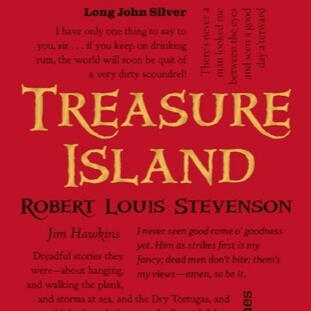
TREASURE ISLAND
Robert Louis Stevenson (1882)
(11/12/2022)
Another 1800s narrative written as though it were written in 1980. Remarkably ahead of its time, prose-wise. Illustrative characters and scuffles, an atmosphere of tavern brawls and drunken singing. It's ripe with tropes it created, and huge elements are more or less ripped off by Pirates of the Caribbean and passed as homage, in some cases, but nonetheless Pacing is inconsistent but dynamic; the characters are wonderfully voiced, clearly imagined, driven by the plot and driving the plot forwards with their prose. I liked Silver quite a bit as an antagonist, though Jim's everyman quality left him colourless in some respects. Good book!
CONSIDER THIS: MOMENTS IN MY WRITING LIFE AFTER WHICH EVERYTHING WAS DIFFERENT
Chuck Palahniuk (2020)
(10/12/2022)
pages: 4, 23, 26, 30, 34, 46, 52, 57, 60, 84, 96, 115, 120, 122, 131, 144, 160, 193, 200
"What's your gun? What's your clock?"
Page 114 - NO DREAMS - sucks big time. There are a lot of his opinions here that I fundamentally disagree with, among all the interesting and useful advice.
Harsh and unforgiving but mostly true and correct. His style might not be my own, but his philosophy usually is. Some genuinely tear-jerking moments throughout; and some horrific ones. Overall, a brilliant read. Would I consider it a must-read for writers? Maybe, actually.

PETER PAN
J. M. Barrie (1911)
(09/12/2022)
It reads as if it were wrote in the 80s in places. That is, it's aged exceptionally well for a 100 year old book. The characters and their voices are perfectly conveyed, and I love the metaphorical substrate, the amount of allusions and parallels to be derived from the text - from the cognitive solipsism of Peter to the fear of death and time indicative of Hook.Freudian concepts, Theseus tale, the Greek Pan and his flutes. Wendy isn't the best representation of women, but if you're going to be a mother housewife, if that's legitimately an aspiration, then she's a wonderful representation in that way.Native American stuff was shit, though - and let's not ignore the misogyny though I ignored it before. There's something eternally relevant to this story...
Shmee best girl.
Nonetheless, I can't help but relate to childishness infantility of Peter, his stunted expressionism, and the problems he has with motherhood, abandonment, and authority. For better or worse.
THE MERCHANT AND THE ALCHEMIST'S GATE
Ted Chiang (2007)
(04/12/2022)
W
onderful three-pronged narrative of time travel paradox through the outfit of an old oral tale, equal Arabian Nights and Sci-Fi, a beautiful merger between the ancient and futuristic. The frame-narrative was the weakest component, alongisde somewhat the ending, but I was engrossed the entire journey and the 30 pages flew by in no time. Bravo.

AUGUSTUS
John Williams (1972)
(04/12/2022)
1/3 - absolutely phenomenal. Inspiring, immersive, engaging; I'm addicted to reading it. The pace is swift but certain, not too fast, perfect. The action is somehow dynamic and orchestral in the mind. Dialogue is stellar. Interactions, subtext, character motivations, scale - near unmatched in a novel of this size with a concentration like this. Octavius is fascinating, his friends just as fascinating. Atnonius is a brilliantly written foil. The historicism is eye-opening, I've learned so much already. Somehow, this might be better than Stoner.Book One - yes, this is a new favourite. All of Book One was stellar and engaging. My only complaints are a desire for even more depth and insight, but that's the beauty of Williams's storytelling, not a flaw of it; the depth and insight is just that plentiful and addictive. Quotes on morality and justice run everywhere, and I'm constantly made to think of how much personal injustice one must suffer to be worthy of ruling with justice.2/3 - Horace's Orpheus-lidden speech, sublimely invoking the muse of poetry, was... Absolutely stellar. And Octavius' reaction, moreso. This book is incredible - I rarely say this, but I'm shocked it hasn't been adapted to film, in many respects, it suits it. Though, as a book, this is near-perfect. The feminist angle courtesy of Julia; the death and poetic reciting of Vergil; the forlorn aging of Augustus, alienated by power and responsibility; the splintering of a family.Book Two - Julia's oppression is heartbreaking; forced to repress feelings of honest emotion because of her title. Everything has become insidious.3/3/ Book Three - at last, we are given insight into Augustus's mind; a discussion directly on dramaturgy, lifting lines from Jacques as I often have; a meditation on the affection, compassion, and reflection attributed to the poet, and why he sought their company; and a deliberation on the sea, the ocean, the infinite, the collective consciousness.'It was my destiny to change the world, I said earlier. Perhaps I should have said that the world was my poem, that I understood the task of ordering its parts into a whole.'The epilogue devastated me... Words can't do it justice.

THE PLAGUE
Albert Camus (1947)
(01/12/2022)
Homage to L'Etranger earlier on which I found a nice touch. Part one was speedy, building, and climactic. Part two is disgustingly prophetic of the Covid-19 Pandemics, from page one alone. Otherwise, this might be the most accessible of Camus novels I've read yet. Even though the writing style has that standard existentialist air to it - a focus on meaning over beauty, to generalise - the prose is functional at transitioning the eye. I've not been caught up too much, and it's all exceptionally easy to understand; and I wonder if that's because of Covid. Chapter three was great, too, but two has been my favourite so far. Particularly harrowing: burial customs and emerging apathy from the death of imagination due to anomie and alienation.

WUTHERING HEIGHTS
Emily Brontë (1847)
(26/11/2022)
"Proud people breed sad sorrows for themselves."It took me fifteen pages until the prose flew through my head naturally, her manners and cadence easy to slip into with a bit of chance.
I'm fifty pages in, now, and... Yes, I see well why two people in my past have called me a Heathcliff, before. I should have listened to them, read it, opened my heart and head to the concept.
Instead, I nodded. He's like the dog from Your Typical Entertainer. I'm fully immersed.Now 80 pages in, and the voice is natural to me. Likewise, I'm finding myself curious as to where the story will go, and heartfelt during moments of romance. When Heathcliff cried out his window - or when Catherine admitted her love to Ellen, to which he overhead and walked away too quick...
Damn it...At the end, I understand why it's a classic. It's the precursor to The Great Gatsby and an evolution of Romeo and Juliet, threading considerably modern depictions of mental health and atypical romance or youthful connection. Beautiful book, though it's dense as all hell in its illustration - thick paint, complex textures. Unforgettable.

THE DEATH OF FRANCIS BACON
Max Porter (2022)
(25/11/2022)
More of a fever dream than a novel; more a poetic eulogy from the point of view of a painting, illustrating a mad deconstruction of an artist. This is a bizarre book - a succinct, single dosage of madness, and a stream of consciousness pouring over the reader with each melodic passage, each Nietzschean meditation or sexual narcoleptic fit, each smoky scene or broken dream.

I AM A STRANGE LOOP
Douglas Hofstadter (2007)
(05/11/2022)
Notes: so the first page basically gives me a reading list. I'm both ecstatic and exhausted - mostly the former. Just incredible already -He discusses how a photograph is a soulshard.
His reasons for vegetarianism - PIG, Soul, Carcass - kidney, heart, brain?
He's EXTREMELY like me.Soul size (and Hunikers) may well stick with me forever.
Thinkodynamics.
Domino effect and priming via the traffic analogy was genius.
Basically explains the conceptual baseline behind the phrase 'the road to Vegas is defined by Vegas' without showing awareness of that phrase. Could've saved a lot of time - but he may never have heard it , or a variation, himself.Infinite relay with audio visual feedback / Phantasomniphobia - kindred spirits.Epiphenomenon (marble, pg93) and mosquitos.Simms and carenium, and the automacy of a human.Quine's Quasi-Quip on PG140 is bloody genius and really funny. Stressing. oncemore. the importance of isomorphism and self-reference with/without infinite recurrence. And I feel him, I really do.Posh Shop Picketeers - brilliant, PG154. In fact, all of How Analogy Makes Meaning is perfect.KG theorem disproving Principia Mathematica was brilliant, too - all such uncommon sense.Turing and AI representation.A/B Relay Loop is a brilliant metaphor to explain how we interact as humans, and one I'm distinctly familiar with...Twinwirld and the Chaplin twins of Yorke.Beautiful page 220 made me tear up. Bach cantata aria. I now am a radiant couple.Absolutely beautiful chapter on Carol, his wife.Phones are Turing's Universal Machines.Page 248 is one of the best pages in literature I've personally encountered.Concept of a Cartesian Ego is a revolutionary and radical one I am willing to dissonantly accept.
COSMICOMICS
Italo Calvino (1965)
(27/10/2022)
Distance of the Moon -
fucking charming. Illustrative, sad, witty, Collecting moon-cheese as a job. A love square between a man, the woman he loves, the man she loves, and the moon he loves (who seems to cling particularly hard to the main character!) Seriously, just fantastic. Calvino is certainly among my favourite conceptual literary artists, now.
At Daybreak -
yet another charming and human, but innately geeky exploration of our cosmological creation. This is a kitchen sink creationist myth, a family drama told through stars and nebulae. Conceptually, it's a 100, except I got lost in excess on occasion, and the dialogue had aged!
A Sign in Space -
my favourite. Conveying its significance would be so difficult.
All At One Point -
the 'worst' yet, but still GREAT. Showing the Big Bang through a humble and social interaction, culminating in the eruption of all thing. Kinda sequel to At Daybreak but not AS good! Funny, though.
Without Colours -
the 'What Mary Didn't Know' knowledge argument compounded with Orpheus and Eurydice - a wonderful romance of monochroma into the chromatic, back to a psychological greyscale. Fucking hell, Calvino.
Games Without End -
an infinite relay and the creation of the universe told through a children's game of marbles and catch. FUCK, Calvino, you're smart. If only your prose/dialogue was as beautiful as your mind... That's too harsh, there are genuinely moments of beauty scattered across every page.
The Aquatic Uncle -
I just read a MASTERPIECE short story about when your great uncle Nig, who is a fish and refuses to evolve impresses your land-bound, HATCHED, girlfriend and man, you wanna impress her with your amphibious feet but your uncle just keeps cucking you and eventually she chooses to de-evolve and learns how to swim and goes off into the ocean with your uncle Nig, who is a fish
How Much Shall We Bet? -
a parable of gambling addiction with all permutations of known existence as the stakes.
The Dinosaurs -
a story of identity, deindividuation, and cultural assimilation, all told through a parable of 'the last dinosaur' forgetting, along with everyone else, what being a 'dinosaur' comrprises, yet feeling the struggle to maintain its relevancy and memory. Beautiful.
The Form of Space -
what begins as extremely confusing and vague quickly turns into, possible, the best fight scene I've ever seen in literature; combat between letters, hiding between the 'l's in 'parallel' and hiding in the nook of a 'g'. Absolutely... Wow. I followed it, too. Calvino...
The Light-Years -
a parable on omnipresent visibility and guilt, existential even; told beautifully - appealing to things I've always wondered, exploring concepts on the precipice of my mind. Which spins into something more... Something more primordial; an ode to solipsism, perhaps? The Truman Show with awareness and no escape.
The Spiral -
beautiful. Spoke to me, personally... Didn't expect a romance of insecurity and isolation, of art and symbolism and communication. Beautiful. And funny and silly!...and so ends one of, if not THE, best short story collections I've ever read. Absolutely inspiring, and he's definitely a writer, conceptually, that I can see eye-to-eye. So much wisdom and humour and beauty in such a short amount of time - yet, it took me ages to read because each page required savouring. Fast paced yet never pulling back on slow revelation, expanding and dilating in purpose before exploding orgastically across the page. I'm reading everything Calvino authored, for certain.
Edit Review

THE ADULT
Joe Stretch (2012)
(25/10/2022)
I'm crying by the end.
Didn't realise it would relate to me that much. From names - Jim, Harry, Kate - to mentioning Kafka and Sonic the Hedgehog only pages apart. All told with a Murakami-esque sensibility but partial to realism. Harry's queer reading is wonderful, the humour was delightful and sometimes uncomfortable. Moving around all the time. Meditations on art - "anyone can do it" - to the thought that, were we read our internet history on our deathbed, we'd keel over from sadness and grief there and then. His letter to Jordan and relationship to Kate were wonderful, and all told through an honest lens. Captures the transition not only through centuries but, technically, the threshold of a millennia. Ending with a deliberation on fame with Adorno quotes to reinforce the argument. Combat Bombastic is a clear and tear-jerking reflection of fatherly love.
This was a time capsule.TO JOE:
"It's a wonderful time capsule of hedonism coated in celebrity, advertisement, brands - all embolic of what living 1980-2010 would comprise. You set out on a mission and achieved it, no matter what, aha. So vivid - and I'm not sure where Joe ends and Jim begins. I do feel, somewhat, as though the book was made for me to read it, considering I've lived in a number of the places, dealt with a familiar number of issues, and felt parts of me throughout. You even mention Kafka in regards to cunnilingus which was great and he'd have probably liked that, for whatever I know ahahahaha"

THE MEZZANINE
Nicholsan Baker (1988)
(22/10/2022)
This is a quintessential novel in understanding pacing, as the excruciating lackadaisical nature of the plot is a double edged blade, inciting boredom just before it blows the mind with an observation of profound insight.“Shoes are the very first adult machines we are given to master.”Every page has a moment of, "huh." A moment that makes one feel less alone with their thoughts - will this elevator eat me? We all wonder if it will, but Baker asks and answers if it will. Fascinating use of in-media-res storytelling, too.It's a difficult book to read in terms of excitement, as excessive mundanity to the point of worship is the name of the game here, but what an excitingly boring game it is!

NO ONE IS TALKING ABOUT THIS
Patricia Lockwood (2021)
(28/10/2022)
First page gave an unusual impression - "philosophical position even Jesus couldn't have held" - but let's see! Judgemental centred enlightenment. Critiquing internet. Written like Twitter posts. Apophenia, correlation. Meme culture. Absurdly normal interpretation of the weirdness of the internet. Not a fan of the humour. Insights aren't doing much for me either; showerthoughts collated, so far. Clickbait title? Mood swings. Solipsism. Appeal to the collective consciousness, again. Very American, very political. Engages in the same stream of consciousness as LANNY but with less focus, which is the point, but is therein less effective for me.Watching Meeting People is Easy again because she mentioned Thom Yorke. Crying at the aformentioned Thom Yorke performance. Makes me think of Aaron Schwartz a bit.MAINSTREAM OF CONSCIOUSNESSIt discusses important contemporary matters without a clear voice or direction.
Part 1 was a drag of irrelevance brought together through meta-relevance.“Every day their attention must turn, like the shine on a school of fish, all at once, toward a new person to hate. Sometimes the subject was a war criminal, but other times it was someone who made a heinous substitution in guacamole. It was not so much the hatred she was interested in as the swift attenuation, as if their collective blood had made a decision.”I couldn't relate due to the consciousness. Interesting insight, but really awkward. It definitely has its place in this contemporary era of scrolling and flickering attention, but it was too much for me in general and I couldn't emotionally connect long enough for something to settle. She would pivot onto a new insight without letting the previous linger.
LANNY
Max Porter (2019)
(13/10/2022)
sparse, minimal prose, interspersed with ergodically twisting fragmentary passages. Subconscious association is the MO. Lanny and Pete are both weirdos, finely attuned to their imagination. The interaction with the stereoscope was absolutely wonderful; gave Lanny a suitable opportunity to see from another perspective, an autistic Theory of Mind, if you will.All forces of the forest united against the impure imposter. Neither good, nor bad, Lanny is led by the forest into the fortune and misfortune of a bee's nest - a greater symbol of emotional purity, as dictated by the forest. Lanny is his mother's muse.We've entered the Borgesian. Our Dead Papa is in the middle of a maze.Synaesthesia Heaven - "We see shapes and patterns and it's incredibly beautiful like the best art ever, with maths and science and music and feelings all at once, the whole of everything."The second part is the collective consciousness, a vast stream of interweaving opinions, thoughts, chastisements, judgements all coalescing into a streamlined narrative; familiar characters are, amazingly, still distinguishable due to the characterization used in the former part. Lanny diffuses into their omnipresent projections as they ponder to his whereabouts, vocally and imaginatively.
"It's almost as if Lanny's scent is the village's scent."
Are they all, the citizens, impure imposters?When presented with a nest - a bower - they crack open 'time' and she watches a dilated lapse of her son's life, and realises all she thought of as his life were fleeting pitstops anyway - or bowers (a nice retreat). Earlier, Lanny referred to himself as a Bowerbird and had been building a great nest of things for the village to find and make them fall in love with everything. Discovered trapped in a drain like the hedgehog but is saved as opposed to murdered.
Hedgehog Dilemma; regarding Lanny.
IE the tragedy of the hedgehog is in how they strive to cuddle for warmth during winter, but struggle due to their quills.But that's after the village has had the opportunity to speak its truths, as disheartening and problematic they may be. All of the honesty comes out - even the father masturbates to a police officer attending to the scene. Folk demons have kicked up.Toothwort is a modern British folklore mythic creature, a puck or sprite or fairy or guardian, some sentient representation of nature (explicitly spelled out in the unnecessary afterword) watching over the prospective child since the start. He can take any form he wants, but a lot of natural, fungal, and dendritic language is ascribed to him.
Toothwort etymology: parasitic wildflower that grows on trees and feasts on planets; a self-contained ecosystem blended with a self-serving organism.
Metafictionally profound creature that speaks through trees...
Sorta like words, a story, an author?
SEROTONIN
Michel Houllebecq (2019)
(13/10/2022)
Notes: hedonism out the gate, and perhaps a homage to Sartre in some form. Libido at maximum, and constantly requiring stimulation in the form of chemical rushes; particularly sexual. Leaps from activity to activity with little precognition or algorithm; no heuristic. Excess. Though, not enjoying the prose that much. Impulsively nearly crashes the two of them when he realizes he can. Xenophobic and stereotyping, projecting incessantly. Elitist, middle-upper class, contemplating swapping out partners to keep his interest afloat. Sleeps on a balcony so he can continue sleeping throughout the night; addicted to the nicotine (page 1 nicotine quote)."I mightn't have done much good in my life, but at least I contributed to the destruction of the planet."
The unbearable lightness of being, Nietzsche's 'eternal return,' and solipsistic nihilism. Anti-intellectually engages with pornography and condescends Yuzu.
Psychopathic levels of low cunning and priority. Bestiality: greaaaat.Just got to the bit where he compared himself to Raskolnikov from Dostoyevsky's Crime and Punishment which is one of my favourite books. I'm unsure if Michel is illustrating the protagonist's ego with such a comparison, or if Michel is just trying to appear smart by throwing in a reference. I'm gonna put a pin in it and see if, by the end, there was any substantive reason for the reference.Disgusting alpha-male rhetoric. No life or genuine interests at all; vacuous and vapid.Yuzu, the zesty citrus fruit woman, is compared to the Jorogumo of Yokai myth.Sans the cancer aspect, the death of Claude's parents mirrors the double suicide projection of Osamu Dazai in Ningen Shikkaku. This book shares other similarities, too, now I think about it."It was easy to tell by their positions on the bed that they had wanted to hold hands until the end, but they had suffered from convulsion in their death throes, and their hands had parted."Anhedonia and ennui.
Is given an SSRI to inhabit the reuptake procedure of NT-transference RE: serotonin and other monoamine NTs.So much misinformation in this book. I seriously hope no one seeks to actively learn the trivia expelled throughout, as it's all armchair.
He's right, though. Porn does push technology forward.I loved the telemancy. The idea of divining your future based on a random scene from a show; it shows he is egodystonic. Non-agentic. External locus of control - unwilling to create self, instead yearns to discover self.His character contradictingly knows a lot about literature, art, and film - for someone with barely any interest in any of them, reportedly, and never evidently engaging with them beyond the superfluous or superficial. Just inconsistent in general - and I can't tell if that's intentional.Ayn Rand-esque on occasion.Notes From the Underground flashbacks to when he retreats from Claire's story about her life callously and represses any compassion.Engages with plant formations in order to shut up green activists about consequences of climate change. Cool. Cool guy. Motives are great...Typo RE: Thomas Disch suicide rubbed me wrong way.Tasteless shock value to drive home few points. Can relate to few components and vehemently dislike most, in a way I can't compliment him for. Wallowing misery masturbation; nihilism without objective, projected onto those around him. Woe is me, now I'll woe you. Red pilled edgelord.How deep and sexy to be addicted to porn enough to think this is what sex is, too. Dreadful women characters. Dreadful structure. If this is the reaction he wanted, congratulations. Tiring, though.
Epicureanism paired (canonically) with alternative forms of stoic, solipsistic, and nihilist philosophy - man on fire.It got me thinking out of vulgarity aversion. This wouldn't teach you anything.Last chapter are best and borders self-awareness without fully grasping it. Challenges Conan Doyle's 'message that each page had to vibrate with the protestations of a sincere and good heart."Interestingly ends with the main character perusing his life across his walls via photographs, romanticizing his suicide before flinging himself out the window.
A GIRL IS A HALF-FORMED THING
Eimear McBride (2015)
(12/10/2022)
fragmentary prose to convey dissociation and deindividuation, depersonalisation in the wake of trauma in patriarchy. Her relative perspective of self is defined by the male figures in her life due to this. As such, the stream of consciousness is marred by fractured meanders, disrupting the flow like a diffusing bead of water rolling down a mountain side. Agentically challenged by authorities in her life at every turn, she strives for identity independence through caustic actions and reactions. Joyce, Beckett, almost ergodic, Namelessness denotes a cosmopolitan universality - it is a gendered experience, whatever that means, and so I can assume it's to further denote identitylessness. Rewards careful, compassionate, and tentative reading. Explores what a 'girl' is in the eyes of a patriarchal, religious society. Particularly a Northern Irish one. Beckettian in its presentation, and asks a lot from the reader in many ways. Unbearable to read, which is why one must try read it. That said, may not be rewarding and the plot is sparse though heavy on trauma. This is a fever dream of neurotic upset - but that final passage is stellar.
That just was life. And now. What? My name is gone.
MY PHANTOMS
Gwendoline Riley (2021)
(05/10/2022)
I've edited this review (neatening up some prose, minor things). Even then, it's too wordy for a book so complexly simple, simply complex. I struggle talking about this book because I'm in the middle of its subtext, and figuring out my life will help me understand this book.
I met Gwendoline in class a few days ago. She was wonderful, inspiring, interesting, informative.
This was four months after I read her book (twice). I'd read it a third but want to move onto one of her other projects (if not other authors). These books are just the start of a fascinating career. Comparing her to another author is difficult, and the comparison would be flippant.---My Phantoms is, among other things, a testimonial account of narcissism.
The father repeatedly belittles others out of inferiority and insecurity, but also may sincerely believe that he is making connections with the people he loves. However, he is stereotyping their multidimensional facets into a caricature of their genuine selves to help him inappropriately fit into the world around him - which is, to him, comprised of a cast of flawed characters gravitating the sun he thinks he is. In fact, those characters, or people, are ships invited into a maelstrom.This clearly affected the emotional sustainability and growth of her mother, who wanted to be seen just as much as her father did - dancing for them to Kate Bush in the kitchen - but platforms herself with less ego and more grace, aware of the insecurity his showmanship can foster. There's an element of Holden Caulfield to him, yelling "posing!" and "poser" at things he hardly understands, clearly baring the self defence mechanism of decades. Will he allow a moment of honest intimacy? Will we ever be told he feeds ducks, or forever his ego?He collects and synthesises experiences not into art or empathetic moments of familiarity to understand loved ones, but into ammunition so he can project further insecurity. By forcing others to perceive him upon a pedestal, he enforces a vertical relativity one might misconstrue for inferiority. He is the boss. He always has a passive-aggressive angle frequently bordering on pure-aggressive. Russia is huge - angrily. He wants to reach a larger point, to roleplay the thespian with the silk scarf, but the concepts are beyond his reach. Rather than be impressed by what he doesn't know, he continued his anti-intellectualism.He speaks on their behalf, advancing their story and robbing them of the agency because, 'I only have them very rarely.' So ardent is he to enforce a memory, some disposition on him as a person, that I'm curious as to the nature of His Phantoms. Did his father die young? Has he few positive memories? Would faux-positive, or even negative, be better than nothing, to him?
He steamrolls the actress with a patriarchal sense of entitlement that epitomises the memory for Bridget. And how narratively rich it is, that this takes place in the realm of the dramaturgical; of actors and pretenders. He would fit right in, except he doesn't, and he knows it(?)I find myself, interestingly, projecting onto the mother. Her deindividuating isolation, a result of, perhaps, prolonged artificial social exposure. It makes me think -
"Too cowardly to die, too cowardly to live."
- which is what someone once told me.
There's a veil between her and the world, a fear of engagement born out of the aforementioned exposure. Geoff is one exceptional veil-piercer capable of compromising himself out of respect and love for her as a friend. The 'Nice!' interaction got a tear from me.I adore the moment where she asks how her mother was, and what might have worked better. The retrospective is entirely different to the one concerning Lee, her father. "I should have said this instead." In retrospect, there is sometimes a beauty in compromise. But her mother makes earnest attempts at self-betterment and social engagement despite her predisposition. She visited Plath's grave, and was affected enough to remark upon it and retain the memory, but doesn't engage intellectually with her daughter about it. However, she doesn't flaunt this, or overtly deflect, or attack her daughter. She knows what she knows.She gets frustrated by Geff's moments of dramaturgy, such as his 'handspan waist' and 'proper morning coffee.' Her depiction of normality is epitomised on the walls of Caffe Nero, where women engage in banter while drinking.
It makes me think of the hedgehog dilemma. She desires individuality and deindividuating social conformity; both independence and interdependence, and struggles with the paradox and how that might reflect on her, someone now acutely attuned to the socially dramaturgical engagements we can surmise from her past relationship with Lee. Therein, she marries another abrasive anomic; and that marriage fails accordingly.
Intergenerational trauma and perpetuity.
Both parents are socially anomic, and how they deal with this results in the misdirecting lessons on socialization for Bridget.She can't engage with volunteering because you can see why they're volunteering, sort of eccentrics who don't have friends. I'm not going to say she has a lack of self awareness, more she hates her current state of temporal isolation and cannot engage with likeminded individuals because of the previous paradox. She doesn't like them. They are her. She hates herself. Her discompassionate self-hate manifests through a cycle of continuous dissonance.Her mother communicates via schadenfreude. Social engagements involving her are amiable but nonetheless placating, just in a different way to Lee. The scene concerning Ferrante fever and their amateur book club proved Gwendoline's compassionate understanding of the nuanced pitfalls of intergenerational communication.
Bridget's calm intellectual disposition makes her parents want to impress her, out of a multitude of existential, insecure, and personal reasons.Walking on eggshells. Dissociation and the phantasmagorical.
"It did strike me, though, that at least those spectral associates my father raised didn't persecute him. They were a supporting cast: a wise counsel or a happy coterie, rushing in to fill coveted positions in his court."Her mother's nickname being Hen makes me think of the numerous paradoxes I've mentioned, and appeals to the idea of intergenerational trauma as a connecting loop - a'la, Bridge(t) is the egg.
Thank you, Gwendoline. No review nor notes could do this book justice. I'll re-read someday.
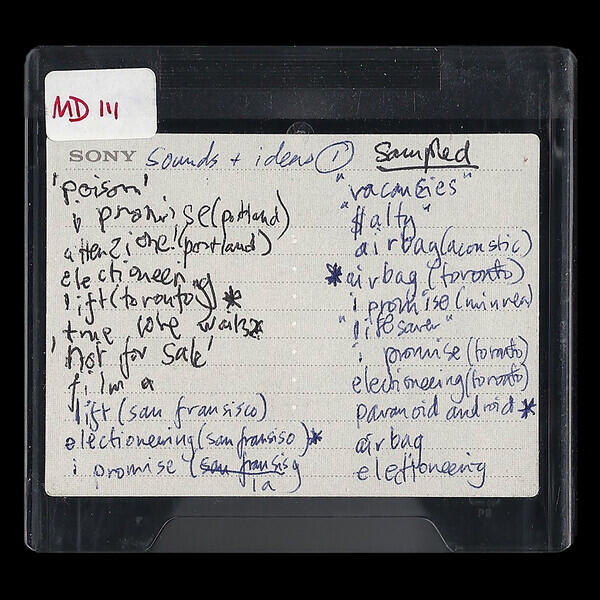
MINIDISCS (HACKED)
Radiohead (2019)
(21/09/2022)
Organ
Largely repetitive in places, but occasional glimpses of artistry shine through. My personal favourites are MD113 and MD119. We've got plenty of material left from them, and this proves their perfectionist attitude. There exist hundreds of permutations of OK Computer.
It took a lot of work.
These minidiscs made me re-evaluate and appreciate The King of Limbs, ironically, in the process.
More than anything, people complain it felt unfinished and rushed... and lacking the perfectionist anxiety permeating their best albums. I often think of Thom dancing, almost liberated, in the music video for Lotus Flower.
I'm okay with getting a TKOL for every AMSP.
They're human. They're trying.Thank you for sending us that MD113 Nude, Thom.I've reworked some of my favourite little moments and tracks into a fan album! Feel free to take a look: https://youtu.be/XeN2xsppf9o
CAT'S CRADLE
Kurt Vonnegut Jr. (1963)
(17/08/2022)
Vonnegut's humour and style has always endeared me to him; he tackles the harshest topics with humour which only occasionally deflates the severity of the circumstance. His characters are vivid and immediately illustrative for the mind even if one doesn't get too attached. What impressed me most about this book aside from the structure would be the occasional vignette thrown out with clarity, sublime moments of impact that stick floating in a sea of occasional comedic irrelevance. Brilliant and entertaining.

GUARDS! GUARDS!
Terry Pratchett (1989)
(06/06/2022)
Even better than Reaper Man, his best book I've read yet. I was laughing out loud more so than I have at any book; the characters are absolutely delightful, the monologues ranging smart to absurdly dumb; the scenario is exciting and innovative, wrapped in subtext and dipped in twists. I simply cannot believe how great this was: and there was barely any DEATH! Though when he appeared it was equally hilarious. Vimes is by far my favourite protagonist I've read of his (which is shocking). Of course, the usual issues were there (pacing, conflation of details, over dedication to a specific joke) but I really don't care that much. Not remotely a waste of time, simply joyous.
NAUSEA
Jean-Paul Sartre (1938)
(18/05/2022)
I like the remarks on the The Autodidact who learns by reading authors alphabetically; an audacious task with an unusual method that, ultimately, isn't that different from the holistic reading any other would do, but is perceived through Antoine's eyes as an impressive feat. Impressive or insane? I'm unsure. As someone with OCD, this book has struck me to the core. Still reading... Improved substantially with the dematerialising, dissociative aspects of pages 100-150. The narrative found its voice and purpose (in tandem with the text; it worked).
Finished it now, and what a conclusion. I adored everything past page 100, but everything before was needed. Wonderful work reminiscent of L'Etranger, Dostoevsky's Underground Man, Hesse's Harry, and Dazai's main character. Philosophically innovating if not... If not inconclusive, but that's not his fault.

THE INVISIBLE MAN
H. G. Wells (1897)
(21/04/2022)
Innovative in a way that doesn't need introduction. What's remarkable is the depth, the details described by citizenry, the characterisation of the locale around him. It's all so vivid, so brought to life, that I can read it better than much contemporary writing. This has been the case for all his works. However, I wasn't completely taken by the antics or philosophy attached to this - it's a fantastic speculative starting point, though one wonders what it would have been like had he wrote it later in life.

THE WAR OF THE WORLDS
H. G. Wells (1898)
(20/04/2022)
I agree with Borges in disagreeing with Oscar Wilde. It's easy to assume Wells is the father of sci-fi, but he was a speculative writer, a prophetic-type looking into the future. It's our fault Wells is a sci-fi because we became a more scientific society. His works concern the future, our doom, his grandchildren's problems. We went to the moon and focused on quantum physics and furthered technology and made the web - not he. When he saw a metallic contraption from mars, it was the endpoint of natural analysis, not the founding's of sci-fi. I certainly prefer Wells to Asimov; Asimov was perhaps too aware he was a sci-fi writer.

WE
Yevgeny Zamyatin (1924)
(21/03/2022)
There are so many elements of this I enjoy. The occasional bit of prose; the setting; the main character; the keyword aspect. So many, and yet I'm left cold. This was certainly the precursor to 1984 and Brave New World, a must read of dystopic literature with many of the threads we'd later unravel, and I'm grateful for its existence but could not bond with its pages.